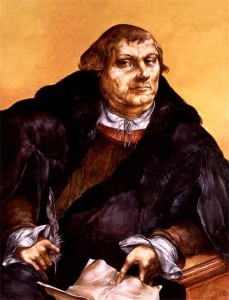
 James Swan at his simply making it say what he wanted it to.
How to respond:
1. First, which has startled and shocked many simple Christians, even among the educated who do not know the Hebrew and Greek languages. It is devoutly to be hoped that with this publication the slander of the godless will be stopped and the scruples of the devout removed, at least in part. Perhaps it may even give rise to more writing on such questions and matters such as these. Therefore I ask all lovers of the truth to take this work to heart seriously, and faithfully to pray to God for a right understanding of the divine Scriptures, to the improvement and increase of our common Christendom.”
The first section of the treatise is actually fairly angry, sarcastic, and humorous. Luther shows himself fed up with his Papal critics. His anger was fueled against them for an ironic reason- they rallied against his translation, while at the same time utilizing it for their own new translations. A strong Papal critic of Luther (Emser) did just that:
“We have seen that scribbler from Dresden play the master to my New Testament. I will not mention his name again in my books, as he has his Judge now, and is already well-known. He admits that my German is sweet and good. He saw that he could not improve upon it. Yet, eager to dishonor it, he took my New Testament nearly word for word as it was written, and removed my prefaces and notes, replaced them with his own, and thus published my New Testament under his name!”
2. Put this context into the quotes being misued.
With this context in mind, point out that Luther was blasting away at his Papal critics:
“If your papist wishes to make a great fuss about the word sola (alone), say this to him: “Dr. Martin Luther will have it so, and he says that a papist and a donkey are the same thing.” …For we are not going to be students and disciples of the papists. Rather, we will become their teachers and judges. For once, we also are going to be proud and brag, with these blockheads; and just as Paul brags against his mad raving saints, I will brag against these donkeys of mine! Are they doctors? So am I. Are they scholars? So am I. Are they preachers? So am I. Are they theologians? So am I. Are they debaters? So am I. Are they philosophers? So am I. Are they logicians? So am I. Do they lecture? So do I. Do they write books? So do I.”
“I will go even further with my boasting: I can expound the psalms and the prophets, and they cannot. I can translate, and they cannot. I can read the Holy Scriptures, and they cannot. I can pray, they cannot. Coming down to their level, “I can use their rhetoric and philosophy better than all of them put together. Plus I know that not one of them understands his Aristotle. If any one of them can correctly understand one preface or chapter of Aristotle, I will eat my hat! No, I am not overdoing it, for I have been schooled in and have practiced their science from my youth. I recognize how deep and broad it is. They, too, are well aware that I can do everything they can do. Yet they treat me as a stranger in their discipline, these incurable fellows, as if I had just arrived this morning and had never seen or heard what they teach and know. How they do brilliantly parade around with their science, teaching me what I outgrew twenty years ago! To all their noise and shouting I sing, with the harlot, “I have known for seven years that horseshoe nails are iron.”
“Let this be the answer to your first question. Please do not give these donkeys any other answer to their useless braying about that word sola than simply this: “Luther will have it so, and he says that he is a doctor above all the doctors of the pope.” Let it rest there. I will from now on hold them in contempt, and have already held them in contempt, as long as they are the kind of people (or rather donkeys) that they are.”
One can almost feel Luther’s anger towards his Papal critics. They discredited him as a doctor of theology, a degree he earned in a rather quick period of time, and his academic abilities were above most. Indeed, he had done the work necessary to be taken seriously. His critics criticized his German translation while at the same time stealing it for their own translation- this infuriated him, and rightly so.
3. Luther’s actual reasoning for using “alone” in Romans 3:28
This is the sad part about those who use Luther’s Open Letter On Translating against him. He actually goes on to give a detailed explanation of why he uses the word “alone” in Romans 3:28. In the same document, in a calmer tone, Luther gives his reasoning for those with ears to hear:
“I know very well that in Romans 3 the word solum is not in the Greek or Latin text — the papists did not have to teach me that. It is fact that the letters s-o-l-a are not there. And these blockheads stare at them like cows at a new gate, while at the same time they do not recognize that it conveys the sense of the text — if the translation is to be clear and vigorous [klar und gewaltiglich], it belongs there. I wanted to speak German, not Latin or Greek, since it was German I had set about to speak in the translation.”
Luther continues to give multiple examples of the implied sense of meaning in translating words into German. He then offers an interpretive context of Romans:
“So much for translating and the nature of language. However, I was not depending upon or following the nature of the languages alone when I inserted the word solum in Romans 3. The text itself, and Saint Paul’s meaning, urgently require and demand it. For in that passage he is dealing with the main point of Christian doctrine, namely, that we are justified by faith in Christ without any works of the Law. Paul excludes all works so completely as to say that the works of the Law, though it is God’s law and word, do not aid us in justification. Using Abraham as an example, he argues that Abraham was so justified without works that even the highest work, which had been commanded by God, over and above all others, namely circumcision, did not aid him in justification. Rather, Abraham was justified without circumcision and without any works, but by faith, as he says in Chapter 4: “If Abraham were justified by works, he may boast, but not before God.” So, when all works are so completely rejected — which must mean faith alone justifies — whoever would speak plainly and clearly about this rejection of works will have to say “Faith alone justifies and not works.” The matter itself and the nature of language requires it.”
4. Previous translations of the word “alone” in Romans 3:28
Luther offers another line of reasoning in his “Open Letter on Translating” that many of the current Cyber-Catholics ignore, and most Protestants are not aware of:
“Furthermore, I am not the only one, nor the first, to say that faith alone makes one righteous. There was Ambrose, Augustine and many others who said it before me.”
Now here comes the fun part in this discussion.
The Roman Catholic writer Joseph A. Fitzmyer points out that Luther was not the only one to translate Romans 3:28 with the word “alone.”
At 3:28 Luther introduced the adv. “only” into his translation of Romans (1522), “alleyn durch den Glauben” (WAusg 7.38); cf. Aus der Bibel 1546, “alleine durch den Glauben” (WAusg, DB 7.39); also 7.3-27 (Pref. to the Epistle). See further his Sendbrief vom Dolmetschen, of 8 Sept. 1530 (WAusg 30.2 [1909], 627-49; “On Translating: An Open Letter” [LuthW 35.175-202]). Although “alleyn/alleine” finds no corresponding adverb in the Greek text, two of the points that Luther made in his defense of the added adverb were that it was demanded by the context and that sola was used in the theological tradition before him.
Robert Bellarmine listed eight earlier authors who used sola (Disputatio de controversiis: De justificatione 1.25 [Naples: G. Giuliano, 1856], 4.501-3):
Origen, Commentarius in Ep. ad Romanos, cap. 3 (PG 14.952).
Hilary, Commentarius in Matthaeum 8:6 (PL 9.961).
Basil, Hom. de humilitate 20.3 (PG 31.529C).
Ambrosiaster, In Ep. ad Romanos 3.24 (CSEL 81.1.119): “sola fide justificati sunt dono Dei,” through faith alone they have been justified by a gift of God; 4.5 (CSEL 81.1.130).
John Chrysostom, Hom. in Ep. ad Titum 3.3 (PG 62.679 [not in Greek text]).
Cyril of Alexandria, In Joannis Evangelium 10.15.7 (PG 74.368 [but alludes to Jas 2:19]).
Bernard, In Canticum serm. 22.8 (PL 183.881): “solam justificatur per fidem,” is justified by faith alone.
Theophylact, Expositio in ep. ad Galatas 3.12-13 (PG 124.988).
To these eight Lyonnet added two others (Quaestiones, 114-18):
Theodoret, Affectionum curatio 7 (PG 93.100; ed. J. Raeder [Teubner], 189.20-24).
Thomas Aquinas, Expositio in Ep. I ad Timotheum cap. 1, lect. 3 (Parma ed., 13.588): “Non est ergo in eis [moralibus et caeremonialibus legis] spes iustificationis, sed in sola fide, Rom. 3:28: Arbitramur justificari hominem per fidem, sine operibus legis” (Therefore the hope of justification is not found in them [the moral and ceremonial requirements of the law], but in faith alone, Rom 3:28: We consider a human being to be justified by faith, without the works of the law). Cf. In ep. ad Romanos 4.1 (Parma ed., 13.42a): “reputabitur fides eius, scilicet sola sine operibus exterioribus, ad iustitiam”; In ep. ad Galatas 2.4 (Parma ed., 13.397b): “solum ex fide Christi” [Opera 20.437, b41]).
See further:
Theodore of Mopsuestia, In ep. ad Galatas (ed. H. B. Swete), 1.31.15.
Marius Victorinus (ep. Pauli ad Galatas (ed. A. Locher), ad 2.15-16: “Ipsa enim fides sola iustificationem dat-et sanctificationem” (For faith itself alone gives justification and sanctification); In ep. Pauli Ephesios (ed. A. Locher), ad 2.15: “Sed sola fides in Christum nobis salus est” (But only faith in Christ is salvation for us).
Augustine, De fide et operibus, 22.40 (CSEL 41.84-85): “licet recte dici possit ad solam fidem pertinere dei mandata, si non mortua, sed viva illa intellegatur fides, quae per dilectionem operatur” (Although it can be said that God’s commandments pertain to faith alone, if it is not dead [faith], but rather understood as that live faith, which works through love”). Migne Latin Text: Venire quippe debet etiam illud in mentem, quod scriptum est, In hoc cognoscimus eum, si mandata ejus servemus. Qui dicit, Quia cognovi eum, et mandata ejus non servat, mendax est, et in hoc veritas non est (I Joan. II, 3, 4). Et ne quisquam existimet mandata ejus ad solam fidem pertinere: quanquam dicere hoc nullus est ausus, praesertim quia mandata dixit, quae ne multitudine cogitationem spargerent [Note: [Col. 0223] Sic Mss. Editi vero, cogitationes parerent.], In illis duobus tota Lex pendet et Prophetae (Matth. XXII, 40): licet recte dici possit ad solam fidem pertinere Dei mandata, si non mortua, sed viva illa intelligatur fides, quae per dilectionem operatur; tamen postea Joannes ipse aperuit quid diceret, cum ait: Hoc est mandatum ejus, ut credamus nomini Filii ejus Jesu Christi, et diligamns invicem (I Joan. III, 23) See De fide et operibus, Cap. XXII, §40, PL 40:223.
Source: Joseph A. Fitzmyer Romans, A New Translation with introduction and Commentary, The Anchor Bible Series (New York: Doubleday, 1993) 360-361.
Even some Catholic versions of the New Testament also translated Romans 3:28 as did Luther. The Nuremberg Bible (1483), “allein durch den glauben” and the Italian Bibles of Geneva (1476) and of Venice (1538) say “per sola fede.”
Further Information
I’ve also had a written debate with a Roman Catholic on Luther’s use of the word “alone.” That can be found here.

 Justin Taylor writes concerning the insights of David Powlison: