Grace in Every Book of the Bible

Dane Ortlund:

There is always a danger of squeezing the Bible into a mold we bring to it rather than letting the Bible mold us. And, there could hardly be more diversity within the Protestant canon–diverse genres, historical settings, authors, literary levels, ages of history.

But while the Bible is not uniform, it is unified. The many books of the one Bible are not like the many pennies in the one jar. The pennies in the jar look the same, yet are disconnected; the books of the Bible (like the organs of a body) look different, yet are interconnected. As the past two generations’ recovery of biblical theology has shown time and again, certain motifs course through the Scripture from start to end, tying the whole thing together into a coherent tapestry–kingdom, temple, people of God, creation/new creation, and so on.

Yet underneath and undergirding all of these, it seems to me, is the motif of God’s grace, his favor and love to the undeserving. Don’t we see the grace of God in every book of the Bible? (NT books include the single verse that best crystallizes the point.)

Genesis shows God’s grace to a universally wicked world as he enters into relationship with a sinful family line (Abraham) and promises to bless the world through him.

Exodus shows God’s grace to his enslaved people in bringing them out of Egyptian bondage.

Leviticus shows God’s grace in providing his people with a sacrificial system to atone for their sins.

Numbers shows God’s grace in patiently sustaining his grumbling people in the wilderness and bringing them to the border of the promised land not because of them but in spite of them.

Deuteronomy shows God’s grace in giving the people the new land ‘not because of your righteousness’ (ch. 9).

Joshua shows God’s grace in giving Israel victory after victory in their conquest of the land with neither superior numbers nor superior obedience on Israel’s part.
Continue reading

The Battle for Justification

Some Quotes from Martin Luther:

“Justification by faith alone is the article of the standing or falling Church.”

“This doctrine [justification by faith alone] is the head and the cornerstone. It alone begets, builds, preserves, and defends the church of God; and without it the church of God cannot exist for one hour. For no one who does not hold this article or, to use Paul’s expression, this ‘sound doctrine’ (Titus 2:1) is able to teach aright in the church or successfully to resist any adversary… this is the heel of the Seed that opposes the old serpent and crushes its head. That is why Satan, in turn, cannot but persecute it.”

“Whoever departs from the article of justification does not know God and is an idolater . . . For when this article has been taken away, nothing remains but error, hypocrisy, godlessness, and idolatry, although it may seem to be the height of truth, worship of God, holiness, etc… If the article of justification is lost, all Christian doctrine is lost at the same time.”

“When the article of justification has fallen, everything has fallen. Therefore it is necessary constantly to inculcate and impress it, as Moses says of his Law (Deut. 6:7); for it cannot be inculcated and urged enough or too much. Indeed, even though we learn it well and hold to it, yet there is no one who apprehends it perfectly or believes it with a full affection and heart. So very trickish is our flesh, fighting as it does against the obedience of the spirit.”

The youtube videos below are taken from a seminar given on Saturday & Sunday, February 7, 8, 2009, at the Sola Conference at Countryside Bible Church in the Dallas area.

The first video is an overview of the historic and present day attacks against the doctrine of Sola Fide (justification by faith alone).

Lasting approx. 72 minutes, this presentation made by a man I am proud to call my friend, Dr. James White, is excellent for both its clarity and insight concerning the Gospel of Jesus Christ. It is highly recommended.

The second video (below) lasts approx. 55 minutes and is entitled Living Out Sola Fide.

Travailing for souls

“As soon as Zion was in labor she brought forth her children.” Isaiah 66:8

“If any minister can be satisfied without conversions, he shall have no conversions. God will not force usefulness on any man. It is only when our heart breaks to see men saved, that we shall be likely to see sinners’ hearts broken. The secret of success lies in all-consuming zeal, all-subduing travail for souls. Read the sermons of Wesley and of Whitfield, and what is there in them? It is no severe criticism to say that they are scarcely worthy to have survived. And yet those sermons wrought marvels…

In order to understand such preaching, you need to see and hear the man, you want his tearful eye, his glowing countenance, his pleading tone, his bursting heart. I have heard of a great preacher who objected to having his sermons printed, ‘Because,’ said he, ‘you cannot print me.’ That observation is very much to the point. A soul-winner throws himself into what he says. As I have sometimes said, we must ram ourselves into our cannons, we must fire ourselves at our hearers, and when we do this, then, by God’s grace, their hearts are often carried by storm.”

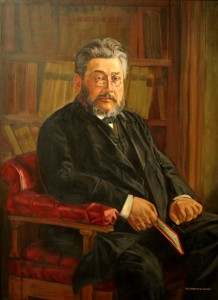
C. H. Spurgeon, “Travailing for Souls,” 3 September 1871. Italics original.