
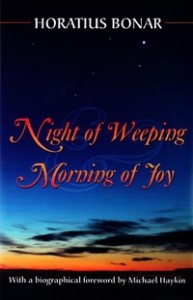
 (1) Actually, this first book is two books in one. Horatius Bonar, a well-known nineteenth-century minister called ‘the prince of Scottish hymn-writers,’ was also a prolific writer of scriptural, practical, and experiential Christian literature. Two of his books that bore considerable fruit and have often been reprinted were The Night of Weeping and The Morning of Joy, here reprinted under one cover.
“The Night of Weeping expounds compassionately and beautifully a biblical view of suffering, showing how it is an integral part of belonging to God’s family, how to cope with it, and how it benefits the believer. The chapters on the purifying and solemnizing fruits of suffering are themselves worth the price of the book. The Morning of Joy shows how God leads believers to rejoice in the present and future joys of the living church, particularly through fellowshipping with the resurrected Christ. The chapters on the majestic kingdom of Christ and the superlative joys of glory are most uplifting. By the Spirit’s grace, both books can be life-changing; they present us with a clear, powerful, profound, and balanced view of the Christian life and of God’s dealings with His people.” — Joel R. Beeke, Puritan Reformed Theological Seminary
(2) In Sammy and His Shepherd, veteran children’s writer Susan Hunt takes youngsters on a delightful trip through Psalm 23 from the point of view of a sheep named Sammy.
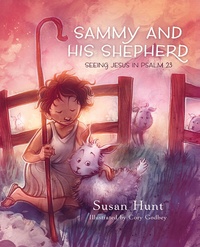 Sammy lives happily under the care of his faithful shepherd. But one day he meets a sheep from another flock, one who lives in misery because her shepherd is not so caring. Eventually, to the delight of both of them, Sammy’s shepherd buys the needy little sheep for his flock and gives her a name—Precious. Thereafter, Sammy tells Precious all the wonderful things about their shepherd. At first, Precious has a hard time believing that the shepherd can be so good. But eventually, as she sees the shepherd pouring out his energies for the good of his flock, she comes to trust him, for she sees that he loves his sheep unconditionally and sacrificially.
Each chapter of Sammy and His Shepherd is an exploration of a passage from Psalm 23. As they work through the book, children will grow in their understanding of the metaphors the psalmist used in composing this beloved poem. But more important, they will gain a deeper appreciation for the one who is the subject of the psalm: the Good Shepherd, Jesus Christ. Captivating illustrations by Corey Godbey help Sammy and Precious come to life for children. A special section in the back of the book provides Bible passages, discussion questions, and activities to reinforce the lessons of each chapter.
Both of these books are on special offer TODAY (Friday, March 2) for $5. The online sale starts at 8 a.m. EST and goes on for 24 hours or until items are sold out. Check out the $5 Ligonier sale here.
 Question: How can you reject free will? Does not Moses say to the Israelites “Therefore choose life, that you and your offspring may live?” (Deut 30:19)
 This means that spiritual circumcision was not given to all physical descendants of Abraham but to the children of promise in their midst. The rest were commanded but refused to obey. Some get mercy but the rest get justice.