
 by R.C. Sproul Jr.
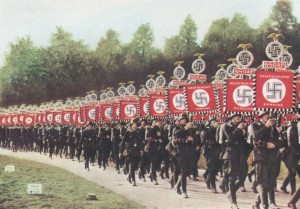
Do you think it possible that there were during World War II Nazi’s that were Christians? Do you think there were Nazi’s that were committed to the rule of law, even that hoped that the Allies would defeat Germany? Isn’t it likely that there were men in uniform, in the party, that found themselves there because of sundry social pressures, and not a small amount of confusion and ignorance about what Nazi’s believed? I would argue that such a truth is self-evident. Given the size of the party, given the confusion of the times, given the propaganda skill of the Nazi leadership there surely must have been at least one genuinely born again Christian that was a Nazi. And I think, had I been an Allied soldier during that time it would have been my duty to kill him. Why? Because he’s a Nazi, a servant and soldier of a regime that declared war against these United States.
If such a view shocks you, you might want to thank Rousseau. Rousseau was the great engine of romanticism, that worldview that drives us today to believe that forms, oaths, uniforms, formal loyalties mean nothing at all, that all that matters is the invisible recesses of our hearts. What a man feels is sacrosanct. What he says means nothing, except insofar as he is speaking about his feelings. Thus the Nazi can tell us, “I know I am dressed in a Nazi uniform. I know I have fought for the Nazi cause. I know I have sworn fealty to the Fuehrer. But I didn’t really know what I was doing. I didn’t really know what I was thinking. Besides, that was then, and this is now. “
Before I shoot the man, I would want to ask him one more question- “Do you disavow your loyalty to the Reich? Will you now take off that uniform? Will you come and join the Allies?” If so, what a cause for celebration. A brother has been rescued from an evil system. Kill the fatted calf, bring a robe and a ring. But what do I do if he replies, “Well, no. I was raised in the Nazi’s. And I happen to know there are a lot of people like me, people like you, who believe what we believe, in the Nazi’s. Why can’t we, Nazis and Allies, work together for the greater good?” What if he meant every word he was saying? He is speaking out of both sides of his mouth, and my duty is to believe the solemn oath, the uniform, the salute, not his self-report on his subjective feelings. One truth, the uniform, will get him shot. The other truth, his faith, will take him straight to heaven.
 Of course this is all moot, because that war is over. But there are other uniforms, other loyalties, other solemn oaths. Rome solemnly and irrevocably asked, in the sixth session of the Council of Trent, during the counter-Reformation, that God would damn all those who say a man is justified by faith, apart from the works of the law. They have not changed that dogma, whether anyone inside the institution actually believes it or not. And when we enter the Roman fold we swear an oath to uphold and believe all Roman dogma. When we come to the mass we solemnly salute their system. When we receive her baptism we put on her uniform.
I am not, of course, equating Roman Catholicism with Nazism. The Nazi’s, after all, sent six million Jews to their deaths. Rome, on the other hand, has no concentration camps, no gas chambers. All she has is a false, damning gospel that sends billions to a lake of fire. That, not our feelings, not even our friendships, is what matters.
 (1) Most Christians would be ill equipped to respond Matthew Vines’ “The Gay Debate: The Bible and Homosexuality” YouTube presentation. However, Dr. James White’s does do so
  (3) I continue to be very much encouraged by the reaction to my new book “Twelve What Abouts” now out in paperback. At 168 pages, it seeks to provide answers to the most frequently raised objections to the doctrine of God’s Sovereignty in salvation.
 “We must have the heathen converted; God has myriads of His elect among them, we must go and search for them somehow or other.” – C. H. Spurgeon