
 By Dr. James White
From the archives at www.aomin.org:
Roman Catholic apologists are going about the land presenting seminars and talks in parish halls and church buildings, all designed to 1) confirm the faithful in their allegiance to Rome and the Papacy, and 2) invite the “separated brethren home to Mother Church.” While the number of RC apologists has grown exponentially over the past decade, the one gentleman who has been out-front, or maybe better, in light of the article we will be reviewing, “up-front,” the longest, is Karl Keating, president of Catholic Answers.
In an article in the December, 1996 edition of This Rock magazine, Keating introduces his readers to Liber Pontificalis, The Book of Pontiffs. Keating doesn’t give his readers much background on the book. I quote from J.N.D. Kelly, who describes the work:
A collection of papal biographies from St Peter to Pius II (d. 1464), compiled in its first redaction in the middle of the 6th cent. and extended by later hands. While much of the material embodied, especially in the earlier section, is apocryphal, the work is in the main based on valuable sources, and while it is often biased it is indispensable for the history of the papacy (J.N.D. Kelly, The Oxford Dictionary of Popes, (1986), xi).
One is struck by the fact that Keating, despite an early acknowledgement of some factual problems with the work, accepts every word of Liber Pontificalis that he quotes as if it were solid history, and he is dealing with the very first stories of the first Popes-material Kelly specifically identifies as mainly “apocryphal.” Keating notes,
Not all of the lives are reliable, it should be noted. The Liber Pontificalis needs to be supplemented with information from other ancient texts. In the best-known error, the compiler lists the fifth pope as Aneclitus, who turns out really to have been the same man as the third pope, Cletus, who also was known as Anencletus. The mix-up must have been because of the dual name.
Aside from the uncritical use of Liber Pontificalis, the main focus of our criticism of Mr. Keating’s article will center upon the issues raised by the letter commonly identified as Clement’s Epistle to the Corinthians. I quote from Keating:
There is no disputing, though, the identity of the “intervening” pope, Clement, known to history as Clement of Rome and the author of an epistle, addressed to the Corinthians, that is used by Catholic apologists to show the early exercise of papal authority.
We note that it is Keating himself who acknowledges the use of this epistle by Catholic apologists. It is indeed often used to present an “early exercise of papal authority.” What kind of authority? Keating continues:
It seems that the Corinthians had called on Clement to settle a dispute (the poor Corinthians were still troubled, long decades after Paul had tried to straighten them out — apparently with insufficient success). The last surviving apostle, John, lived much closer to them and would have been the logical adjudicator, but they didn’t write to him. They wrote to the successor of the chief apostle, and Pope Clement replied in tones of authority.
While Keating moves on to other issues, dwelling mainly on speculations based upon the apocryphal stories contained in Liber Pontificalis, I would like to provide the reader with a much more accurate view of this supposed “early exercise of papal authority” that is so easily assumed by Roman apologists. What is the truth about Clement’s epistle to the Corinthians? Does it, indeed, provide us with a first century example of papal supremacy?
Let’s Look at the Facts
First and foremost, there is tremendous confusion concerning the early “lists” of the bishops of Rome, and for good reason. Different sources give different renderings. Why? As simple as it may sound, the reason is easily discovered: no one really cared for the first century of the history of the church at Rome. All the lists come from at the earliest many decades later, and show a concern that did not arise until the Church as a whole began struggling with heresy and began formulating concepts of authority to use against heretics. But in those first decades, even into the middle of the second century, no one was particularly concerned about who the bishop of Rome was. Why? Because no one had the concepts that Rome now presents as “ancient.” No one thought the bishop of any one church was above any other, or that the bishop of Rome was somehow invested with any particular authority.
Continue reading
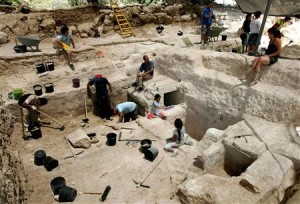 Highlights of recent archeaological finds include:
 I just received this note of encouragement from someone who read but somehow managed to hold on by a thread. As I read the verse 1 Timothy I came across this Scripture and decided to Google for some insight. I randomly came across your page, and was deeply touched and given me so much motivation and I feel like God directed me here so that He could speak through you. All I got to say is thank you for taking the time to write this because it has more meaning to me than you could imagine.” – Jane