

Miscellaneous Quotes (44)

“Although my memory’s fading, I remember two things very clearly: I am a great sinner and Christ is a great Savior.” – John Newton

“The devil is aware that one hour of close, spiritual and hearty converse with God in prayer, is able to pull down what he hath been contriving and building many a year.” – John Flavel

“The shop, the barn, the scullery, and the smithy become temples when men and women do all to the glory of God!” – C. H. Spurgeon

“All who are saved are saved as a result of what God does. All who are lost are lost as a result of what they do.” – Don Fortner

“To the Arminian, Christ can never truly be Savior in this life. At best, He is Probation Officer.” – Dan Phillips

“Some men cannot endure to hear the Doctrine of Election. I suppose they like to choose their own wives, but they are not willing that Christ should select His bride, the Church!” – C. H. Spurgeon

“The doctrine of providence teaches Christians that they are never in the grip of blind forces (fortune, chance, luck, fate); all that happens to them is divinely planned, and each event comes as a new summons to trust, obey, and rejoice, knowing that all is for one’s spiritual and eternal good (Rom. 8:28).” J. I. Packer

“It is a sin when I place myself deliberately in the place of tempatation… either because I enjoy the prospect or because I’m not determined enough in my desire to overcome it.” – Alistair Begg

“A natural faith is sufficient for trusting a human object; but a supernatural faith is required to savingly trust in a Divine object.” – A.W. Pink, Studies On Saving Faith

“When God hardens hearts He gives them their freedom to exercise the evil of their own desires.” – R.C. Sproul

“To sum up, man cannot without sacrilege claim for himself even a crumb of righteousness, for just so much is plucked and taken away from the glory of God’s righteousness. We must hold this as a universal principle: Whoever glories in himself glories against God.” – John Calvin

“The reason the church tries so many other things besides preaching Christ is because it suspects the kingdom can be established some other way. But there is no other way. People will not come into the kingdom because they like the minister, support the children’s program, or enjoy the music. They may come into a church that way, but not into the kingdom. The only way people ever come into God’s kingdom is by hearing His heralds proclaim a crucified King.” – Philip Graham Ryken

“I’ve often reflected on the rather obvious thought that when his disciples were about to have the world collapse in on them, our Lord spent so much time in the Upper Room speaking to them about the mystery of the Trinity. If anything could underline the necessity of Trinitarianism for practical Christianity, that must surely be it!” Sinclair Ferguson, cited in Letham, The Holy Trinity, 375
Continue reading
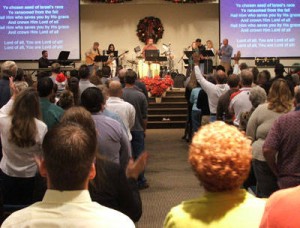
Organized Religion?

When someone tells me, “I’m not into organized religion,” I might replay, “Oh, that’s interesting. So you prefer the disorganized kind?”

The conversation normally goes somewhat quiet when I ask that question. Usually, most people have not thought about the matter to any great degree.

Yet, if we were to understand that WE and our feelings and opinions are not what matters on this issue – that we are not the center of the universe and in fact, that God has the right to orchestrate worship as He sees fit.. I know, what a concept!!… but yes, were we brave enough to stop and ask God’s opinion, seeking to find out what pleases Him, we would not read far in our Bibles before finding out that worship is to be carried out His way on His terms.

Remember Cain and Abel? Remember how one sacrifice was accepted by God (Abel’s) and the other was not (Cain’s). Remember the Tabernacle? Remember that His instructions had to be followed precisely and meticulously? Talk about organization… Entire books of the Bible were dedicated to revealing His precise instructions. God is holy and is to be treated as such by those seeking to approach Him in worship. Failure to do so had severe consequences. Nadab and Abihu were struck dead by God for seeking to design their own methods of worship. After their deaths, no one in Israel (including Aaron their own father) was allowed to even mourn their loss (Leviticus Chapter 10). Remember that?

Leviticus 10 reads: 1 Now Nadab and Abihu, the sons of Aaron, each took his censer and put fire in it and laid incense on it and offered unauthorized fire before the Lord, which he had not commanded them. 2 And fire came out from before the Lord and consumed them, and they died before the Lord. 3 Then Moses said to Aaron, “This is what the Lord has said: ‘Among those who are near me I will be sanctified, and before all the people I will be glorified.’” And Aaron held his peace.

4 And Moses called Mishael and Elzaphan, the sons of Uzziel the uncle of Aaron, and said to them, “Come near; carry your brothers away from the front of the sanctuary and out of the camp.” 5 So they came near and carried them in their coats out of the camp, as Moses had said. 6 And Moses said to Aaron and to Eleazar and Ithamar his sons, “Do not let the hair of your heads hang loose, and do not tear your clothes, lest you die, and wrath come upon all the congregation; but let your brothers, the whole house of Israel, bewail the burning that the Lord has kindled. 7 And do not go outside the entrance of the tent of meeting, lest you die, for the anointing oil of the Lord is upon you.” And they did according to the word of Moses.

8 And the Lord spoke to Aaron, saying, 9 “Drink no wine or strong drink, you or your sons with you, when you go into the tent of meeting, lest you die. It shall be a statute forever throughout your generations. 10 You are to distinguish between the holy and the common, and between the unclean and the clean, 11 and you are to teach the people of Israel all the statutes that the Lord has spoken to them by Moses.”

Frightening stuff, yes? Actually, its meant to be. It is a fearful thing to come before God in worship. All of us will be consumed if we do not come His way, on His terms, and by means of the sacrifice He has authorized. (see Hebrews 10:19-22)

So back to our discussion – were we to seek God’s thoughts on the matter, one of the many things we would find is that He loves the corporate worship gathering of His people, greatly preferring it to all of our private spiritual devotions combined.

“The Lord loves the gates of Zion more than all the dwellings of Jacob. Glorious things are spoken of you, O city of God.” (Ps. 87:2-3)

“And let us consider how to stir up one another to love and good works, not neglecting to meet together, as is the habit of some, but encouraging one another, and all the more as you see the Day drawing near.” (Hebrews 10:25, 26)

This is just the starting point of course, but rather than taking a poll of the community to ask for people’s personal preferences, its time we come on our knees humbly before God and with open Bibles ask Him, “What pleases You God? What is a true Church in Your eyes? What is Your view of worship? What isn’t?”

I hope that each of us are prepared to obey Him when He tells us the answers.

Friday Round Up

(1) A Reminder – in case you were not aware (the blog has been down for 5 of the last 7 days): I was interviewed by Pastor Kevin Boling on the “Knowing the Truth” Broadcast about my book “Twelve What Abouts” (and the subject of Divine election) last week on a radio station covering all of South Carolina and parts of neighboring states. Dr. R. C. Sproul’s CD series The Promise Keeper: God of the Covenants is available in the Ligonier Friday $5 sale (normally $38). In this series, Dr. Sproul demonstrates that the one, true Promise Keeper always keeps His promises. He explains how God, throughout history, has fulfilled His promised plan of redemption in and through His people.

There are other very useful materials available today also. Check out the $5 Ligonier sale here.

(3) Talking about Divine election, Modern Reformation magazine interviewed Dr. J. I. Packer some time back. There was an interesting exchange on the subject:

MR: Dr. Packer, what exactly do people mean by unconditional election?

Packer: It is a phrase which folk use to express this thought: that because we sinners are helpless, God has to take all the steps that are necessary in order to bring us to faith and fellowship with himself and finally to eternal life. Unconditional election is the name for the choice God makes to do that in any particular case, and it has to be unconditional because if God waited for man to merit it, he would wait forever.

MR: Dr. Packer, why do we need an election?

Packer: Because we will never be saved unless God chooses to save us. Election leads to the saving action of God in his lordship, and if we were left to ourselves we would never respond to God on our own at all. This is what people don’t seem to appreciate, that all of us by nature are anti-God in our deepest instincts (see Romans chapter 3). We don’t always realize this because many of us think we are seeking God, and frankly, people want a God they can manage and manipulate and have as a safety net. Those are facts about human life, and very familiar facts. But when it is a matter of responding to the real God and responding in a way that he calls for –that is by humbling ourselves before him, learning to trust his word absolutely, turning from sin, taking our hands off of the reins of our own life and letting him be in control –we wake up to the fact that we don’t like this at all and we shy back from it. That is our nature. So you see, God has to take action otherwise we shall never come to him at all because that is the state in which fallen humans find themselves.

MR: Doesn’t this detract from our responsibility to respond to the gospel? If I’m one of the elect, God will save me, and if I’m not I cannot be saved anyway so why worry about it?

Packer: No, that isn’t the way to look at it because God has made us folk who act of their own will and he keeps us that way. And so he takes account of us for the things that we have done because they really were our own actions. The fact that we haven’t got it in us to respond to God in a positive way doesn’t mean that we don’t choose not to respond to God. We do choose not to respond to God, and it’s for that choice that we’re responsible before him. The truth about us is that we are like drowning folk who can’t swim and left to ourselves would just go under and eventually not come up again. God takes action, as it were, to dive in, swim to us, grab hold of us and save us. Election, as we said a moment ago, is his decision to do that, and in his lordship and power he does it, and so our salvation is entirely due to him. But all the time we are responsible for being the people that we are, drowning in our own moral mess.

MR: Isn’t foreknowledge the basis of election? Didn’t God choose us because he looked down into the future and foresaw that we would believe in him?

Packer: He foreknew us all right, but he foreknew us as we are by nature, that is, he foreknew us as folk who wouldn’t respond to him unless he first changed our heart, so he chose us to have our hearts changed. But it’s all his initiative, all his sovereignty first to last. The Bible describes this human condition in many ways. It tells us that we are spiritually blind, spiritually deaf, our hearts are hard–that is to say we are unresponsive to God, and we are spiritually dead. The Bible says all those things. You couldn’t express the thought of unresponsiveness more strongly.
Continue reading