
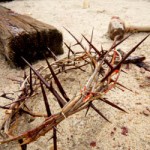
 by ay, d’ye know what it was—dying on the cross,
forsaken by His Father — d’ye know what it was?…
It was damnation — and damnation taken lovingly.”
— John “Rabbi” Duncan (1796–1870)
“And about the ninth hour Jesus cried with a loud voice, saying, Eli, Eli, lama sabachthani? that is to say, My God, my God, why hast thou forsaken me?” (Matt. 27:46, KJV).
It is noon, and Jesus has been on the cross for three pain-filled hours. Suddenly, darkness falls on Calvary and “over all the land” (v. 45). By a miraculous act of Almighty God, midday becomes midnight.
This supernatural darkness is a symbol of God’s judgment on sin. The physical darkness signals a deeper and more fearsome darkness.
The great High Priest enters Golgotha’s Holy of Holies without friends or enemies. The Son of God is alone on the cross for three final hours, enduring what defies our imagination. Experiencing the full brunt of His Father’s wrath, Jesus cannot stay silent. He cries out: “My God, my God, why hast thou forsaken me?”
This phrase represents the nadir, the lowest point, of Jesus’ sufferings. Here Jesus descends into the essence of hell, the most extreme suffering ever experienced. It is a time so compacted, so infinite, so horrendous as to be incomprehensible and, seemingly, unsustainable.
Jesus’ cry does not in any way diminish His deity. Jesus does not cease being God before, during, or after this. Jesus’ cry does not divide His human nature from His divine person or destroy the Trinity. Nor does it detach Him from the Holy Spirit. The Son lacks the comforts of the Spirit, but He does not lose the holiness of the Spirit. And finally, it does not cause Him to disavow His mission. Both the Father and Son knew from all eternity that Jesus would become the Lamb of God who would take away the sin of the world (Acts 15:18). It is unthinkable that the Son of God might question what is happening or be perplexed when His Father’s loving presence departs.
Jesus is expressing the agony of unanswered supplication (Ps. 22:1–2). Unanswered, Jesus feels forgotten of God. He is also expressing the agony of unbearable stress. It is the kind of “roaring” mentioned in Psalm 22: the roar of desperate agony without rebellion. It is the hellish cry uttered when the undiluted wrath of God overwhelms the soul. It is heart-piercing, heaven-piercing, and hell-piercing. Further, Jesus is expressing the agony of unmitigated sin. All the sins of the elect, and the hell that they deserve for eternity, are laid upon Him. And Jesus is expressing the agony of unassisted solitariness. In His hour of greatest need comes a pain unlike anything the Son has ever experienced: His Father’s abandonment. When Jesus most needs encouragement, no voice cries from heaven, “This is my beloved Son.” No angel is sent to strengthen Him; no “well done, thou good and faithful servant” resounds in His ears. The women who supported Him are silent. The disciples, cowardly and terrified, have fled. Feeling disowned by all, Jesus endures the way of suffering alone, deserted, and forsaken in utter darkness. Every detail of this horrific abandonment declares the heinous character of our sins!
But why would God bruise His own Son (Isa. 53:10)? The Father is not capricious, malicious, or being merely didactic. The real purpose is penal; it is the just punishment for the sin of Christ’s people. “For he hath made him to be sin for us, who knew no sin; that we might be made the righteousness of God in him” (2 Cor. 5:21).
Christ was made sin for us, dear believers. Among all the mysteries of salvation, this little word “for” exceeds all. This small word illuminates our darkness and unites Jesus Christ with sinners. Christ was acting on behalf of His people as their representative and for their benefit.
With Jesus as our substitute, God’s wrath is satisfied and God can justify those who believe in Jesus (Rom. 3:26). Christ’s penal suffering, therefore, is vicarious — He suffered on our behalf. He did not simply share our forsakenness, but He saved us from it. He endured it for us, not with us. You are immune to condemnation (Rom. 8:1) and to God’s anathema (Gal. 3:13) because Christ bore it for you in that outer darkness. Golgotha secured our immunity, not mere sympathy.
This explains the hours of darkness and the roar of dereliction. God’s people experience just a taste of this when they are brought by the Holy Spirit before the Judge of heaven and earth, only to experience that they are not consumed for Christ’s sake. They come out of darkness, confessing, “Because Immanuel has descended into the lowest hell for us, God is with us in the darkness, under the darkness, through the darkness — and we are not consumed!”
How stupendous is the love of God! Indeed, our hearts so overflow with love that we respond, “We love him, because he first loved us” (1 John 4:19).
 From the” announced Rolf Heuer, director of the European Center for Nuclear Research (CERN) on July 4. “We have a discovery. We have observed a new particle that is consistent with a Higgs boson.” Thundering applause resounded from the packed auditorium in Geneva and at the 36th International Conference on High Energy Physics in Melbourne, Australia, which was linked by a live feed.4 Joe Incandela and Fabiola Gianotti, the heads of the two large teams of scientists at CERN, announced they have detected a new subatomic particle consistent with the elusive Higgs boson, commonly called the “god particle.”