 Arminius moved to Amsterdam to pastor a prominent church there. As a pastor, he was called upon to defend Calvinistic teaching against Dirck zoon Koornheert. In preparing his defense of traditional Calvinist doctrine, Arminius became convinced of his opponent’s teaching.
In 1603, Arminius was appointed professor of theology at the University of Leiden, where he was strongly opposed by his colleague, Francis Gomarus. Both Arminius and Gomarus believed in predestination, but they differed over the meaning of the word. At the heart of the disagreement was whether predestination was based solely on the will of God (Calvinism) or based on foreseen knowledge of belief (what would later be called Arminianism). The two met for a public debate in 1608, but the issue was no closer to being settled. Both men thought of themselves as Reformed, as Calvinists, but they were not saying the same thing.
Following Arminius’ death in 1609, the movement continued under the leadership of Janus Uytenbogaert, a court preacher at the Hague. In 1610, the Arminian party issued a document called the Remonstrance, setting forth the “Five Articles of the Arminians.” Gomarus and others formed a Contra-Remonstrance party (Gomarists) to oppose the Arminians. Things continued to heat up when Arminius’ successor at the University of Leiden was named–a man by the name of Vorstius, who was practically a Socinian. When the Arminian Simon Episcopius was named Gomarus’ replacement at Leiden, it looked like the tide had turned in favor of the Remonstrants. The Remonstrance party was further supported by the statesman John van Oldenbarneveldt and the jurist/theologian Hugo Grotius.
Political Intrigue
The Netherlands had recently won its independence from Spain. Some were still leery of the Spanish, while others welcomed a closer relationship. In general, the merchant class, for economic and trading reasons, desired improved relations with Spain. The clergy, on the other hand, feared that more contact with Catholic Spain would taint the theology of their churches. The lower class sided with the clergy for theological reasons, for national reasons (anti-Spain), and for class reasons (anti-merchants). Thus, merchants saw Arminianism as favorable to their desire for improved relations with Spain, while the clergy and lower class sided with Gomarus.
The Remonstrance of 1610 was issued to Oldenbarneveldt, Advocate-General of Holland and Friesland. Oldenbarneveldt, who was working to secure a better relationship with Spain, wanted toleration for the Arminians. The Contra-Remonstrance from Gomarists was submitted to the States of Holland in 1611. Oldenbarneveldt and the States of Holland decided on toleration. But the Gomarists wanted an official theological pronouncement to settle the issue once and for all.
Prince Maurice, the son and heir of William of Orange, eventually took the side of the Gomarists (perhaps for theological reasons, but perhaps in an attempt to garner more control of the Netherlands for himself). After Maurice had Olderbarneveldt and others imprisoned, the Estates-General called for an assembly to end the conflict.
The Synod
An international synod convened in Dordrecht from 1618-19. Of the approximately 100 members present, 27 were from Britain, Switzerland, and Germany, while the rest were Dutch. The Dutch contingent was comprised of roughly an equal number of ministers, professors, laymen, and members of the Estates-General. The Remonstrants were soundly defeated at Dort, leading to one of the greatest theological formulations of the Reformation. Unfortunately, Maurice, a product of his times (and not a very nice man it seems), condemned Barneveldt to death and had some Arminian pastors imprisoned. When Maurice died in 1625, measures loosened considerably, and in 1631 Arminians were officially tolerated in the Netherlands.
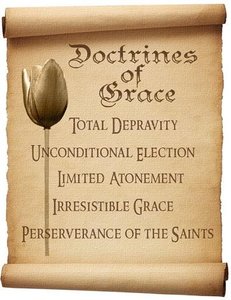
The Canons of Dort, in rejecting the five points of Arminianism, outlined five points of their own. The first concerning divine election and reprobation, the second on Christ’s death and human redemption through it, the third and fourth points on human corruption and how we convert to God, and finally the perseverance of the saints. Centuries later these five heads of doctrine would become the five points of Calvinism known at TULIP (total depravity, unconditional election, limited atonement, irresistible grace, and perseverance of the saints). The Canons do not pretend to explain everything about Reformed theology, or about the Bible for that matter. Dort simply sought to declare what was “in agreement with the Word of God and accepted till now in the Reformed churches” concerning “Divine Predestination.” With that goal in mind I think the Canons can be counted as a faithful witness and a God-glorifying success.

 Christianity Light – not enough truth to save you, but just enough to innoculate you against the real thing!
 I moved from England to the USA twenty years ago today. Though it is true to say that there have been many twists and turns along the way, I thank God that He remains so faithful, that His abiding presence is still a reality in my life.