Five Big Myths About Calvinism

Repost:

I speak for many when I say that I have not always embraced the doctrines of grace or what is commonly called Calvinism. Its actually unfortunate that a man’s name is associated with the doctrines that came out of the Protestant Reformation. Calvin was not the first to articulate these truths, but merely was the chief systematizer of such doctrines. There was actually nothing in Calvin that was not first seen in Luther, and much of Luther was first found in Augustine. Luther was an Augustinian monk, of course. We would also naturally affirm that there was nothing in any of these men that was not first found in Paul and Peter and John in the New Testament.

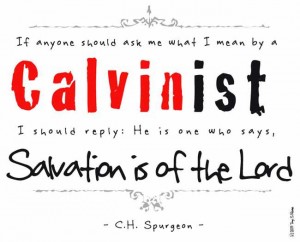
Even now, I have no desire to be a Calvinist in the Corinthian sense of the word – a follower of John Calvin, per say. Though I believe Calvin was a tremendous expositor of the Scriptures and had many great insights, I am not someone who believes he was in any way infallible. I am with Spurgeon who declared, “There is no soul living who holds more firmly to the doctrines of grace than I do, and if any man asks me whether I am ashamed to be called a Calvinist, I answer – I wish to be called nothing but a Christian; but if you ask me, do I hold the doctrinal views which were held by John Calvin, I reply, I do in the main hold them, and rejoice to avow it.” (C. H. Spurgeon, a Defense of Calvinism)

In coming to understand these doctrines that are now so precious to me, I now realize that there were fortresses built in my mind to defend against the idea of God being Sovereign in the matter of salvation. Such was my total depravity! These fortresses were not made of stone and brick but of man made ideas – concepts that I believed Scripture taught with clarity. These fortresses did not come down easily. In fact, I believe it is a work of Divine grace in the heart not only to regenerate His people, but also to open hearts and minds, even of His own people, to the truth of His Sovereignty in election.

There are many false concepts about Calvinism. Here are five that are very common:

1. CALVINISM DESTROYS EVANGELISM

I think some Calvinists do have an aversion for evangelism, and this is something that needs to be addressed whenever this tendency is seen, yet both historically and biblically, nothing could be further from the truth. It is quite easy to prove that the whole missions movement was started by Calvinists who believed Christ had His elect sheep in every tribe, tongue, people and nation. Romans 8 and 9 teaches election clearly, and Romans 10 tells us of the necessity of preaching the Gospel. How shall they (the elect) hear without a preacher? Romans 10 is in no way a contradiction to Romans 8 and 9.

Divine election is the only hope of evangelism. No one we speak to about Christ is beyond hope, for God may well have ordained from all eternity that our conversation or preaching is to be the very means by which He would achieve His ends – the gathering of one of His elect sheep into the fold! What a privilege to be used by God in this way.

Divine election should never undermine evangelism. In fact, the truth about election should cause us to continue to proclaim Christ, even when results may not come immediately. The concept of election should actually fuel our evangelism when mere human emotion wanes. We should remember that God has His elect sheep who will hear His voice and will follow Him when we preach the Gospel of Christ. So then faith comes by hearing and hearing the word of Christ (Rom. 10:17).

Election is not a hindrance to evangelism. It simply explains to us why some believe the Gospel and why some do not. Jesus said to one group hearing Him “you do not believe because you are not My sheep” (John 10:26) and Luke explained the evangelistic results of the early church by declaring, “as many as were ordained to eternal life believed.” (Acts 13:48)

2. CALVINISM APPEALS TO THE PRIDE OF MAN

Sadly, some Calvinists do reek of pride and give off an air of being better than those around them, but such is a total betrayal of biblical Calvinism. If we recognize our total depravity or radical corruption, we understand that there was absolutely nothing in us that caused God to look down upon us to show us such favor. The only thing we can say in response to His electing grace is “Lord, why me?”

Romans 9:11-16 11 though they were not yet born and had done nothing either good or bad- in order that God’s purpose of election might continue, not because of works but because of his call- 12 she was told, “The older will serve the younger.” 13 As it is written, “Jacob I loved, but Esau I hated.” 14 What shall we say then? Is there injustice on God’s part? By no means! 15 For he says to Moses, “I will have mercy on whom I have mercy, and I will have compassion on whom I have compassion.” 16 So then it depends not on human will or exertion, but on God, who has mercy.

“God intentionally designed salvation so that no man can boast of it. He didn’t merely arrange it so that boasting would be discouraged or kept to a minimum – He planned it so that boasting would be absolutely excluded. Election does precisely that.” – Mark Webb Continue reading

Ephesians 1; Romans 9; John 6

by James White

Numerous biblical passages can be cited that plainly teach the divine truth that God predestines men unto salvation. John 6:35-45, Romans 9:10-24, and 2 Timothy 1:8-10 all teach this truth. But I shall focus first upon the classicus locus, Ephesians 1:3-11, for my initial exegetical defense of this divine truth. As space permits, I will then briefly address Romans 9 and John 6. I invite the interested reader to follow along. I shall use as my base text the Nestle-Aland 27th edition of the Greek New Testament. English translations are my own.

Ephesians 1

Paul begins this tremendous introduction to his letter1 with a word of blessing addressed to God the Father of our Lord Jesus Christ (1:3). All of salvation comes from the Father, its source, and its end. It is the Father who has blessed us with every spiritual blessing in the heavenly places in Christ. Immediately we encounter three vital truths: 1) God is the one who has blessed us (we did not bless ourselves); this is seen in recognizing that ho eulogasa refers to the Father specifically; 2) that Paul is not speaking of all mankind here, but specifically of the redeemed, for he uses the personal pronoun hama (us) when speaking of the scope of the blessing of the Father; we will see this is continued throughout the text; and 3) the phrase en Christo (in Christ) or its equivalent in Him, is central to Paul’s thought. All of salvation takes place only “in Christ.”

Verse 4 is central to our subject: “just as He chose us in Him before the creation of the world so that we should be holy and blameless before Him.”2 Again the Father is in view, for He is the one who chose us (hama, accusative, indicating direct object of “to choose”). This choice is exercised only in Christ (there is no salvation outside of the Son). It is vital to recognize the personal aspect of this choice on the part of God the Father. The passage says that we were chosen by God the Father, not that a mere “plan” was chosen, or a “process” put in place. The choice is personal both in its context (in the Son) and in its object (the elect). Next, the time of this choice by the Father is likewise important: before the creation of the world. This is a choice that is timeless. It was made before we were created, and therefore cannot possibly be based upon anything that we ourselves do or “choose.”3 This is sovereignty-free and unlimited.

God does nothing without a purpose. Both the means, and end, are in view. God chooses the elect to the end that they should be “holy and blameless before Him.” God is redeeming for Himself a people, and no power in heaven or earth can stop Him from accomplishing His intention.

Paul continues to expand upon the nature of the Father’s choice: “In love He predestined us to adoption as sons through Jesus Christ to Himself, according to the good pleasure of His will” (v. 5). This is the first appearance of the word “predestined” in the text. The exact same term (proopizo) is used in verse 11 as well. The meaning of the term is not ambiguous, no matter how hard some might try to avoid its impact. It means “to choose beforehand” or “to predestine.”4 In this context, it is unquestionably personal in its object, for again we find hama as the direct object of the action of predestination. This is truly the key element of this [issue], for grammatically there is no escape from the plain assertion here made: God the Father predestined us. He did not predestine a plan, He did not merely predestine a general conclusion to all things, but He chose us and predestined us. The “us” of Ephesians 1:5 is the “we” of Ephesians 1:11 and the “elect” of Romans 8:33 and those who are “given” by the Father to the Son in John 6:37. Continue reading

He Loved Us Then: He’ll Love Us Now

by Dane Ortlund

It is not hard for me to believe God has put away all my old failures that occurred before new birth. What is hard is to believe that God continues to put away all my present failures that occur after new birth.

We tend to view the Father looking down on us with raised eyebrows–‘how are they still such failures after all I have done for them?’ we see him wondering.

A Christian conscience is a re-sensitized conscience. Now that we know God as Father, now that we have become human again, we feel more deeply than ever the ugliness of sin. Failure makes the soul cringe unlike ever before. That’s why Romans 5:1-11 is in the Bible.

Lots to say about 5:1-5 and the present peace believers enjoy because of the past justification that has been secured, but here’s something I’m reflecting on this week from verses 6-11.

No less than three times in these verses Paul says roughly the same thing:

While we were still weak, at the right time Christ died for the ungodly. (5:6)

While we were still sinners, Christ died for us. (5:8)

If while we were enemies we were reconciled to God by the death of his Son, much more, now that we are reconciled, shall we be saved by his life. (5:10)

Three times Paul says that God did something to save us when we were hating him. Weak. Sinners. Enemies. We didn’t have to clean ourselves up first. He didn’t meet us halfway. He pulled us out of the moral mud in which we were drowning. That’s great news. But that’s not Paul’s burden in these verses. He’s after something else.

What’s the ultimate point Paul is driving at in Romans 5:6-11? Not God’s past work, mainly. His point is our present security, given that past work. He raises Christ’s past work to drive home this point: If God did that back then, when you were so screwy and had zero interest in him, then what are you worried about now? The whole point of vv. 6-11 is captured in the “since” of v. 9: “Since, therefore, we have now been justified by his blood, much more shall we be saved by him . . .” It is not hard for him to hug you in your mess now that the hard part’s done. This really helps us relax.

He drew near to us when we hated him. Will he remain distant now that we want to please him?

He suffered for us when we were failing, as orphans. Will he cross his arms over our failures now that we are his adopted children?

His heart was “gentle and lowly” toward us when we were lost. Will his heart be anything different toward us now that we are found?

“While we were still.” He loved us in our mess then. He’ll love us in our mess now. Our very agony in sinning is the fruit of our adoption. A cold heart would not be bothered. We are not who we were.

Spurgeon:

Christ loved you before all worlds; long ere the day star flung his ray across the darkness, before the wing of angel had flapped the unnavigated ether, before aught of creation had struggled from the womb of nothingness, God, even our God, had set his heart upon all his children.

Since that time, has he once swerved, has he once turned aside, once changed? No; ye who have tasted of his love and know his grace, will bear me witness, that he has been a certain friend in uncertain circumstances. . . .

You have often left him; has he ever left you? You have had many trials and troubles; has he ever deserted you? Has he ever turned away his heart, and shut up his bowels of compassion? No, children of God, it is your solemn duty to say ‘No,’ and bear witness to his faithfulness.

–Charles Spurgeon, ‘A Faithful Friend,’ in Sermons of C. H. Spurgeon (New York: Sheldon, Blakeman & Co., 1857), 13-14