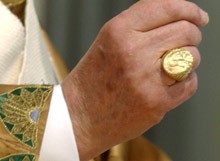
 Today, (February 28, 2013) is a significant day for Roman Catholics worldwide as the current Pope steps aside, the first time a Pope has done so in almost 600 years. A number of symbolic ceremonies will mark the occasion including the breaking of the Papal ring, called the Ring of the Fisherman, also known as the Piscatory Ring, Annulus Piscatoris (in Latin) and the Anello Piscatorio (in Italian). This is an official part of the regalia worn by the Pope, head of the Roman Catholic Church. As I am sure we are all aware, Rome claims that the Pope is the successor of the Apostle Peter, who by trade was a fisherman. The design of the ring features a bas-relief of Peter fishing from a boat. The Fisherman’s Ring was used until 1842 to seal official documents signed by the Pope.
Wikipedia says, “A new ring is cast in gold for each Pope. Around the relief image is the reigning Pope’s Latin name in raised lettering. During the ceremony of a Papal coronation or Papal inauguration, the Dean of the College of Cardinals slips the ring on the third finger of the new Pope’s right hand. Upon a papal death, the ring is ceremonially broken in the presence of other Cardinals by the Camerlengo, in order to prevent the sealing of backdated, forged documents during the interregnum, or sede vacante. This custom is also planned to be followed after the resignation of Pope Benedict XVI.”
With today’s events in mind, what follows is a question and answer repost of a blog article here regarding the question of Peter and the keys:
 Question: The Roman Catholic Church claims that the Apostle Peter was the first Pope. Much is made of Jesus giving Peter the keys of the kingdom. Do you have anything that would help me rightly understand this Matthew 16 passage?
Thank you for your question. It is a very important one. You are right to say that Roman Catholics make much of this passage claiming that it teaches Rome’s position on the Papacy in clear terms. In my opinion, the best treatment of the passage in question is found in Dr. James White’s book “The Roman Catholic Controversy.” The entire book is immensely helpful, and while written back in 1996, is just as relevant to the situation in our day. Roman Catholics, for all their claims, actually do not have history on their side in this debate. This article addresses this in summary form. However, regarding the Matthew 16 passage, rather than summarizing Dr. White’s words, let me quote directly from the book, from Chapter 8 “The Claims of the Papacy”, pages 115-118:
Few would argue that the foundational passage on which the entire Roman Catholic claim for the Papacy rests is found in Matthew 16:13-20, verses 18-19 in particular. We are told that their plain meaning supports the concept. It should be noted that Rome has infallibly interpreted these verses in the words of Vatican I. It is one of the few passages of Scripture that have in fact been infallibly interpreted by the Roman Catholic Church (John 21:25-27 being another). Let’s look at Matthew’s record.
He said to them, “But who do you say that I am?” Simon Peter answered, “You are the Christ, the Son of the living God.” And Jesus said to him, “Blessed are you, Simon Barjona, because flesh and blood did not reveal this to you, but My Father who is in heaven. I also say to you that you are Peter, and upon this rock I will build My church; and the gates of Hades will not overpower it. I will give you the keys of the kingdom of heaven; and whatever you bind on earth shall have been bound in heaven, and whatever you loose on earth shall have been loosed in heaven.”
No one will deny that this is a singularly important passage. Here the Lord Jesus leads His disciples to a confession of faith in himself; the Father from heaven reveals the true nature of His Son, Jesus Christ.
Yet we find these verses being used to support a concept seen nowhere else in Scripture. We are asked to believe that not only is the impetuous and frail Peter made the very foundation of the Church itself, but that this foundational position creates an office of Pope, and that this office involves successors who will sit in the seat of bishop in the city of Rome, 1,500 miles distant.
Continue reading →

 Do my personal prayers make any difference?
 (1) The resources in this week’s