
The Long History of Billy Graham’s Ecumenism

By David Cloud, Fundamental Baptist Information Service, PO Box 610368, Port Huron, MI 48061 , 866-295-4143 – [email protected].

The following was first published in the out-of-print book Evangelicals and Rome in 1999:

When Did Graham’s Compromise Begin?
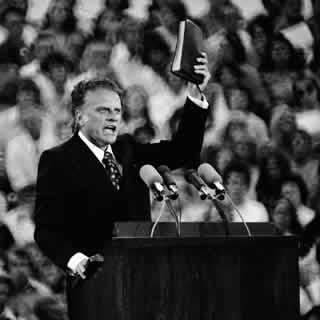
billyBilly Graham’s compromise and disobedience began very early in his ministry. He was born in 1918 into a Presbyterian home and traces his conversion to the preaching of evangelist Mordecai Ham in 1934. He graduated from high school in May 1936 and attended Bob Jones College (which later became Bob Jones University) in the fall but switched to Florida Bible Institute after only one semester because he did not like the strict discipline at Bob Jones.

He notes in his biography that “one thing that thrilled me [about Florida Bible Institute] was the diversity of viewpoints we were exposed to in the classroom, a wondrous blend of ecumenical and evangelical thought that was really ahead of its time” (Graham, Just As I Am , p. 46).

It was during his time in Florida that Graham felt the call to preach. In late 1938, he was baptized by immersion in a Baptist church, and in early 1939, he was ordained to preach by a Southern Baptist congregation.

Graham graduated from the Florida Bible Institute in May 1940 and joined Wheaton College that September, graduating from there in 1943.

In May 1944, he began preaching for the newly formed Chicagoland Youth for Christ, and in January 1945, he was appointed the first full-time evangelist for Youth for Christ International.

He was president of Northwestern Schools (founded by W.B. Riley) from December 1947 to February 1952, though he continued to travel and preach for Youth for Christ and eventually branched out with an independent ministry.

The Billy Graham Evangelistic Association was formed in 1950 and the Hour of Decision radio broadcasts began that same year. Graham conducted his first citywide crusade in Grand Rapids, Michigan, in September 1947, and his October 1948 crusade in Augusta, Georgia, marked the beginning of an openly ecumenical program. This was the first crusade that was sponsored by the city ministerial association. The Graham organization began demanding broad denominational support for his crusades.

During Graham’s 1949 Los Angeles crusade, his ministry began to receive national press coverage. Graham’s final rift with most fundamentalist leaders did not occur until 1957, though. This was brought about by the open sponsorship of the liberal Protestant Church Council in New York City. The Graham crusade committee in New York included 120 theological modernists who denied the infallibility of Scripture. The wife of modernist Norman Vincent Peale headed up the women’s prayer groups for the Crusade. Modernists such as Dr. Martin Luther King, Jr., sat on the platform and led in prayer. In the National Observer, Dec. 30, 1963, King said the virgin birth of Christ was “a mythological story” created by the early Christians. In Ebony magazine, January 1961, King said: “I do not believe in hell as a place of a literal burning fire.”

THE COMPROMISE BEGAN MUCH EARLIER THAN 1957, THOUGH. AS EARLY AS 1944, BILLY GRAHAM WAS BEFRIENDED BY ONE OF THE MOST INFLUENTIAL CATHOLIC LEADERS IN AMERICA, FULTON SHEEN. Continue reading
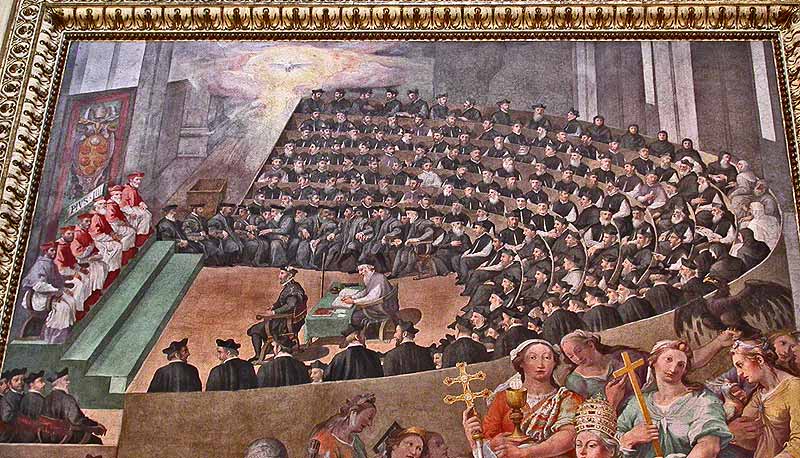
The Council of Trent

TrentJoe Carter, in an article entitled “9 Things You Should Know About the Council of Trent” found writes:

Yesterday marked the 450th anniversary of the closing of the Council of Trent, one of the most significant series of meetings in Christian history. Here are nine things evangelicals should know about the Council and the decrees that it issued:

1. The Council of Trent was the most important movement of the Catholic Counter-Reformation, the Catholic Church’s first significant reply to the growing Protestants Reformation. The primary purpose of the council was to condemn and refute the beliefs of the Protestants, such as Martin Luther and John Calvin, and also to make the set of beliefs in Catholicism even clearer. Approximately forty clergymen, mainly Catholic bishops, were in attendance during the twenty-five times over the next eighteen years that the Council convened.

2. Protestants endorse justification by faith alone (sola fide) apart from anything (including good works), a position the Catholic Church condemned as heresy. During the the sixth session, the Council issued a decree saying that, “If any one saith, that the justice received is not preserved and also increased before God through good works; but that the said works are merely the fruits and signs of Justification obtained, but not a cause of the increase thereof; let him be anathema.”

3. The Protestant Reformers rejected the Apocrypha as part of the biblical canon. (The term Apocrypha (Gr., hidden) is a collection of ancient Jewish writings and is the title given to these books, which were written between 300 and 30 B.C., in the era between the Old and New Testaments.) During the the fourth session, the Council issued a decree damning anyone who rejected these books:

. . . if any one receive not, as sacred and canonical, the said books entire with all their parts, as they have been used to be read in the Catholic Church, and as they are contained in the old Latin vulgate edition; and knowingly and deliberately contemn the traditions aforesaid; let him be anathema.

Many doctrines unique to Catholicism, such as the teachings of purgatory, prayers for the dead, and salvation by works, are found in these books.

4. During the Protestant Reformation, the doctrine of transubstantiation was heavily criticized as an Aristotelian “pseudophilosophy.” The 13th session reaffirmed and defined transubstantiation as “that wonderful and singular conversion of the whole substance of the bread into the Body, and of the whole substance of the wine into the Blood – the species only of the bread and wine remaining – which conversion indeed the Catholic Church most aptly calls Transubstantiation.”

5. Protestants claimed that the only source and norm for the Christian faith was Holy Scripture (the canonical Bible without the Apocrypha). The doctrine of Sola Scriptura was rejected at Trent. The Council affirmed two sources of special revelation: Holy Scripture (e.g., all the books included in the Latin Vulgate version) and traditions of the church (including the “unwritten traditions”).

6. In Catholic theology, an indulgence is a remission of temporal punishment due to sin, the guilt of which has been forgiven. Under Catholic teaching, every sin must be purified either here on earth or after death in a state called purgatory. The selling of indulgences was not part of official Catholic teaching, though in Martin Luther’s era, the practice had become common. (Luther was appalled by the sermon of an indulgence vendor named John Tetzel who said, “As soon as the coin in the coffer rings, the soul from purgatory springs.”) The Council called for the reform of the practice, yet damned those who “say that indulgences are useless or that the Church does not have the power to grant them.”

7. In Catholic theology, purgatory is a place or condition of temporal punishment for those who denied yet were not free from “venial” sins (a lesser sin that does not result in a complete separation from God and eternal damnation in hell). The council affirmed the doctrine of purgatory and damned anyone who claimed “that after the grace of justification has been received the guilt is so remitted and the debt of eternal punishment so blotted out for any repentant sinner, that no debt of temporal punishment remains to be paid.”

8. In the 24 session, the council issued decrees on marriage which affirmed the excellence of celibacy, condemned concubinage, and made the validity of marriage dependent upon the wedding taking place before a priest and two witnesses. In the case of a divorce, the right of the innocent party to marry again was denied so long as the other party was alive, even if the other party had committed adultery.

9. At the request of Pope Gregory XIII, the Council approved a plan to correct the errors to the Julian calendar that would allow for a more consistent and accurate scheduling of the feast of Easter. The reform included reducing the number of leap years in four centuries from 100 to 97. Although Protestant countries in Europe initially refused to adopt the “Gregorian calendar” (also known as the Western or Christian calendar), it eventually became the most widely accepted and used civil calendar in the world.

(Note: The declarations and anathemas of the Council of Trent have never been revoked. The decrees of the Council of Trent are confirmed by both the Second Vatican Council (1962-1965) and the official “Catechism of the Catholic Church” (1992).)

Poem: The Calvinist

Justin Taylor writes, “Calvinism, they say, is making a comeback. But poetry? We rarely hear traditional poems today, apart from rhyming couplets in songs or greeting cards or spoken-word pieces with a beat. So I am thankful to hear and watch this robust, life-giving poem from John Piper—read by Piper with the help of friends Matt Chandler, R. C. Sproul, D. A. Carson, Thabiti Anyabwile, Alistair Begg, and Sinclair Ferguson—showing that Calvinism is not an arcane point of theology but a tough-and-tender approach to all of life before the face of God.”

The Calvinist from Desiring God on Vimeo.

desiringGod.org/calvinist
Sulva Productions
Jeremiah Rounds, Lisa Michelle Rounds, Ophelia Rounds
Poem Written by: John Piper
Directed & Edited by: Tristan Carnahan
Music by: AJ Hochhalter, Tony Anderson
Cinematography by: Tristan Carnahan, Jeremiah Rounds, Gabriel Leake
Sound Design & Mix by: Defacto Sound
Project Managed by: Stefan Green
Produced by: Desiring God