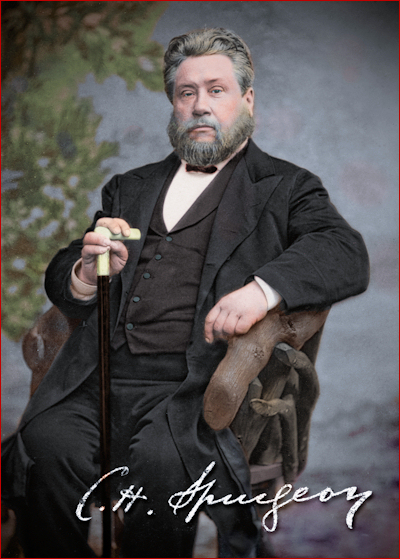
 Was Charles Spurgeon a Calvinist? The Prince of Preachers himself answers this question in the affirmative:
“It is no novelty, that I am preaching; no new doctrine. I love to proclaim these strong old doctrines, that are called by nickname Calvinism, but which are surely and verily the revealed truth of God as it is in Christ Jesus.” — Charles Spurgeon
In Dr. Steven Lawson’s book, The Gospel Focus of Charles Spurgeon, Dr. Lawson argues that not only was Spurgeon a Calvinist, but his fervent commitment to the doctrines of grace actually “sharpened” his “gospel focus.”
Here are several adapted excerpts from The Gospel Focus of Charles Spurgeon to outline Spurgeon’s beliefs concerning the sovereignty of God in salvation.
Total Depravity
For Spurgeon, total depravity was where the message of the gospel begins. The saving message of grace starts with total depravity. Man is entirely corrupted by sin. He is spiritually dead and unable to save himself. He could not be more hopeless and helpless.
“If God requires of the sinner, dead in sin, that he should take the first step, then he requires just that which renders salvation as impossible under the gospel as it was under the law, since man is as unable to believe as he is to obey.” — Charles Spurgeon
Simply put, Spurgeon believed that no human will is entirely free. It is either a slave of sin or a slave of Christ, but never free.
Unconditional Election
By necessity, unconditional election flows from belief in human depravity. Because the will of man is utterly dead and cannot choose God, God must exercise His sovereign will to save. Out of the mass of fallen humanity, God made an eternal, distinguishing choice. Before the foundation of the world, He determined whom He would save. Spurgeon contended that were it not for God’s choice of His elect, none would be saved.
Like all the doctrines that Spurgeon held, he believed this truth because he was convinced it is rooted and grounded in the Bible:
“Whatever may be said about the doctrine of election, it is written in the Word of God as with an iron pen, and there is no getting rid of it.” — Charles Spurgeon
Definite Atonement
Charles Spurgeon strongly affirmed the doctrine of definite atonement. This truth teaches that Christ died exclusively for those chosen by the Father and, thus, actually secured the salvation of all those for whom He died. Such a definite redemption stands in contrast to the Arminian view, which claims that Christ did not actually save anyone in particular by His death, but merely made salvation possible for everyone. Spurgeon adamantly rejected this vague position:
“A redemption which pays a price, but does not ensure that which is purchased—a redemption which calls Christ a substitute for the sinner, but yet which allows the person to suffer—is altogether unworthy of our apprehensions of Almighty God.” — Charles Spurgeon
Such a nebulous belief, he insisted, grossly dishonors God, especially His justice, and distorts the saving purpose of Christ in His substitutionary death.
Irresistible Grace
God’s sovereign call, Spurgeon affirmed, is far more powerful than any man’s resistance: “A man is not saved against his will, but he is made willing by the operation of the Holy Ghost. A mighty grace which he does not wish to resist enters into the man, disarms him, makes a new creature of him, and he is saved.” This means no one is beyond the saving power of God:
“Difficulty is not a word to be found in the dictionary of heaven. Nothing can be impossible with God. The swearing reprobate, whose mouth is blackened with profanity, whose heart is a very hell, and his life like the reeking flames of the bottomless pit—such a man, if the Lord but looks on him and makes bare His arm of irresistible grace, shall yet praise God and bless His name and live to His honor.” — Charles Spurgeon
In short, no human heart is so obstinate that the Spirit cannot conquer and convert it.
Preserving Grace
“I must confess that the doctrine of the final preservation of the saints was a bait that my soul could not resist. I thought it was a sort of life insurance—an insurance of my character, an insurance of my soul, an insurance of my eternal destiny. I knew that I could not keep myself, but if Christ promised to keep me, then I should be safe for ever; and I longed and prayed to find Christ, because I knew that, if I found Him, He would not give me a temporary and trumpery salvation, such as some preach, but eternal life which could never be lost.” — Charles Spurgeon
Preserving grace became a key component of Spurgeon’s gospel focus. Without it, he claimed, he would not be able to preach: “If anybody could possibly convince me that final perseverance is not a truth of the Bible, I should never preach again, for I feel I should have nothing worth preaching.” Simply put, the perseverance of the saints was a necessary link in the unbreakable golden chain of salvation that he preached.
Source: http://www.ligonier.org/blog/charles-spurgeon-calvinist/