
The Slow Killing of Congregational Singing

“Worship is deformed when it becomes vicarious performance rather than congregational and participational.” – Sinclair Ferguson

The following article is by Mike Raiter, Director of the Centre for Biblical Preaching in Melbourne. He was formerly Head of Missions at Moore College and, more recently, Principal of Melbourne School of Theology. Mike spent 11 years working in Pakistan, largely in theological education. He is married to Sarah and they have 4 children (Joel, Nate, Pippa and Lauren). He is the author of over 35 books and articles, most notably the 2004 Australian Christian Book of the Year, Stirring of the Soul. (original source here)

Here is a great historical irony. Fifty years ago choirs ruled the church. Usually, they were supported by a very loud organ. To be frank, many choir members were performers, and when the choir was large they drowned out the singing of the congregation. So, sadly, the very people appointed to help the congregation sing actually smothered congregational singing. Bit by bit, choirs disappeared. I think most churches didn’t mourn the loss.

Here’s the irony: we then replaced the choirs with song leaders (or, what we inaccurately call ‘worship leaders’). Over time the number of song leaders grew and grew until they became as big as a choir. Then we gave the song leaders full-volume microphones and electrical instruments, and many became performers. When the music team was large and the microphones were turned up they drowned out the congregation. So, sadly, the very people appointed to help the congregation sing actually smothered congregational singing.

A few years ago I wrote an article entitled, ‘The Slow Death of Congregational Singing’ (The Briefing, April 2nd, 2008). I now believe my title was too generous. In fact, what we are witnessing in our churches is ‘The Slow Killing of Congregational Singing’.

I’ve just returned from another National Christian conference. Never have so many people complained to me about the singing. So, I am motivated to write again. Or, to use a more appropriate metaphor, to bang the same drum—but louder.

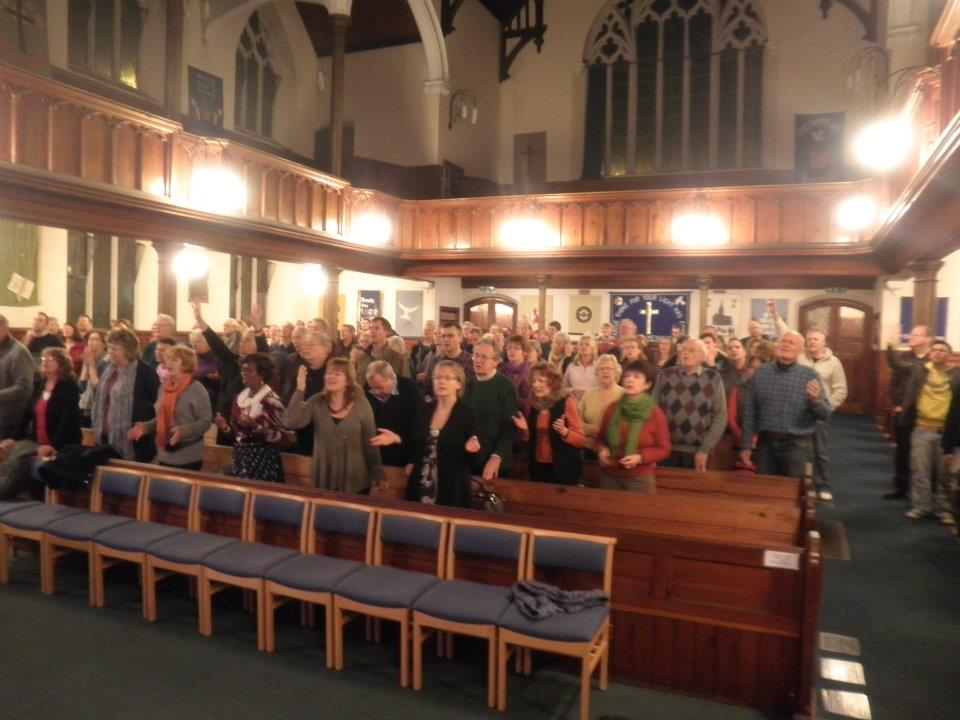
Paul tells us in Ephesians that we should be, “speaking to one another with psalms, hymns and spiritual songs…” (5:19). Similarly, in Colossians we are exhorted to, “teach and admonish one another with all wisdom with psalms, hymns and spiritual songs” (3:16). Singing is a corporate activity with a dual focus. We sing “to one another” and we sing “to God”. But now in many (most?) churches we are sung to by the musicians.

In the past I’ve been reluctant to accuse our worship teams of being primarily performers. I now believe I was wrong. Evidence suggests that most are performers, and the needs of the congregation they are meant to be ministering to are forgotten. Why do I say this?

Signs of Trouble
First, they don’t look at the congregation they’re meant to be leading. The musicians can, perhaps, be excused here but not the song leaders. I tell preachers I mentor there is nothing more important in delivery than eye contact. People must know that you are talking to them, and you must be able to see that they are attentive to your words. This is also true for the song leaders. Indeed, they need both eye and ear contact. Are people singing the songs they’re leading? In most cases I observe that it’s irrelevant to the song leaders whether the people are singing or not. Why? I conclude because the singing event is primarily about them.

Second, they sing new songs but don’t teach the new songs. At this conference it was announced that the next song would be a new one. At that point, the role of the song leader is to teach this song to the people. Mind you, I wonder if any of those leading singing are trained to teach new songs? This is important because a number of new songs are difficult to sing. But we were not taught the song. The band just began to play. If we were able to eventually pick it up, all well and good. If not (and in this case it seemed that many didn’t), no problem. Why? I conclude: because it’s not about the singing of the congregation it’s about the performance of the band. Continue reading

Biblically Directed and Informed Worship

Dr. Ligon Duncan:

The congregation that aims to be biblically directed and informed in its approach to public worship will gather weekly on the Lord’s Day for Bible reading, Bible preaching, Bible praying, Bible singing and biblical observance of the sacraments. These things will be at the core of what they do in public worship. This means the following for biblically-directed congregational services of worship.

They will read the Bible in public worship. Paul told Timothy “give attention to the public reading of Scripture” (1 Tim. 4:13) and so, a worship service influenced by the teaching of Scripture will contain a substantial reading of Scripture (and not just from the sermon text!). The public reading of the Bible has been at the heart of the worship of God since Old Testament times. In the reading of God’s word, He speaks most directly to His people.

They will preach the Bible in public worship. Preaching is God’s prime appointed instrument to build up his church. As Paul said “faith comes by hearing” (Romans 10:14, 17). Faithful biblical preaching is to explain and apply Scripture to the gathered company, believers and unbelievers alike. James Durham put it this way: “This is the great design of all preaching, to bring them within the covenant who are without, and to make those who are within the covenant to walk suitably to it. And as these are never separated on the Lord’s side, so should they never be separated on our side.” This means expository and evangelistic preaching, squarely based in the text of the word of God.

People who appreciate the Bible’s teaching on worship will have a high view of preaching, and little time for the personality driven, theologically void, superficially practical, monologues that pass for preaching today. “From the very beginning the sermon was supposed to be an explanation of the Scripture reading,” says Hughes Old. It “is not just a lecture on some religious subject, it is rather an explanation of a passage of Scripture.” “Preach the word,” Paul tells Timothy (2 Tim 4:2). “Expository, sequential, verse by verse, book by book, preaching through the whole Bible, the ‘whole council of God’ (Acts 20:27), was the practice of many of the church fathers (e.g., Chrysostom, Augustine), all the Reformers and the best of their heirs ever since. The preached word is the central feature of Reformed worship.”

They will pray the Bible in public worship. The Father’s house “is a house of prayer” said Jesus (Matthew 21:13). Our prayers ought to be permeated with the language and thought of Scripture. Terry Johnson makes the case thusly: “the pulpit prayers of Reformed churches should be rich in Biblical and theological content. Do we not learn the language of Christian devotion from the Bible? Do we not learn the language of confession and penitence from the Bible? Do we not learn the promises of God to believe and claim in prayer from the Bible? Don’t we learn the will of God, the commands of God, and the desires of God for His people, for which we are to plead in prayer, from the Bible? Since these things are so, public prayers should repeat and echo the language of the Bible throughout.” The call here is not for written and read prayer, but studied free prayer. Gospel ministers will spend time plundering the language of Scripture in preparation for leading in public worship. Continue reading

The Gift of Congregational Singing

Article: The Encouragement of Congregational Singing by Dustin J Coleman (original source here)

One of the great gifts that God has given His church is the gift of congregational singing. I often come to our worship gathering discouraged – discouraged with my failures, my anxieties, and my weakness. What a gift the gathered church is to a discouraged soul! Every week we come in from our different lives and gather to, among other things, sing the glory and power of the gospel.

This hit home for me at a recent worship gathering of our church. As I sang the songs and thought about the people who were singing around me, my heart was invigorated with the joy of the victory of the gospel.

I saw a woman many of us affectionately call “Grandma Kay.” Kay is in her 90s and suffers from several debilitating weaknesses that come along with being of advanced age. She seems weaker with each passing week and I know the day of her passing is not far away. And yet here she is, sitting (because she can’t stand) and singing with us:

And on that day when my strength is failing

The end draws near and my time has come

Still my soul will sing Your praise unending

Ten thousand years and then forevermore!

This is a victory cry! Throughout the winding years of decades, neither old age nor the pains of impending death have been able to rob Grandma Kay of her joy. Neither life nor death has been able to separate her from the love of God in Christ Jesus our Lord.

And then I see Mary, a single, divorced woman in her mid-50s. She often jokes that Christ had to wear gloves when He reached out to save her, so deep was the filth of her debauchery. Her voice joins all of ours as we sing:

O perfect redemption! The purchase of blood

To every believer the promise of God

The vilest offender who truly believes

That moment from Jesus a pardon receives.

This is a victory cry! Her voice joins the chorus that proclaims that there is no depth of muck and sin that the depth of Christ’s grace and mercy is not deeper still. Sin’s grip is no match when God decides to wrest His children free.

And then I see Ryan, a young single man in our congregation. Ryan is coming out of a very difficult past, a past of drug addiction, alcohol, and sexual sin. But, praise God, he is fighting! He is fighting but there are days of failure. But here he is, standing in the row behind me, as we sing these words:

Christ the sure and steady anchor

While the tempest rages on

When temptation claims the battle

And it seems the night has won

Deeper still then goes the anchor

Though I justly stand accused

I will hold fast to the anchor

It shall never be removed.

This is a victory cry! Sin has won so long in his life and it drove him deeper and deeper into despair. But now he meets those failures with faith, clinging to Christ, trusting in His justifying death, and longing for the light of day to conquer the night.

And I see Eva. Eva immigrated to the United States from India, where her daughters still live. She works the third shift at 7 Eleven so that she can send money back home. Even amidst the spiritual darkness of India, gospel light found her. I see her standing, with eyes closed and hands open toward the sky singing:

Let every kindred, every tribe

On this terrestrial ball

To Him all majesty ascribe

And crown Him Lord of all!

This is a victory cry! Satan is bound and he no longer holds the nations captive in ignorance and sin. The gospel is going forward and Christ is ransoming people for God from every tribe and tongue and people and nation. Eva is a ringing cry that Satan is beaten and Christ’s great kingdom shall reign on earth.

I hear these people singing and I am reminded of the victory and power of the gospel. There is no weakness, no stain of sin, no power of temptation, no spiritual darkness that can ever conquer the power of God working in the lives of His people. Their voices remind me of the freedom and victory and joy of God’s people. The melody of their hearts tunes my troubled soul to the song of God’s triumph.

And in their singing, I am helped and my soul is lifted to God. May we remember the treasured gift of singing that God has given His people!