
Touch Not the Lord’s Anointed? What Does it Mean?

Article: Frequently Abused Verses: Did God Forbid us to Critique or Criticize Church Leaders? (Psalm 105:15; 1 Samuel 24:10) by Cameron Buettel (original source here)

False teaching thrives in environments where it is unlikely to be questioned. Charlatans and heretics prey on uncritical minds, and work tirelessly to protect and preserve that gullibility. Their success depends on dismantling every challenge to their authority and accuracy.

John MacArthur describes why that problem is rampant in the modern church:

In a time like this of tolerance, listen, false teaching will always cry intolerance; it will always say you’re being divisive, you’re being unloving, you’re being ungracious, because it can only survive when it doesn’t get scrutinized. And so it cries against any intolerance. It cries against any examination, any scrutiny.

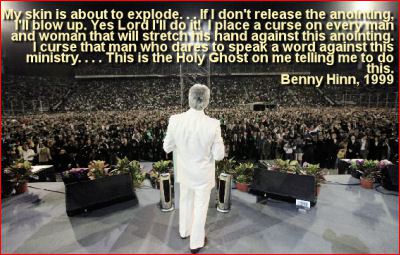
In recent decades, some of the most notorious charismatic church leaders have been doing just that. They continually warn their critics to back off or face the imminent danger of divine judgment. Claiming God’s stamp of approval, they wield Psalm 105:15 like a loaded gun: “Touch not [the Lord’s] anointed” (KJV).

And lest you think such a description to be hyperbole, the following clip from Benny Hinn is a spectacular example.

Hinn’s handling of Psalm 105:15, as well as the story of Saul and David, is hopelessly wrong on too many levels to address in one blog post.

For example we could discuss how Hinn utterly fails to understand Judas’s role in God’s sovereign plan for the crucifixion, while woefully underestimating the deity of Christ. We could invalidate Hinn’s warnings against criticism by pointing out the time Paul rebuked Peter—or when Hinn has publicly rebuked Joel Osteen, among others. Then there’s the problem of Hinn basing his threats upon the extra-biblical revelation of another false teacher (Kenneth Copeland).

What does it mean to “touch”?

But there is one simple, glaring error that explains all the other problems and exposes Hinn as the incompetent and unqualified Bible teacher that he is. When David says, “I will not stretch out my hand against [Saul], for he is the Lord’s anointed” (1 Samuel 24:10), he is explaining why he didn’t kill Saul, not why he didn’t criticize Saul. In fact, David was openly critical of Saul on numerous occasions. Moreover, 1 Samuel 24:10 is part of a larger discourse where David rebukes Saul face-to-face over his murderous scheming: “I have not sinned against you, though you are lying in wait for my life to take it. May the Lord judge between you and me, and may the Lord avenge me on you; but my hand shall not be against you” (1 Samuel 24:11–13). Even if Benny Hinn was “the Lord’s anointed”—he’s not—none of his critics are attempting to “touch” him in the sense described in 1 Samuel 24:10 (or Psalm 105:15; or 1 Chronicles 16:22).

Who are the anointed?

There is another fatal flaw in Hinn’s interpretation. He—and all those who follow this teaching—assume that only certain persons are “anointed.” They claim that pastors and self-appointed prophets and apostles have a unique anointing from God that immunizes them from criticism. But such a concept is foreign to Scripture. In short, the Bible teaches that all believers have an anointing from God.

In his first epistle, the apostle John explained what it means to be anointed as a New Testament believer. After warning his readers about antichrists who were coming to deceive them, John reminded them of their security because of Christ’s anointing:

These things I have written to you concerning those who are trying to deceive you. As for you, the anointing which you received from Him abides in you, and you have no need for anyone to teach you; but as His anointing teaches you about all things, and is true and is not a lie, and just as it has taught you, you abide in Him. (1 John 2:26–27)

The anointing John refers to is the indwelling of the Holy Spirit—a reality for all true Christians. John MacArthur explains the context and meaning of “anointing” as it appears in 1 John:

The false teachers who threatened John’s readers employed the terms for knowledge and anointing to describe their religious experience. They arrogantly saw themselves as possessing an elevated and esoteric form of divine knowledge, and as the recipients of a special, secret, transcendent anointing. That led them to believe they were privy to truth that the uninitiated lacked. John’s response, which was both a rebuttal to the antichrists and a reassurance to the believers, was to assert that, in reality, all true Christians have an anointing from the Holy One.

Because believers have received that anointing, they have the true understanding of God that comes exclusively through Jesus Christ (2 Corinthians 4:6), “in whom are hidden all the treasures of wisdom and knowledge” (Colossians 2:3). They do not need any secret, special, or transcendent understanding or esoteric insight. Anointing (chrisma) literally means “ointment” or “oil” (cf. Hebrews 1:9). In this text it refers figuratively to the Holy Spirit (cf. 2 Corinthians 1:21–22), who has taken up residency in believers at the behest of Jesus Christ, the Holy One (cf. Luke 4:34; Acts 3:14), and reveals through Scripture all they need to know (John 14:26; 16:13; 1 Corinthians 2:9–10). (John MacArthur, The MacArthur New Testament Commentary: 1–3 John (Chicago, IL: Moody Press, 2007), 102.)

The anointing we have as believers reveals the truth and therefore exposes the lies of false teachers. How ironic that the “anointing” Benny Hinn evokes to extort and manipulate churchgoers is actually our warning system to expose the self-serving deception of wolves like him.

Costi Hinn Interview

On Life & Theology With Costi Hinn by Adam Powers (original source here)
I recently had the privilege to sit down with Costi Hinn for a rare Publicans Blog interview. It was a pleasure to get to know the man and hear his heart for the Truth. He has been through a lot in his journey from heresy to faithfulness and we can learn much from him. He is not only a godly man, he’s a husband, father, and faithful pastor seeking to honor Christ in all he does. Our interview is below, enjoy!

Adam: Thank you for joining me for this interview. I don’t think many of our readers will know who you are, even though they may recognize your last name. Could you briefly share about yourself and how God has brought you where you are now?

Costi: Thanks for inviting me to join you Adam. From what I’ve read and seen thus far, “The Publicans” is a blessing to a lot of people.

My name is Costi, but what sticks out to most people is my last name – Hinn. I grew up in the Word of Faith and Prosperity gospel movements and was born and bred to be a tongue-speaking, name-it-and-claim-it, healthy and wealthy charismatic Christian. Some people may have heard of Benny Hinn. He’s my uncle. I grew up traveling globally with him and my father (his brother), and even worked with him when I was 18. My job was to be a “catcher” at the healing crusades. In other words, I was supposed to catch people when they were “slain in the spirit” by uncle Benny’s hand, breath, or infamous white jacket.

Though I had questions about the integrity of his ministry, and the legitimacy of the manifestations and healings occurring at the crusades, the pleasures of the prosperity lifestyle were enough to keep those questions at bay for a time. Luxurious accommodations, private air travel, and the finest things in life were, after all, the blessings of God for our faithful “ministry” work. I often justified any concerns with that belief.

Furthermore, any confusing teachings or things that my uncle said in contradiction to the Bible were never to be challenged. We are taught strictly that one is never to “touch the Lord’s anointed.” That meant no speaking out against or challenging any preacher – no matter what shady things they did behind closed doors or said in error from the pulpit. I was completely blind to the truth and didn’t dare challenge the system.

Eventually God saved me from my life of deception and suddenly the Bible that I had been reading most of my life made sense more than ever before! I experienced illuminating work of the Holy Spirit in a remarkable way. It was as though a light bulb just flipped on and it was obvious that I had been preaching, serving, and believing in a false version of Jesus Christ. Like many believers who have left false beliefs behind, it was a series of providential events in my life and exposure to faithful Bible teachers that led to my conversion.

I’ll never forget the day I wept bitterly over the life of hypocrisy that I had lived. I repented of my sin, and walked away from my false beliefs forever. It was at that time that I committed to being discipled by the pastor who had been used to show me my errors, and reading voraciously to grow in sound doctrine.

Shortly after, I enrolled in seminary. By God’s grace today I am fully committed to preaching the true gospel, and serving God’s people as a faithful under-shepherd for the rest of my life. I currently am on staff as an Associate Pastor at Mission Bible Church in Tustin, California. Our teaching pastor is my brother in the Lord and close friend, Anthony Wood. He’s the one who discipled me closely during my conversion.

Adam: Praise God! It’s encouraging to hear this. God has taken you through a complete theological renovation hasn’t He? I can only imagine the high cost you’ve experienced in turning away from what your family has taught you for so long. I’m guessing that you once rejected suffering as a lack of faith in God? If so, are you now encouraged by the numerous passages of Scripture teaching us that conflict and suffering will be a normal part of the Christian life?

Costi: Yes it’s been a total transformation of my desires, beliefs, and teachings. Only God could do such a thing. I wake up thankful every day that He graciously saved me. As far as my view on suffering in the past, it certainly was tied to Word of Faith theology. For example, if there is conflict in a person’s life the culprit could be the “spirit of strife” or they could be causing the conflict with negative confessions, negative thoughts, or lack of faith. The solution is (normally) to rebuke the devil, pray in the spirit (meaning tongues), speak positive confessions, or even sow a seed into a ministry that is seen as good soil. This couldn’t be further from the biblical view on suffering but I was honestly clueless.

Since my conversion, a passage that has greatly encouraged me during conflict and temporal suffering has been Matthew 10:26-39. Jesus really is the dividing line – and serving Him faithfully is not going to lead to a cake-walk through this life. Since taking a public stand for the true gospel, I’ve been received death threats, threats of physical violence, cursed for “touching the Lord’s anointed”, been called a heretic, and more. I count it a privilege to experience barely a fraction of what better men of women have gone through long before I was saved. Ultimately, we are all standing on the shoulders of faithful generations who have stood for Christ before we did. I never intended to be divided with my family over doctrine, but I refuse to compromise the gospel or turn a blind eye when a false Christ is being preached.

Adam: Amen and well said. There is a lot of deep and good stuff here to chew on. It all seems to come down to right theology and the importance of it before, in, and after seasons of suffering. Having been corrected by God theologically you have found deeper and truer wells of joy, even in the midst of difficulty. What would you say to someone who thinks theology is too controversial or too divisive and therefore avoids it trying to have a simple faith, perhaps saying, ‘I don’t do theology, I just want to love Jesus’?

Costi: First off, to avoid theology because it’s hard, controversial, or divisive, in favor of just “loving Jesus” and keeping faith simple, is like keeping your marriage superficial and shallow for fear of ever having conflict. It doesn’t make for true relationship and is not a true relationship. Jesus can’t be loved without conflict of some kind. We will either be offending someone, or conflicting with our own sinful nature that doesn’t want to submit to Him. He said He would divide people (Matthew 10:34-36), He said if you love Him you’ll obey Him (John 14:23), and He said He was the only way to heaven (John 14:6) – which means all other roads lead to hell. You literally can’t love Jesus without controversy of some sort.

Second, we all need to “do theology.” By definition theology simply refers to the study of knowing God and His nature. What better way to have a relationship and thrive in true worship of God than to know Him deeply! Theology also provides an amazing platform for growing in our faith. Wrestling with doctrines, being sharpened by sound teaching, and having our man-centered pride crushed by the notion that we exist for God’s glory is sanctifying for the Christian.

Lastly, some people have a bad taste in their mouth when it comes to theology because of bad experiences. One of my seminary professors told us a story of how in his day, all seminary students tended to do was debate over non-essentials and forget about the Great Commission. I think there is a lesson there. Still, theology is the furthest thing from mere head knowledge that puffs up. To quote R.C. Sproul, “The purpose of theology is not to tickle our intellects but to instruct us in the ways of God, so that we can grow up into maturity and fullness of obedience to Him. That is why we engage in theology.”

Adam: I love these three things you state here, they’re absolutely necessary to keep them in view in order to do life glorifying God. Regarding your third statement here, what are the theological essentials we must never compromise on and what are the theological non-essentials we can afford to be a bit more open handed with?

Costi: Essentials are things like the deity of Christ, the virgin birth, the Trinity, the inerrancy and sufficiency of Scripture, salvation by grace through faith, the resurrection of Christ, the return of Christ, and you could certainly add several more to this list under those headings but you get the picture.

As far as non-essentials, that list may look like the cessation or continuation of certain gifts, eschatology, ecclesiology, and church government structures. Again, several more could be added to this list but in general, these aren’t hills we should be dying on or spending our entire ministry solely focused on.

I would clarify this list by saying that many of these non-essentials can easily become essential issues when they infringe upon the deity of Christ, the work of the Holy Spirit, the sufficiency of Scripture or other excesses being witnessed in the church today. In other words, there is a huge difference between Wayne Grudem and Bill Johnson, though they both would be considered “continuationists.” One is a biblically sound theologian, the other is a false teacher.

Adam: Knowing the difference between what hills to die on and what hills to not die on is indeed extremely helpful. Thank you so much for your time with me and answering my questions. One last question: if you were stranded on an island and were allowed to have 5 books with you, what 5 would you take and why?

Costi: Thank you Adam. I’d take 1) My Bible for obvious reasons. 2) A Bible handbook because I enjoy background and context 3) J.C. Ryle: Prepared to Stand Alone by Iain Murray because Ryle is one of my heroes and I’d be stranded alone on an island 4) The Sovereignty of God by Arthur Pink for those days when I’d question why God allowed me to end up stranded on an island 5) Church History in Plain Language by Bruce Shelley because I never get bored of reading about where we’ve come from as Christians. We are just standing on the shoulders of faithful men and women who stood boldly for Christ long before us.

Adam: Well said sir, I praise God for the testimony of His grace in your life and will continue to pray for you and your ministry. May the Lord bless, increase, and spread His fame through you in the years to come. Thank you for taking time to spend with us Publicans 🙂

Costi: It was fun Adam – I enjoyed it! Keep up the great work at The Publicans.

Exposing The So Called “Prosperity Gospel”

On Friday, Sept. 8th I am scheduled to team up with Costi Hinn (Benny Hinn’s nephew, now converted and a Reformed Baptist Pastor in California) on Chris Arnzen’s “Iron Sharpens Iron” broadcast. The show’s theme for the two hours will be to bring the light of God’s word in exposing the Word of Faith movement. Please be in prayer that many will be drawn out of deception. Here’s a recent article Pastor Costi wrote:

Article: The Prosperity Gospel: A Global Epidemic by Costi Hinn (original source here)

Prosperity is hot topic in the church. Does God care if a pastor drives a nice car or lives in a nice home? Does God command that all who follow Him take a vow of poverty and starve their families in a protest of earthly comfort? Bible teachers sell millions of books and accumulate mass amounts of wealth, are they in the same league as other wealthy preachers? Some men will have deep convictions about attaining any measure of wealth, while others will be content use their wealth to give back to their church. Some will use their wealth to fund a child’s college tuition, or even scholarship a seminary student. Others will invest their wealth with the goal of giving even more away in the future.

Stewardship comes in all shapes and sizes but one thing doesn’t—God’s ability to weigh a man’s heart and motives. It is a man’s heart that God is most interested in and the gospel a man proclaims that God will judge most. When Heaven’s final bell rings and every man is recompensed according to his deeds, God will have the final say. The issue will not be whether that pastor took home a six-figure salary; the issue will be what that man taught and wrote while representing the gospel of Jesus Christ.

In this article, the prosperity gospel is placed front and center as one of the deadliest teachings in the world today. It has attached itself to the Bible, and to Jesus Christ—though it has no business doing so. Billions chase after it in search of stability and hope. Yet, all those who live and die trusting in the prosperity gospel for salvation will be left wanting in both this life, and the next.

What is Prosperity Gospel Theology?

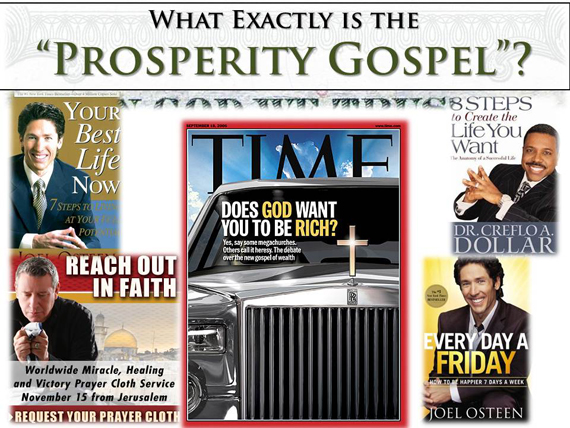
A very basic definition of the prosperity gospel can be described as this: God’s plan is for you to live your best life now. Health, wealth, and happiness are guaranteed on Earth for all who follow Jesus. Heaven is simply the eternal extension of your temporal blessings. The prosperity gospel’s theological foundation can be traced to at least three twisted versions of biblical truths. Prosperity preacher’s twist these in order to legitimize their version of the gospel.

Christ’s Atonement Means Abundant Life Now

The Bible clearly teaches that Christ died to atone for our sin (Isaiah 53) and that because of what He accomplished through His death and resurrection, we’ll experience the abundant life that He came to give us (John 10:10). Though we enjoy some benefits of the atonement now—such as the forgiveness of our sins and assurance of salvation—His atonement guarantees eternal promises that won’t be fully be realized until Heaven. We’ll receive a glorified body, there will be no death, no sin, no pain, no suffering, and no disease! Those are just a few of the eternal benefits of the atonement. Best of all, we’ll enjoy perfect fellowship with our God forever more.

Prosperity preachers teach that health and wealth were “paid for” in the atonement—just like sin. Therefore, this twisted interpretation allows them to teach people to expect complete healing, monetary riches, and total victory in every area of their earthly life. Instead of telling people to put faith in Jesus Christ and excitedly await their best life in heaven, they offer an empty gospel that promises people their best life now.

God’s Covenant with Abraham Means Inheritance Now

There’s an old children’s song that goes something like this: “Father Abraham had many sons. Many sons had Father Abraham. I am one of them, and so are you. So let’s just praise the Lord!” It’s used by many faithful Christians as a way to teach children about the great joy associated with God’s covenant with Abraham. Specifically speaking, the Abrahamic covenant (Genesis 12:1-3) has much to do with redemption, and God’s promises to His people. However, prosperity preacher’s use the covenant as a means to promise an inheritance (usually land and money) for their followers now. This has become their most common use for it.

In the prosperity gospel, God’s covenant with Abraham is littered with statements like, “If you’ll sow a seed of faith like Abraham, God will bless you”, or “If you speak it and live it by faith like Abraham, God will prosper you.” These type of statements are a way to present any temporal or eternal inheritance that awaits God’s people as a blanket guarantee.

If these twisted versions of the Abrahamic covenant were true, then the millions who trust in the prosperity gospel would become millionaires and land-owners overnight. Thus far, it is mainly the prosperity preachers who are benefitting from the offerings of those they deceive.

Faith is a Force You Can Use to Control God

The Bible teaches that Christians are justified by faith (Romans 5:1), that Christians overcome the world through faith (1st John 5:5), and that Christians live by faith because of what Christ has done (Galatians 2:20). The list of verses on the blessings of faith is endless! Faith pleases God, is directly related to salvation, and is the evidence of trust in God for the believer.

Prosperity gospel preachers depart from this orthodox teaching on faith when they teach that faith is a force you can use to get what you want from God. In other words, you were able to obtain salvation and justification by faith, so why can’t you obtain a Ferrari the same way? Prosperity theology is centered on the notion that right believing, right thinking, and right speaking are all linked with faith in order to create physical blessings. This is where the word of faith movement also hybrids with the prosperity gospel.

How Did the Prosperity Gospel Get So Popular?

Long before the Catholic Church was selling indulgences, the correlation between ministry, money, and manipulation was crystal clear. The Bible even describes Simon the Sorcerer (Acts 8:9-24) as a magician who thought he could buy the gift of God with money. Specifically speaking, the modern day roots of the prosperity gospel go back approximately seventy years. It was during the 1950’s that this divergent gospel pioneered its way into the mainstream evangelical scene and nobody at the time could have imagined that it would spread across the globe.

Born in 1918, Granville “Oral” Roberts was, in many ways, the lead prosperity pioneer. He went from being a local pastor, to building a multimillion dollar empire based on one major theological premise: God wanted people to be healthy and wealthy.

Oral Roberts didn’t mince words about his version of Jesus or the gospel. He adamantly taught and defended his belief that Jesus’ highest wish is for us to prosper materially and have physical health equal to His peace and power in our soul. He twisted the Bible to make his point and would teach that it was Jesus who said, in 3rd John 1:2, “Beloved, I wish above all things that thou may prosper and be in health, even as thy soul prospereth,” when in fact that was the Apostle John’s loving way of greeting his readers at the time. John’s greeting is comparable to the first line of many of our modern day e-mails that begin with, “Hi! I hope everything is going well for you.” Continue reading