
 “Many atheistic books and blogs seethe with anger. Remarkably, the authors do not limit their anger to Christians. They seem most livid with God. I don’t believe in leprechauns, but I haven’t dedicated my life to battling them. I suppose if I believed that people’s faith in leprechauns poisoned civilization, I might get angry with members of leprechaun churches. But there’s one thing I’m quite sure I wouldn’t do: I would not get angry with leprechauns. Why not? Because I can’t get angry with someone I know doesn’t exist.” – Randy Alcorn, If God Is Good
“Know this! They (false prophets) are the judgment of God upon a wicked defiled people who although they have a knowledge of God they do not want him. And so God sends them the teachers that they themselves desire.” – Paul Washer
“Among these tenets [of the Pelagians]…is the evil and tenuous seed of the others, namely, that God’s grace is given in answer to men’s merits…In this manner, grace is no longer grace, because, if it is rendered for merit and does not itself cause what is good in man, then its name is meaningless.” Prosper of Aquitaine, 5th Century
“When we see that others are saved, we should not make so bold to say that they were worthy of salvation, since of course God could have condemned them in justice had He so chosen. But the reason why He does not save all or saves some in preference to others, there is no need for us to inquire, nor is it possible for us to find out. Without considering the reason for that discrimination, it should be enough for us to know that mercy does not do away with justice, nor justice with mercy, in Him who condemns no one except in justice and saves no one except through mercy.” – Prosper of Aquitaine, 5th Century
“The Holy Spirit has brought us into an inseparable union with Christ — one that is as secure as the Father’s love for the Son, as sure as God’s love is for himself.” – John Piper
“Some make man God’s co-worker, to ratify election by his consent. Thus, according to them, man’s will is superior to God’s plan. As if Scripture taught that we are merely given the ability to believe, and not, rather, faith itself!” – John Calvin
“Bold-hearted men are always called mean-spirited by cowards.” – C. H. Spurgeon
“If you want to follow Jesus because He’ll fix your marriage, if you want to follow Jesus because He’ll give you a better life, that’s idolatry. Follow Christ for the sake of Christ; He is worthy!” – Paul Washer
“Faith is the means by which the righteousness of Christ is given to us.” – R.C. Sproul
“The Scriptures should be read with the aim of finding Christ in them. Whoever turns aside from this object, even though he wears himself out all his life in learning, he will never reach the knowledge of the truth.” – John Calvin
“The most effective sermons are those which make opposers of the Gospel bite their lips and gnash their teeth.” – C. H. Spurgeon
“Christians have a new identity. We are no longer ‘in Adam’ but ‘in Christ’; no longer in the flesh but in the Spirit…” – Sinclair Ferguson
“The true gospel…stands before the throne of God declaring, ‘Jesus did it all.'” – R.C. Sproul Jr
“The gospel is the good news that God bought for us the everlasting enjoyment of God.” – John Piper
“When God calls, it has the intensity of a shout and the authority of a summons. When He calls, He secures His own desired results.” – Steven Lawson
“If we refuse mercy here, we shall have justice in eternity.” – Jeremy Taylor
“We are not called to make a crowd of worldly folk happy–even worldly evangelistic folk happy–but so to labour amongst them that, through many tribulations, discouragements and misunderstandings, we form a faithful people of God, however small a remnant of the total congregation that may be.” – William Still in The Work of a Pastor
“You see no beauty in any action that you do. All seems imperfect, blemished, and defiled. You are often sick at heart of your own shortcomings. But now know, that Jesus can see some beauty in everything that you do from a conscientious desire to please him. His eye can discern excellence in the least thing which is a fruit of his own Spirit. He can pick out the grains of gold from amid the dross of your performances, and sift the wheat from amid the chaff in all your doings. Your endeavors to do good to others, however feeble, are written in his book of remembrance. He does not forget your work and labor of love, however little the world may regard it.” (J.C. Ryle, Holiness, pg.228)
“In truth, from the top of his head to the bottom of his feet, lost mankind is completely infected by sin.” – Steven Lawson
“The only righteousness that meets the requirements of the Law is the righteousness of Christ.” – R.C. Sproul
“A sinner is justified as soon as he, or she, believes in the Lord Jesus Christ. God pronounces us righteous immediately the instant we place our trust in Christ as the Saviour whom God sent into the world to live and die for us. There is no place whatever in justification for the merit, so-called, of our own good works. Neither the sacraments, nor prayers, nor devotions, nor good works of any kind enter into a sinner’s justification before God. This is the clear teaching of the Bible and it is essential that we do not allow any false teaching to spoil our understanding. The great Apostle Paul states: ‘Therefore we conclude that a man is justified by faith without the deeds of the law’ (Rom. 3:28). We see from these words that nothing but faith justifies us. By ‘works of the law’ Paul means our observance of the Moral Law, the Ten Commandments. The Ten Commandments cannot save us. Our own good works cannot justify us, either in whole or in part.” – Maurice Roberts, ‘Finding Peace With God – Justification Explained’
“There is no little sin, because no little God to sin against.” – Thomas Brooks
“There is more evil in the least sin than in the greatest affliction.” – Thomas Brooks
“Take this for your motto; wear it in your heart; keep it in your eye; have it often in your mouth, till you can find something better. The cross of Christ is the tree of life and the tree of knowledge combined. Blessed be God! there is neither prohibition nor flaming sword to keep us back; but it stands like a tree by the highway side, which affords its shade to every passenger without distinction.” – John Newton
“Serve God with integrity, and if you achieve no success, at least no sin will lie upon your conscience.” – C. H. Spurgeon
“The character of God is the foundation of all holy joy, as his nature is the basis of all right theology, . . .” – William S. Plumer, (1872). Commenting on Psalm 119:137 in his book “Studies in the Book of Psalms: Being a Critical and Expository Commentary, with Doctrinal and Practical Remarks on the Entire Psalter” (p. 1079). Philadelphia: J. B. Lippincott Company.
 Yes. This, of course, is not what we typically hear about this text. We are told, for instance, that Jesus was tapping into the first use of the law rather than the third here, that rather than telling the young man what he must do to inherit eternal life He was demonstrating that despite the man’s claims, he had not in fact kept the ten commandments. Jesus here is saying, “Well, let’s look at commandment one. Do you have any gods before me? Money perhaps?” This is all true and good exegesis of the text.
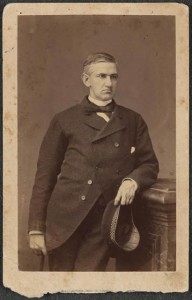 Repost from Sept. 29, and were good friends of D.L. Moody and Ira Sankey for many years. Mr. Spafford’s children had come to Christ through the influence of Ira Sankey’s music and efforts with the children of Chicago. Shortly before the Great Chicago Fire of October 8th, 1871, the Spafford’s son died and the family went into deep mourning.