 Scripture is explicit then in saying that Jesus died for His people, His sheep, His friends, His Church, securing eternal life for them in doing so.
However, many object to this understanding of Christ’s work on the cross, not because of the many clear texts that teach it, but because other verses seem, a least at first glance, to strongly deny this. For instance, 1 John 2:2, speaking of Jesus, states, “He is the propitiation for our sins, and not for ours only but also for the sins of the whole world.”
I can certainly see how someone would use this verse to undermine all I have been saying above. Yet scripture, I believe, is not contradictory to itself. There is one Divine Author of Scripture and He does not contradict Himself.
So how are we to understand 1 John 2:2?
I have written elsewhere about the principles of correct interpretation. There is only one correct interpretation of Scripture. Though there may be many applications of a verse, it only means what it was intended to mean when it was written.
In my article entitled “Playing Marbles with Diamonds” I refer to twelve principles of biblical interpretation (hermeneutics), two of which would apply here:
1. Consider the Author – who wrote the book? (what was his background, language, culture, vocation, concerns, education, circumstance, what stage of life?)
2. Consider the Audience (why was the book written? who was the audience? what would these words have meant to its original recipients?)
I quote again Dr. James White, when he wrote, “Remember when you were in school and you had to take a test on a book you were assigned to read? You studied and invested time in learning the background of the author, the context in which he lived and wrote, his purposes in writing, his audience, and the specifics of the text. You did not simply come to class, pop open the book, read a few sentences, and say, “Well, I feel the author here means this.” Yet, for some odd reason, this attitude is prevalent in Christian circles. Whether that feeling results in an interpretation that has anything at all to do with what the original author intended to convey is really not considered an important aspect. Everyone, seemingly, has the right to express their “feelings” about what they “think” the Bible is saying, as if those thoughts actually reflect what God inspired in His Word. While we would never let anyone get away with treating our writings like this, we seem to think God is not bothered, and what is worse, that our conclusions are somehow authoritative in their representation of His Word.”
A third principle I mentioned in the article relates to the concept of considering the author’s context. This refers to looking at all of a person’s writings – John’s writings, Paul’s writings, Luke’s writings, etc..
When we look elsewhere in John’s writings we notice in his Gospel an exact parallel in John’s use of words, which give us a great deal of insight as to what he (John) was referring to.
In John’s Gospel, chapter 11, verses 51-52, John wrote these words, “he prophesied that Jesus would die for the nation, and not for the nation only, but also to gather into one the children of God who are scattered abroad.”
In chart form, the parallel with 1 John 2:2 becomes clear:
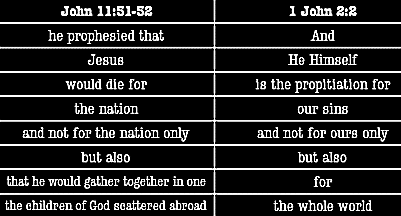
Phil Johnson (who provided this helpful chart) writes, “There is little doubt that this is how John’s initial audience would have understood this expression. “The whole world” means “people of all kinds, including Jews, Gentiles, Greeks, Romans, and whatnot” as opposed to “ours only” i.e., the Jewish nation. What the apostle John is saying in the John 11 passage is particularly significant: Christ died so that he might gather “the children of God” the elect, from the whole world.”
I believe therefore that rather than undermining the case for Christ’s death for His elect sheep, 1 John 2:2 actually affirms it. When we understand the verse in its Johannine context (the writings of the Apostle John) then the correct interpretation becomes very clear.
In Hebrew culture, it is the father who chooses a bride for his son. In the same way, the bride of Christ was chosen by the Father, then given to the Son, and all in this number are without fail raised up to eternal life (John 6:37-39). The Son loses none of those given to Him by the Father.
A second objection to this, that needs to be dealt with are the words of Hebrews 2:9 which say,
“But we see him who for a little while was made lower than the angels, namely Jesus, crowned with glory and honor because of the suffering of death, so that by the grace of God he might taste death for everyone.”
Surely “everyone” means everyone, right?
Well usually, yes, but not always. This in fact has to be determined by the context in which the words are spoken. For example, if a teacher asks his class of students, “Is everyone present?” he is not asking if everyone on the planet is present in the room, but rather all the students enrolled in the class. That’s how the word everyone is used, and so it is the context in which the words are used that determine what is meant by the words. The question in Hebrews 2:9 is whether “everyone” refers to all human beings without distinction, or whether it refers to everyone within a certain group.
To determine the answer to that question, lets now read Hebrews 2: verses 9 -10 together:
9 But we see him who for a little while was made lower than the angels, namely Jesus, crowned with glory and honor because of the suffering of death, so that by the grace of God he might taste death for everyone.
10 For it was fitting that he, for whom and by whom all things exist, in bringing many sons to glory, should make the founder of their salvation perfect through suffering.
Immediately after saying that by the grace of God Christ tasted death for everyone, the writer of Hebrews explains that God’s intention or design in the cross of Christ was to “bring many sons to glory” (verse 10). Christ tasted death for everyone, because it seemed fitting to God that the way to lead His children to glory was through the suffering and death of Christ.
The “everyone” of verse 9 refers to the “everyone” of the sons being led to glory in verse 10.
Verses 11 and 12 confirm this is indeed the context for the use of “everyone” (in verse 9):
11 For he who sanctifies and those who are sanctified all have one origin. That is why he is not ashamed to call them brothers,
12 saying, “I will tell of your name to my brothers; in the midst of the congregation I will sing your praise.”
13 And again, “I will put my trust in him.” And again, “Behold, I and the children God has given me.”
Following the thread of these verses, the sons God is leading to the glory of heaven through the death of Christ are now called the brothers of Christ. It was for everyone of these that Christ tasted death.
Hebrews 9:15 declares, “Therefore He is the mediator of a new covenant, so that those who are called may receive the promised eternal inheritance, since a death has occurred that redeems them from the transgressions committed under the first covenant.”
According to this text who does it redeem?
Answer: The called.
Christ’s work on the cross achieved all of the Divine purposes for it. The intent of the design was not merely to try to save all, but when all was said and done, the plan could fail for many because of that stubborn thing called “free will,” with the Savior sad for all eternity because many He died for received no benefit for all His labor. No, He died a satisfied Savior, giving Himself for His friends, for His sheep, for His people, for His Church, and fully accomplished the work of redemption for all in this number.
All who are particularists (who believe that not everyone will be saved – that some people will in fact spend eternity in hell) believe in some type of limitation to the atonement of Christ. The Arminian limits its power, for it only becomes effectual through man’s cooperation; the Reformed person limits its extent.
As C. H. Spurgeon said, “The doctrine of Holy Scripture is this, that inasmuch as man could not keep God’s law, having fallen in Adam, Christ came and fulfilled the law on the behalf of his people; and that inasmuch as man had already broken the divine law and incurred the penalty of the wrath of God, Christ came and suffered in the room, place, and stead of his elect ones, that so by his enduring the full vials of wrath, they might be emptied out and not a drop might ever fall upon the heads of his blood-bought people.” (Sermon 310 – “Christ our Substitute – New Park Street, Southwark)
Elsewhere he preached, “I had rather believe a limited atonement that is efficacious for all men for whom it was intended, than an universal atonement that is not efficacious for anybody, except the will of man be joined with it.” (Sermon number 173 – Metropolitan Pulpit 4:121)
In another sermon, Spurgeon said, “Once again, if it were Christ’s intention to save all men, how deplorably has He been disappointed, for we have His own evidence that there is a lake that burneth with fire and brimstone, and into that pit must be cast some of the very persons, who according to that theory, were bought with His blood. That seems to me a thousand times more frightful than any of those horrors, which are said to be associated with the Calvinistic and Christian doctrine of particular redemption.” (C. H. Spurgeon – Sermon 204 – New Park Street Pulpit 4:553)
This doctrine of the particular redemption or definite atonement of Christ, speaks of God’s design in the atonement, and who it was God was intending to save when Christ went to the cross. Christ died as a substitute who bore the full weight of God’s wrath on behalf of His people, paying the penalty for their sin. Christ intended to save His sheep and actually secured everything necessary for their salvation. The gift of faith is infallibly applied by the Spirit to all for whom Christ died, thereby guaranteeing their salvation.
Christ did not build a wide bridge that merely went most of the way from heaven to earth, requiring all who were willing to jump the final few yards. It was a narrow cross shaped bridge, that extended all the way from heaven to earth, with Jesus the Savior, walking the bridge, finding His sheep on the other side in spiritual death, raising them to life, and carrying each one safely to heaven in His arms.
Salvation is by grace alone, through faith alone, because of Christ alone, based on the Scripture alone, to the glory of God alone! Christ’s all sufficient work affirms this!

 Question: If Christ actually “saved” the elect on the cross, isn’t it true to say that the elect are born already justified and there is no need to exercise faith?
 There are also Scriptures that clearly state that Christ gave Himself for His Church: