
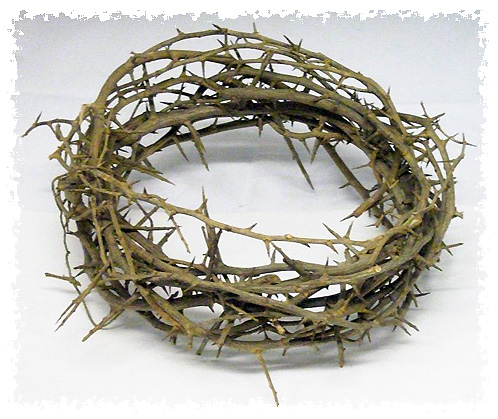
Made to be sin for us?

crown_of_thornsNathan Busenitz serves on the pastoral staff of Grace Church and teaches theology at The Master’s Seminary in Los Angeles. In an article entitled, “Did Jesus become the literal embodiment of sin, or take on a sin nature, or become a sinner when He died at Calvary?” I very much appreciate his sound Biblical answer. He writes:

The heart of the question centers on Paul’s statement in 2 Corinthians 5:21: ”He made Him who knew no sin to be sin on our behalf, so that we might become the righteousness of God in Him.”

In what sense did Jesus become “sin on our behalf”? Does that phrase mean that Jesus literally became a sinner on the cross?

There are some today who teach that Jesus became a sinner (or took on a sin nature) at the cross. Benny Hinn is one such advocate. In a TBN broadcast, Hinn exclaimed:

“He [Jesus] who is righteous by choice said, ‘The only way I can stop sin is by me becoming it. I can’t just stop it by letting it touch me; I and it must become one.’ Hear this! He who is the nature of God became the nature of Satan when he became sin!” (Benny Hinn, Trinity Broadcasting Network, December 1, 1990)

Prosperity-preacher Kenneth Copeland echoes those same teachings. In Copeland’s words:

“The righteousness of God was made to be sin. He accepted the sin nature of Satan in His own spirit. And at the moment that He did so, He cried, ‘My God, My God, why hast thou forsaken me?’ You don’t know what happened at the cross. Why do you think Moses, upon instruction of God, raised the serpent upon that pole instead of a lamb? That used to bug me. I said, ‘Why in the world would you want to put a snake up there; the sign of Satan? Why didn’t you put a lamb on that pole?’ And the Lord said, ‘Because it was a sign of Satan that was hanging on the cross.’ He said, ‘I accepted, in my own spirit, spiritual death; and the light was turned off.’” (Kenneth Copeland, “What Happened from the Cross to the Throne,” 1990, audiotape #02-0017, side 2)

On another occasion, Copeland reiterates that same teaching: Continue reading

Was the Cross “Sufficient for All”?

by Jim Ellis

Among those who generally accept the doctrine of a definite or limited atonement, it is often heard by way of explanation that “the atonement is sufficient for all, but efficient only for the elect.” In fact this terminology may be found in some of the most respected Reformed theologians such as Hodge, Shedd, Buswell and others. While no Calvinist would deny the intrinsic sufficiency of Christ’s death for the redemption of all men had God so designed and intended it, I find the use of such phraseology dubious.

Maintaining the infinite intrinsic value of Christ’s death is not the same as saying “He died sufficiently for all men and efficiently only for the elect.” The latter seems to ascribe to Christ a purpose or intention to die in the place of all men, and to benefit all by the proper effects of His death as an atonement or propitiation. This inference is not supported by a scriptural view of the nature of the atonement or by the Calvinistic understanding of limited atonement. My purpose here is to show that this phraseology is ultimately meaningless and fails to adequately perceive the nature of the atonement. In the final analysis, it does not distinguish a definite atonement from a general or universal atonement1.

Why is the term “sufficient for all” used in discussing the atonement?

It is with some interest that we look at some of the probable reasons why such language has become rather common in discussions of this matter. Primarily, the use of this terminology seems to be an attempt to soften the impact of the doctrine of limited atonement on the natural mind, for it is indeed no simple matter of understanding. Most people don’t want a theological treatise as an explanation, they just want a simple answer (and in no more than three minutes, if you please). So we say, “His death was sufficient for all, but efficient only for the elect.” This may be brief and easy to remember, but accuracy and integrity have been sacrificed for the sake of brevity. Its use anticipates objections to the doctrine and pretends to diffuse those objections by declaring a universal application of the atonement. Rather than providing a real answer, however, it only deflects the potential objections and often leaves the questioner unsatisfied or at least scratching his head, wondering what it really means.

This statement has been used by good solid Calvinists who have no intention of giving way on the doctrine of limited atonement, but that does not make it valid or advisable phraseology. There appear to be several underlying reasons why this statement has been used. I believe the following are representative of those reasons: Continue reading

Unconditional Election and Particular Redemption

every six or seven weeks or so, at the Apologia Church in Tempe, Arizona. The theme has been “The Doctrines of Grace.” The last two sessions are now available to hear online.

The first teaching is on “Unconditional Election” and starts at the 35 minute, 28 second mark here.

The second teaching is on Limited Atonement (or perhaps better expressed as “Definite Atonement” or “Particular Redemption”). The teaching begins at the 36 minute, 25 second mark here.