
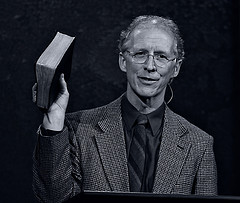
 By John Piper: Website: www.desiringGod.org. Email: [email protected]. Toll Free: 1.888.346.4700.
Sometimes readers of the Bible see the conditions that God lays down for his blessing and they conclude from these conditions that our action is first and decisive, then God responds to bless us.
That is not right.
There are indeed real conditions that God often commands. We must meet them for the promised blessing to come. But that does not mean that we are left to ourselves to meet the conditions or that our action is first and decisive.
Here is one example to show what I mean.
In Jeremiah 29:13 God says to the exiles in Babylon, “You will seek me and find me, when you seek me with all your heart.” So there is a condition: When you seek me with all your heart, then you will find me. So we must seek the Lord. That is the condition of finding him.
True.
But does that mean that we are left to ourselves to seek the Lord? Does it mean that our action of seeking him is first and decisive? Does it mean that God only acts after our seeking?
No.
Listen to what God says in Jeremiah 24:7 to those same exiles in Babylon: “I will give them a heart to know that I am the Lord, and they shall be my people and I will be their God, for they shall return to me with their whole heart.”
So the people will meet the condition of returning to God with their whole heart. God will respond by being their God in the fullest blessing. But the reason they returned with their whole heart is that God gave them a heart to know him. His action was first and decisive.
So now connect that with Jeremiah 29:13. The condition there was that they seek the Lord with their whole heart. Then God will be found by them. But now we see that the promise in Jeremiah 24:7 is that God himself will give them such a heart so that they will return to him with their whole heart.
This is one of the most basic things people need to see about the Bible. It is full of conditions we must meet for God’s blessings. But God does not leave us to meet them on our own. The first and decisive work before and in our willing is God’s prior grace. Without this insight, hundreds of conditional statements in the Bible will lead us astray.
Let this be the key to all Biblical conditions and commands: “Work out your own salvation with fear and trembling, for it is God who works in you, both to will and to work for his good pleasure.” (Philippians 2:12-13). Yes, we work. But our work is not first or decisive. God’s is. “I worked harder than any of them, though it was not I, but the grace of God that is with me” (1 Corinthians 15:10).
 There are two ditches on the side of the road of Christian life. One ditch is lawlessness (antinomianism), and on the other side, the ditch of a harsh and hostile legalism that binds spiritual chains around us. Both of these extremes should be avoided always. Yet there is a road to walk if progress in sanctification is to be made, and as the saying goes, to fail to plan is to plan to fail.
 Justification is a legal court room term defined as the act of God when He declares a person just or righteous in His sight. This takes place the moment a sinner places their trust in the Savior, the Lord Jesus Christ. For the sinner who has faith in Jesus, God pronounces the sentence “I find you not guilty! I reckon (I count, I declare) you righteous in My sight, and you and I are forever at peace with each other. All of your sins were transferred to your sin bearing Substitute, the Lord Jesus Christ, who took the full brunt of My holy wrath for you, and what has been transferred to your account is the righteousness of My Son, who lived not only a sinless life, but a life fully pleasing to Me. This very real righteousness is yours now and forever.”