Its the world’s smallest country, has around 500 citizens, its own king and, well.. its very complicated, as this video explains:
Vatican City Explained
Reply

Augustus Nicodemus Gomes Lopes is a Presbyterian minister, theologian, professor, international conference speaker, and bestselling author. Augustus holds a BA in theology from North Presbyterian Seminary in Recife, Brazil, a ThM in New Testament from the Reformed University of Potchefstroom, South Africa, and a PhD in biblical interpretation from Westminster Theological Seminary in Philadelphia. He is also an associate pastor of the Presbyterian Church of Santo Amaro in São Paulo.
In an article entitled, “From Peter to Francis: A Biblically Misguided Route” found here, he writes:
The resignation of Pope Benedict XVI and the election of Argentine Cardinal Jorge Mario Bergoglio to replace him brings up, once again, the Roman Catholic claim that the pope is the successor of the apostle Peter as the head of the church of Jesus Christ here on earth. To the Catholic, Francis now sits on Peter’s throne.
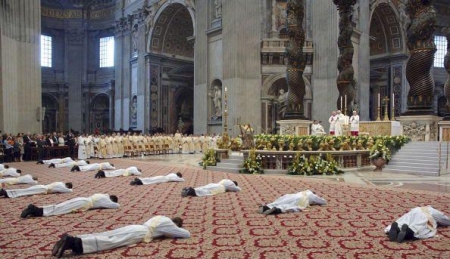 The first question to be determined, of course, is: Did Peter have a throne? If he really was the early church’s proto-pope, then it’s reasonable to assume he had a throne—or at least something like it. And if he left a successor, who in turn left a successor and so on, then I suppose it’s reasonable to say Francis is now the throne’s rightful owner. This is the first question to consider since the mere fact of the office’s existence deserves to be examined in light of the Word of God. After all, Catholics and Protestants take Scripture to be authoritative and infallible. A concept with such incredible import, then, must have some kind of biblical foundation. But does it?
To be fair, it’s true the Lord Jesus distinguished Peter from the other disciples on several occasions. He was among the first to be called (Matt. 4:18) and his name always appears first on lists of the Twelve (Matt. 10:2, Mark 3:16). Jesus includes him among his closest disciples (Matt. 17:1). It was to Peter that Jesus said, “Feed my sheep” (John 21:17), and it was to Peter that he spoke the famous words: “You are Peter, and on this rock I will build my church, and the gates of hell shall not prevail against it. I will give you the keys of the kingdom of heaven, and whatever you bind on earth shall be bound in heaven, and whatever you loose on earth shall be loosed in heaven” (Matt 16:18-19).
However, it’s not apparent in Scripture or church history that Peter had preeminence over his colleagues or other Christians. It’s also not apparent that his fellow apostles, other local churches, or even Peter himself recognized his role in the church as exclusive in its representation of Jesus Christ. Certainly he was respected and revered as a leader, but these readily admitted realities do nothing to bolster Rome’s contention that the pope functions as an infallible mouthpiece of God.
The Bible is clear on this point. The apostle Paul felt perfectly comfortable confronting and scolding Peter publicly when he acted improperly toward Gentile believers in Antioch (Gal. 2:11-14). Moreover, it was the apostle James—not Peter—who served as the leader at the Jerusalem Council (Acts 15) and when a decision was made it was sent on behalf of the “apostles and elders.” Clearly, first-century Christians didn’t esteem Peter in a separate category.
Matthew’s Gospel corroborates this point, such that Jesus’ promises to Peter were never understood as an exclusive delegation to Peter alone. In fact, just a few chapters later Matthew applies the same responsibility to the entire congregation:
If your brother sins against you, go and tell him his fault, between you and him alone. If he listens to you, you have gained your brother. But if he does not listen, take one or two others along with you, that every charge may be established by the evidence of two or three witnesses. If he refuses to listen to them, tell it to the church. And if he refuses to listen even to the church, let him be to you as a Gentile and a tax collector. Truly, I say to you, whatever you bind on earth shall be bound in heaven, and whatever you loose on earth shall be loosed in heaven. Again I say to you, if two of you agree on earth about anything they ask, it will be done for them by my Father in heaven. For where two or three are gathered in my name, there am I among them. (Matt. 18:15-18)
It’s instructive to note how Paul viewed Peter. Along with Apollos and himself, Paul views Peter as a mere instrument through which God accomplishes his work (1 Cor. 3:22). He certainly recognizes Peter as a leader in the Jerusalem church—but among other apostles (Gal. 1:18-19). He mentions they were pillars of the church, but then proceeds to narrate the episode in which he openly confronted Peter (Gal. 2:11). Quite revealing is what Paul writes about his own calling: “For he who worked through Peter for his apostolic ministry to the circumcised worked also through me for mine to the Gentiles” (Gal. 2:8). According to Paul, then, the same Spirit enables these two apostles; no apostolic hierarchy exists. Continue reading
 Dr. John Gerstner, in his “Primer on Roman Catholicism” writes:
Rome denies that the Bible is a self-interpreting revelation. The Bible declares itself to be self-explanatory. This is called the doctrine of the perspicuity of the Scriptures (the see-through-ableness of the Scripture). It may be understood in its own light. What is obscure in one passage will be clearer in another. What is incomplete here is completed there. What is a figure in one place is a commentary in another.
Rome has substituted for the doctrine of the perspicuity of the Scriptures the doctrine of the audacity of the Church. The Bible says that those who run may read; Rome says that those who run to her may read. The Bible says of the Bereans who searched the Scriptures that they were noble; Rome says of the Reformers who searched the Scriptures that they were heretics. The Scriptures say, “Study to show thyself approved unto God, a workman that needeth not to be ashamed, rightly dividing the word of truth,” 2 Timothy 2:15. Rome says, “Study to show thyself a slave obediently accepting the word of Rome.”
“But,” the Roman Catholic church maintains, “the Word of God needs an interpreter.”
“If so,” replies the Protestant church, “the word of the pope also requires an interpreter.” If the Bible must be interpreted by the Church in order to render its meaning certain, then the interpretation of the Church will have to be interpreted by another authority to make its meaning certain, and then there will need to be an interpreter of the interpreter, and so on ad infinitum.
Now if the Romanist replies, “Where there are divergent views on the Bible teaching there must be some authoritative decision,” we will agree. Nor do we only agree. Our various Protestant church courts actually provide authoritative interpretations on most points when such decisions are necessary. But there is a difference between authoritative and infallible decisions. Compare, for example, the necessity for an authoritative interpretation of the Constitution. A Supreme Court performs that task. Yet what American believes the Supreme Court is infallible? Still, its decisions prevail as a matter of necessity. On occasions the Court may be “stacked” and its interpretations biased. In the long run, however, the people of this land believe an authoritative interpreter necessary, but never do they regard it as infallible. The Constitution remains the law of the land, not the Supreme Court. Likewise, the Bible remains the law of the Christian, not the Church.
The Roman Catholic church proclaims itself to be “the pillar and ground of the truth,” since 1 Timothy 3:15 says that the church is the pillar and ground of the truth. But that verse does not say that the Roman Catholic church is the pillar and ground of the truth; in fact, the Roman Catholic church did not even exist when this verse was penned. Additionally, where did the Church get the idea that it is the pillar and ground of the truth? From the Bible! It is the Bible which is the basis of the church’s authority, not the church which is the basis for the Bible’s authority. The Bible is the pillar on which the church rests; the church is not the pillar on which the Bible rests. Incidentally, the expression that the church is the pillar and ground of the truth does not point to a pillar on which truth rests, but to a pillar on which truth was posted for public announcement in antiquity. In other words, it refers to the church as witness to the truth and not the basis of it.
The Protestant church has provided for authority so that decisions can be rendered when necessary, but has avoided the error of investing this authority with infallibility. The Protestant church, not being infallible, can err, has erred, will err. There is one error, however, which it has not made and that is the greatest of them all—the error of thinking it cannot err.