 Here is an excerpt from correspondence I had with a Roman Catholic named Steve today – I will put my words in bold so that it is easy to follow along:
John Samson: Luther argued that the Bible is our sole ultimate authority.
Steve: I would say he (Martin Luther) argued that his interpretation of his particular version of the Bible was the ultimate authority.
John Samson: and I would strongly disagree with what you would argue for. I would argue for the perspecuity of Scripture – that in its essential message, it is clearly understood. The Scriptures on the subject of salvation are clear to anyone who will read the Bible.
2 Tim 3: “14 But as for you, continue in what you have learned and have firmly believed, knowing from whom you learned it 15 and how from childhood you have been acquainted with the sacred writings, which are able to make you wise for salvation through faith in Christ Jesus.”
I also do not need a so called infallible council to tell me that “Therefore we conclude that a man is justified by faith apart from works of the law” (Romans 3:28) actually means “a man is justified by faith along with works of the law.”
Steve: James 2:24 (AKJV) Ye see then how that by works a man is justified, and not by faith only.
As St. Augustine said, “If you believe what you like in the gospels, and reject what you don’t like, it is not the gospel you believe, but yourself.”
John Samson: I do not pick and choose what I believe. I believe ALL of Scripture and seek to rightly interpret it by means of the context in which those verses occur…
“In Romans 3:28 Paul says, “For we maintain that a man is justified by faith apart from works of the Law.” In James 2:24 we read, “You see that a man is justified by works, and not by faith alone.” If the word justify means the same thing in both cases, we have an irreconcilable contradiction between two biblical writers on an issue that concerns our eternal destinies. Luther called “justification by faith” the article upon which the church stands or falls. The meaning of justification and the question of how it takes place is no mere trifle. Yet Paul says it is by faith apart from works, and James says it is by works and not by faith alone. To make matters more difficult, Paul insists in Romans 4 that Abraham is justified when he believes the promise of God before he is circumcised. He has Abraham justified in Genesis 15. James says, “Was not Abraham our father justified by works, when he offered up Isaac his son on the altar?” (James 2:21). James does not have Abraham justified until Genesis 22.
This question of justification is easily resolved if we examine the possible meanings of the term justify and apply them within the context of the respective passages. The term justify may mean (1) to restore to a state of reconciliation with God those who stand under the judgment of his law or (2) to demonstrate or vindicate.
Jesus says for example, “Wisdom is justified of all her children” (Lk 7:35 KJV). What does he mean? Does he mean that wisdom is restored to fellowship with God and saved from his wrath? Obviously not. The plain meaning of his words is that a wise act produces good fruit. The claim to wisdom is vindicated by the result. A wise decision is shown to be wise by its results. Jesus is speaking in practical terms, not theological terms, when he uses the word justified in this way.
How does Paul use the word in Romans 3? Here, there is no dispute. Paul is clearly speaking about justification in the ultimate theological sense.
What about James? If we examine the context of James, we will see that he is dealing with a different question from Paul. James says in 2:14, “What use is it, my brethren, if a man says he has faith, but he has no works? Can that faith save him?” James is raising a question of what kind of faith is necessary for salvation. He is saying that true faith brings forth works. A faith without works he calls a dead faith, a faith that is not genuine. The point is that people can say they have faith when in fact they have no faith. The claim to faith is vindicated or justified when it is manifested by the fruit of faith, namely works. Abraham is justified or vindicated in our sight by his fruit. In a sense, Abraham’s claim to justification is justified by his works. The Reformers understood that when they stated the formula, “Justification is by faith alone, but not by a faith that is alone.””
R. C. Sproul – Knowing Scripture; InterVasity Press, p. 83, 84
Steve: Yes it may take a man of R. C. Sproul’s erudition to make sense of this mess and still remain in the reformed tradition. As for me, a mere uneducated, semi-literate reader, I can not make the mental leaps necessary to reconcile the citations of James and Paul via Luke. To me it seems that Paul is talking about works of the law. Paul is saying we are not justified by sacrificing crops or livestock. We are not justified by circumcision or observing holy days. After all Paul was the apostle to the Gentiles, and the Gentiles knew little of Jewish law. James, on the other hand is stating that if you don’t do good, you aren’t good. Do right and you must be right. In that we have the tempest in the teapot that Martin Luther had to make into a movement. At any rate, as Sproul says, “The claim to faith is vindicated or justified when it is manifested by the fruit of faith.” and you can’t manifest fruit without work for the work is the fruit. And since you need faith to manifest fruit, faith alone isn’t enough. So in spite of this easy explanation you want to make a big deal out of it and start your own religion? Oh wait, . . . yes you do, and Martin Luther did! I’ll stick with Christendom as it had been practiced.
By the way, did Martin Luther mention who won the farting contest he had with the devil?
John Samson: It was not a tempest in a tea pot when the very gospel of Christ was (and is) at stake. Paul and James spoke of justification in TWO DIFFERENT CONTEXTS. There is nothing hard to understand here. Luther did not start his own religion – justification by faith alone has always been the way of salvation and is contstantly affirmed by the early Church fathers. Please read this.
Also: taking a cheapshot at Luther is an ad hominem attack and evidence of a failed argument – it is like saying “you cannot be right because you have a big nose.”
Steve: Mentioning that a man misunderstood the context of Paul and James,mentioning that a man wanted to eliminate the “straw gospel” of James because it disagreed with his feelings about justification by faith alone, and mentioning that he had mental delusions is not the same as saying a man has a big nose. It is merely pointing out that his reliability as a church authority should be questioned. Martin Luther was a man of great faith unto his own interpretations of the Bible and was able to start a movement of which you are an adherent. Was the man of sound mind? To me, his argument fails on its own merit. But when you fail to agree with me on the merit if is argument (and vice versa, I fail to agree with you on the merits of his argument), then the soundness of his mind is a secondary test. A test which he also fails to pass. In my opinion, of course.
John Samson: 1) I believe Sproul’s argument is sound regarding the context of James and Paul and EASILY understood. Paul in Romans has a context of justification in the ultimate sense of being declared right in the sight of God for salvation. That is what the entire book of Romans is addressing. James is asking a completely different question concerning what true faith looks like. That is what the entire book of James is addressing. Both of these assertions are easily defended. Even a casual reading of the two books would affirm this.
2) Luther was a young reformer when he said the book of James was an epistle of straw. No one claims Luther’s infallibility on the Protestant side … Luther changed his view after lengthy study of the book and ADMITTED such. As the link I gave you provided, Luther DID NOT come up with a new doctrine when he heralded justification by faith alone. He was merely the one that stood for it in a historical context that meant his life was in danger for doing so – facing Rome’s anathema in the process, just as I do, for conscience sake. As we look at some of the world changers in history, there is often a fine line between genius and insanity. If Luther was indeed insane, may God raise up many millions of lunatics in our own day who will stand for the truth of the Gospel, no matter what the cost.
Steve: Agreed: “may God raise up many millions of lunatics in our own day who will stand for the truth of the Gospel” Amen, brother. I am one of the Catholic ones standing up.
John Samson: If you truly do so, you will face the eternal and irrevocable curse and sentence of damnation (anathema) of Rome, just as I do.
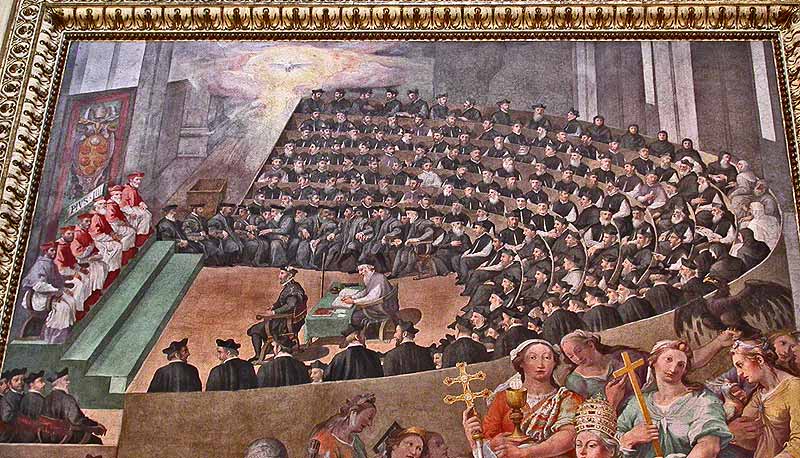
“If anyone says, that by faith alone the impious is justified; let him be anathema” (Council of Trent #9)
and…
“If anyone says that the justice [or justification] received is not preserved and also not increased before God through good works but that those works are merely the fruits and signs of justification obtained, but not the cause of the increase, let him be anathema” (Council of Trent, #24).
Steve: Not bothered. I have faith and works. Separately and together. So by St, James and St. Paul, I am covered.
John Samson: We can make a distinction between a man’s head and a man’s body without inflicting harm on the person, but if we separate head and body, we kill him. Though faith and works are not to be separated (works flow from true faith) they HAVE TO BE DISTINGUISHED or else we believe a false gospel. With all my heart I appeal to you to flee the false gospel of Rome and embrace the once for all message of the gospel of Christ – “For it is by grace you have been saved, through faith, and this is not of yourselves, it is the gift of God, NOT OF WORKS lest any man should boast.” – Ephesians 2:8,9
…..
For a comparison of evangelical v. Roman Catholic issues see this helpful short article by Nathan Busenitz here.