 John Flavel, the English Puritan pastor (1630-1691), helps us get past our complaining when we find it hard to obey Christ. He re-creates in his theological imagination the conversation between the Father and the Son in eternity past, when the Son accepted hard obedience for us:
“Father: My Son, here is a company of poor miserable souls that have utterly undone themselves and now lie open to my justice! Justice demands satisfaction for them or will satisfy itself in the eternal ruin of them. What shall be done for these souls?
Son: O my Father, such is my love to and pity for them that, rather than they shall perish eternally, I will be responsible for them as their Surety. Bring in all thy bills, that I may see what they owe thee. Lord, bring them all in, that there may be no after-reckonings with them. At my hand shalt thou require it. I will rather choose to suffer thy wrath than they should suffer it. Upon me, my Father, upon me be all their debt.
Father: But my Son, if thou undertake for them, thou must reckon to pay the last mite [cent]. Expect no abatements [discounts]. If I spare them, I will not spare thee.
Son: Content, Father. Let it be so. Charge it all upon me. I am able to discharge it. And though it prove a kind of undoing to me, though it impoverish all my riches, empty all my treasures, yet I am content to undertake it.”
Then Flavel makes his point: “Blush, ungrateful believers. O let shame cover your faces. Judge in yourselves now, hath Christ deserved that you should stand with him for trifles, that you should shrink at a few petty difficulties and complain, ‘This is hard, and that is harsh’? O if you knew the grace of our Lord Jesus Christ in this his wonderful condescension to you, you could not do it.” – John Flavel, Works (London, 1820), I:61.
John Flavel was one of the main influences in Charles Spurgeon’s spiritual formation in the gospel. This quote will let you know why:
“Ecstasy and delight are essential to the believer’s soul and they promote sanctification. We were not meant to live without spiritual exhilaration, and the Christian who goes for a long time without the experience of heart-warming will soon find himself tempted to have his emotions satisfied from earthly things and not, as he ought, from the Spirit of God. The soul is so constituted that it craves fulfillment from things outside itself and will embrace earthly joys for satisfaction when it cannot reach spiritual ones. The believer is in spiritual danger if he allows himself to go for any length of time without tasting the love of Christ and savoring the felt comforts of a Savior’s presence. When Christ ceases to fill the heart with satisfaction, our souls will go in silent search of other lovers. By the enjoyment of the love of Christ in the heart of a believer, we mean an experience of the “love of God shed abroad in our hearts by the Holy Ghost which is given to us” (Rom. 5:5). Because the Lord has made himself accessible to us in the means of grace, it is our duty and privilege to seek this experience from Him in these means till we are made the joyful partakers of it.”
“The happiness of the creature consists in rejoicing in God, by which also God is magnified and exalted.” – Jonathan Edwards
“wo, dude, like, errr, yeah!” – John Samson
“Blessed be God, our calamities are matters of time, but our safety is a matter of eternity.” – C. H. Spurgeon
“We need the law and the Gospel. We need the law to drive us to Christ. We also need the law to lead us, as Christians, in the things that please God. But the law cannot justify us. The Gospel is not our doing, the Gospel is Jesus’ doing. And therefore, it is not something for us to do, but something for us to believe.” – Dr. Michael Horton
“Justice is getting what you deserve, mercy is not getting what you deserve, and grace is getting what you don’t deserve.” – Unknown
“He that wants relief must come to Christ himself. He must not be content with coming to His Church and His ordinances or to the assemblies of His people for prayer and praise. He must not stop short even at His holy table or rest satisfied with privately opening his heart to His ordained ministers. Oh no!… He must go higher, further, much further than this. He must have personal dealings with Christ Himself. All else in religion is worthless without Him. The King’s palace, the attendant servants, the richly furnished banqueting house, the very banquet itself — all are nothing, unless we speak with the King. His hand alone can take the burden off our backs and make us feel free… We must deal directly with Christ.” – J. C. Ryle, Holiness (Old Tappan, n.d.), pages 266-267.
Martin Luther was once approached by a man who enthusiastically announced that he’d recently become a Christian. Wanting desperately to serve the Lord, he asked Luther, “What should I do now?” As if to say, should he become a minister or perhaps a traveling evangelist. A monk, perhaps.
Luther asked him, “What is your work now?”
“I’m a shoe maker.”
Much to the cobbler’s surprise, Luther replied, “Then make a good shoe, and sell it at a fair price.”
“How great an honor will it be to a person to have God at the day of judgment owning a person, declaring before all men, angels and devils that that person is before his all-seeing eyes and that he stands innocent and perfect in his sight, clothed with perfect righteousness and entitled to everlasting glory and blessedness. How honorable will this render them in the eyes of all that vast assembly that will be together at the day of judgment. That will be an infinitely greater honor than any man or any angel declaring that they judge him upright and sincere and that eternal life belongs to him. What can be a greater honor than this — to be owned by the great King and Lord of all things?” – Jonathan Edwards, The Glory and Honor of God (Nashville, 2004), edited by Michael D. McMullen, page 61.
“Man is a free agent but he cannot originate the love of God in his heart. His will is free in the sense that it is not controlled by any force outside of himself. As the “bird” with a broken wing is “free” to fly but not able, so the natural man is free to come to God but not able. How can he repent of his sin when he loves it? How can he come to God when he hates him? How can he come to God when he hates Him? This is the inability of the will under which man labors.” – Lorraine Boettner
“Religion is man searching for God; Christianity is God seeking man, manifesting Himself to him, drawing Himself unto him.” – Martyn Lloyd Jones
“Most of us have become so familiar with sin that we no longer see it as a deadly monster. Sin is more dangerous than wild bears, more deadly than blazing forest fires. Ask Nebuchadnezzar, who lost his mind because he refused to deal with his pride. Ask Samson, who was reduced to a pathetic shred of a man because he never got control over the lusts of his flesh. Ask Achan and Ananis & Sapphira, who all lost their lives over “small”, secret sins.” – Nancy L. DeMoss
“If your opponent wouldn’t agree with the accuracy of your statement about their beliefs then you should not say it.” – Tim Keller
“The call of God cannot fail in its intended effect. It irresistibly secures the faith that justifies.” – John Piper
“If you’re not accountable in life that means ultimately that your life doesn’t count.” — R.C. Sproul
“There is nothing worth living for, unless it is worth dying for.” — Elizabeth Elliott
“Those who rewrite the past, condemn the future!” – Jerry Johnson
“Only a fraction of the present body of professing Christians are solidly appropriating the justifying work of Christ in their lives. Many have so light an apprehension of God’s holiness and of the extent and guilt of their sin, that consciously they see little need for justification. Below the surface, however, they are deeply guilt-ridden and insecure. Many others have a theoretical commitment to this doctrine, but in their day-to-day existence they rely on their sanctification for justification….drawing their assurance of acceptance with God from their sincerity…their recent religious performance or the relative infrequency of their conscious, willful disobedience. Few start each day with a thoroughgoing stand upon Luther’s platform: you are accepted, looking outward in faith and claiming the wholly alien righteousness of Christ as the only ground for acceptance, relaxing in that quality of trust which will produce increasing sanctification as faith is active in love and gratitude.” – Richard Lovelace
“Calvary…not merely made possible the salvation of those for whom Christ died; it ensured that they would be brought to faith and their salvation made actual. The cross saves. Where the Arminian will only say; `I could not have gained my salvation without Calvary,’ the Calvinist will say, `Christ gained my salvation for me at Calvary.” – J. I. Packer, A Quest for Godliness, p. 131
“Humanism was not invented by man, but by a snake who suggested that the quest for autonomy might be a good idea.” – R.C. Sproul
“The pastor ought to have? two voices: one, for gathering the sheep; and another, for warding off and driving away wolves and thieves. The Scripture supplies him with the means of doing both.” – John Calvin
“How groundless and irrational is the mirth and jollity of all carnal and unregenerate men? They feast in their prison, and dance in their fetters. O the madness that is in the hearts of men!” – John Flavel, The Method of Grace, in The Whole Works of John Favel (6 vols.; London: Baynes, 1820), 2:438
Do you want to be shown, you foolish person, that faith apart from works is useless? Was not Abraham our father justified by works when he offered up his son Isaac on the altar? (James 2:20-21)
With his typical combination of illumination and brevity, Cranfield comments: Had there been no works, Abraham would not have been justified; but that would have been because the absence of works would have meant that he had no real faith. –C. E. B. Cranfield, “The Message of James,” Scottish Journal of Theology 18 (1965): 340.
“A man’s converts are always a disgrace to him. It is only those that God converts that will last.” – C. H. Spurgeon
Continue reading →

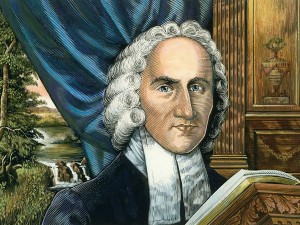 “From my childhood up, my mind had been full of objections against the doctrine of God’s sovereignty. It used to appear like a horrible doctrine to me. But I remember the time very well, when I seemed to be convinced, and fully satisfied, as to this sovereignty of God, and His justice in thus eternally dealing with men, according to His sovereign pleasure. My mind rested in it; and it put an end to all those quibbles and objections. And there has been a wonderful alteration in my mind, with respect to the doctrine of God’s sovereignty, from that day to this. God’s absolute sovereignty is what my mind seems to rest assured of, as much as of any thing that I see with my eyes. But I have often, since that first conviction, had quite another kind of sense of God’s sovereignty than I had then. I have often since had not only a conviction, but a delightful conviction. The doctrine has appeared exceedingly pleasant, bright, and sweet. Absolute sovereignty is what I love to ascribe to God. But my first conviction was not so.” – Jonathan Edwards