 “Someone asked Martin Luther what we contribute to salvation, ‘Sin and resistance.’” – Michael Horton
“The elect are gathered into Christ’s flock by a call not immediately at birth, and not all at the same time, but according as it pleases God to dispense his grace to them. But before they are gathered unto that supreme Shepherd, they wander scattered in the wilderness common to all; and they do not differ at all from others except that they are protected by God’s especial mercy from rushing headlong into the final ruin of death. If you look upon them, you will see Adam’s offspring, who savor of the common corruption of the mass. The fact that they are not carried to utter and even desperate impiety is not due to any innate goodness of theirs but because the eye of God watches over their safety and his hand is outstretched to them!” – John Calvin
“At the moment the Roman Catholic Church condemned the biblical doctrine of justification by faith alone, she denied the gospel and ceased to be a legitimate church, regardless of all the rest of her affirmations of Christian orthodoxy. To embrace her as an authentic church while she continues to repudiate the biblical doctrine of salvation is a fatal attribution.” – R. C. Sproul
“The one thing needed above all else is the accompanying power of the Spirit… It is the power from on high. It is the preacher gliding on eagles wings, soaring high, swooping lie, carrying and being carried along by a dynamic other than his own. His consciousness of what is happening us not obliterated. He is not in a trance. He is being worked on but is aware that he is still working. He is being spoken through but knows he is still speaking.” – Dr. Martyn Lloyd-Jones, The Sacred Anointing pg 28-29
God’s love is unconditional toward those he intends to adopt as his children. He does not make us meet a condition (faith) before he will love us. He meets all conditions for us in Christ by doing for us what we are unable to do for ourselves, that is, giving us everything we need for salvation, including a new heart to believe. (Ezek 36:26).
“Nothing is so calming and comforting to the Christian pilgrim, as the assurance of Divine Guidance in every, even the most minute circumstances which befall him. Without this perception of his heavenly Father’s care, a thousand intricacies must beset his path. He must be staggered at almost every step. But when he beholds, by faith—the unerring hand of infinite wisdom, wielding the stupendous machine of human events—causing everything to promote the spiritual good of His people—then he quiets himself as a little child, and can say with cheerful resignation, “Father, not my will, but yours be done.” – Thomas Reade
“There are two ways to get enough. One is to continue to accumulate more and more. The other is to desire less.” – G.K. Chesterton
“Prayer is nothing but the breathing that out before the Lord, that was first breathed into us by the Spirit of the Lord.” – Thomas Brooks
“The Christian thinks any good he does comes from the Christ-life inside him. He does not think God will love us because we are good, but that God will make us good because he loves us; just as the roof of a greenhouse does not attract the sun because it is bright, but becomes bright because the sun shines on it.” – C. S. Lewis, Mere Christianity, Book 2, chapter 5
“God’s chief gift to those who seek Him is Himself.” – E.B. Pusey
“The testimony of the Spirit is superior to reason. For as God alone can properly bear witness to his own words, so these words will not obtain full credit in the hearts of men, until they are sealed by the inward testimony of the Spirit. The same Spirit, therefore, who spoke by the mouth of the prophets, must penetrate our hearts, in order to convince us that they faithfully delivered the message with which they were divinely entrusted.” – John Calvin
“How soon marriage counselling sessions would end if husbands and wives were competing in thoughtful self-denial.” – Walter Chantry
Some Spurgeon Quotes:
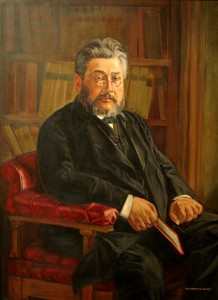 “”Oh!” saith the Arminian, “men may be saved if they will.” We reply, “My dear sir, we all believe that; but it is just the ‘if they will’ that is the difficulty. We assert that no man will come to Christ unless he be drawn; nay, we do not assert it, but Christ himself declares it—’Ye will not come unto me that ye might have life;’ and as long as that ‘ye will not come’ stands on record in Holy Scripture, we shall not be brought to believe in any doctrine of the freedom of the human will.” It is strange how people, when talking about free-will, talk of things which they do not at all understand. “Now,” says one, “I believe men can be saved if they will.” My dear sir, that is not the question at all. The question is, are men ever found naturally willing to submit to the humbling terms of the gospel of Christ? We declare, upon Scriptural authority, that the human will is so desperately set on mischief, so depraved, and so inclined to everything that is evil, and so disinclined to everything that is good, that without the powerful, supernatural, irresistible influence of the Holy Spirit, no human will ever be constrained towards Christ.” – Charles H. Spurgeon – from sermon entitled “Human Inability”
“I question whether we have preached the whole counsel of God, unless predestination with all its solemnity and sureness be continually declared.” (Charles Spurgeon, Sermons, Vol. 6, p. 26).
“One thing more, and it is this. Let us, dear brethren, try to get saturated with the gospel. I always find that I can preach best when I can manage to lie a-soak in my text. I like to get a text, and find out its meaning and bearings, and so on; and then, after I have bathed in it, I delight to lie down in it, and let it soak into me. It softens me, or hardens me, or does wh…atever it ought to do to me, and then I can talk about it. You need not be very particular about the words and phrases if the spirit of the text has filled you; thoughts will leap out, and find raiment for themselves. Become saturated with spices, and you will smell of them; a sweet perfume will distill from you, and spread itself in every direction; — we call it unction. Do you not love to listen to a brother who abides in fellowship with the Lord Jesu s? Even a few minutes with such a man is refreshing, for, like his Master, his paths drop fatness. Dwell in the truth, and let the truth dwell in you. Be baptized into its spirit and influence, that you may impart thereof to others. If you do not believe the gospel, do not preach it, for you lack an essential qualification; but even if you do believe it, do not preach it until you have taken it up into yourself as the wick takes up the oil. So only can you be a burning and a shining light.” – C. H. Spurgeon
“It is no novelty, then, that I am preaching; no new doctrine. I love to proclaim these strong old doctrines that are called by nickname Calvinism, but which are truly and verily the revealed truth of God as it is in Christ Jesus. By this truth I make my pilgrimage into the past, and as I go, I see father after father, confessor after confessor, martyr after martyr, standing up to shake hands with me… Taking these things to be the standard of my faith, I see the land of the ancients peopled with my brethren; I behold multitudes who confess the same as I do, and acknowledge that this is the religion of God’s own church.” (Spurgeon’s Sovereign Grace Sermons, Still Waters Revival Books, p. 170).
“Our estimate of Christ is the best gauge of our spiritual condition; as the thermometer rises in proportion to the increased warmth of the air, so does our estimate of Jesus rise as our spiritual life increases in vigor and fervency.” – C. H. Spurgeon

 “The gospel continually reminds us, “It’s Christmas time!”” – John Fonville
 Five quotes: