 “None reverence the Lord more than they who know him best.” – William Cowper
“It is easier to cry against one-thousand sins of others than to kill one of your own.” – John Flavel
“There is not the meanest, the weakest, the poorest believer on the earth, but Christ prizes him more than all the world besides.” – John Owen, Communion with God (Christian Focus, 2007), 218
“In Christ dwells all the fullness of deity, bodily.” Colossians 2:9….. “Who actually gets what the incarnation is about? The whole fullness of deity… in a body. That’s like all of the oceans of the world… in a cup!” – Jason Meyer
“We need men who will stand before the opposing masses with nothing to help them except the gospel and the God who pledged to work through it.” – Paul Washer
“The gospel is a two-sided coin with forgiveness and life on the one side, and condemnation and death on the other. This truth must be told!” – Paul Washer
“The gospel is not “salvation to all,” but only to “those who believe.” To the rest, it is a sentence of death (II Corinthians 2:16). Christ not only taught that the gospel is for everyone who believes, but he also warned that it is against everyone who does not.” Jn.3:18 – Paul Washer
“Salvation comes to everyone who believes. However, the validity of a man’s confession of faith is confirmed or proven false by his life.” – Paul Washer
Archibald Alexander (1772-1851), founder of Princeton Seminary:
It seems desirable to ascertain, as precisely as we can, the reasons why Christians commonly are of so diminutive a stature and of such feeble strength in their religion.
When persons are truly converted they always are sincerely desirous to make rapid progress in piety; and there are not wanting exceeding great and gracious promises of aid to encourage them to go forward with alacrity. Why then is so little advancement made? Are there not some practical mistakes very commonly entertained, which are the cause of this slowness of growth?
I think there are, and will endeavour to specify some of them.
And first, there is a defect in our belief of the freeness of divine grace.
To exercise unshaken confidence in the doctrine of gratuitous pardon is one of the most difficult things in the world; and to preach this doctrine fully without verging towards antinomianism is no easy task, and is therefore seldom done. But Christians cannot but be lean and feeble when deprived of the proper nutriment. It is by faith, that the spiritual life is made to grow; and the doctrine of free grace, without any mixture of human merit, is the only true object of faith.
Christians are too much inclined to depend on themselves, and not to derive their life entirely from Christ. There is a spurious legal religion, which may flourish without the practical belief in the absolute freeness of divine grace, but it possesses none of the characteristics of the Christian’s life… Even when the true doctrine is acknowledged, in theory, often it is not practically felt and acted on. The new convert lives upon his frames, rather than on Christ; and the older Christian still is found struggling in his own strength… and then he sinks into a gloomy despondency… Here, I am persuaded, is the root of the evil; and until religious teachers inculcate clearly, fully, and practically, the grace of God as manifested in the gospel, we shall have no vigorous growth of piety among professing Christians.” – Archibald Alexander, Thoughts on Religious Experience (Philadelphia: Presbyterian Board of Publication, 1844), 201-2
“The contented man is never poor, the discontented never rich.” – George Eliot
“It is more difficult to be long and convoluted than concise and clear. While it is easy to be comprehensive, it is often more difficult to be direct.” – Jesse Johnson
“Be well instructed in theology, and do not regard the sneers of those who rail at it because they are ignorant of it. Many preachers are not theologians and hence the mistakes which they make. It cannot do any hurt to the most lively evangelist to be also a sound theologian and it may often be the means of saving him from gross blunders. Nowadays we hear men tear a single sentence of Scripture from its connection and cry “Eureka! Eureka!” as if they found a new truth; and yet they have not discovered a diamond, but a piece of broken glass.” – Charles Hadden Spurgeon
“If anyone should ask me what I mean by a Calvinist, I should reply, “He is one who says, Salvation is of the Lord.” I cannot find in Scripture any other doctrine than this. It is the essence of the Bible… I believe nothing merely because Calvin taught it, but because I have found his teaching in the Word of God… ” – C. H. Spurgeon
“If Christ is not all to you He is nothing to you. He will never go into partnership as a part Saviour of men. If He be something He must be everything, and if He be not everything He is nothing to you.” – C. H. Spurgeon
“For all the claims, however, that society is now ‘too visual’ for old-style word-centered religion, and that a book-based evangelicalism runs the risk of becoming a ghetto of middle class, cerebral bookworms with nothing to say to the Generation Xers, there is one embarrassing fact that the new gurus need to face: God gave us a book, full of words, as the basic means of giving us access to his revelation. The gospel is therefore ineradicably verbal and the Bible must remain non-negotiably at the centre of church policy, ministerial training and family life. Not to do so is to leave ourselves vulnerable to every puff of heretical wind that the gurus blow in our direction. It is also to set ourselves above what God himself has laid out for us.” – Carl Trueman, Reformation: Yesterday, Today, and Tomorrow.
“If God created the world, and put one man and one woman in it, married them to each other, and established that as a pattern for the rest of human history, then marriage should be defined in accordance with that reality. If He did nothing of the kind, and we actually evolved out of the primordial goo, then we get to shape and define it however we would like it to go.” – Douglas Wilson
Continue reading →

 “I am an historian, the elders should protect the sinner from the church. When a sinner is defiant, the elders should protect the church from the sinner.”
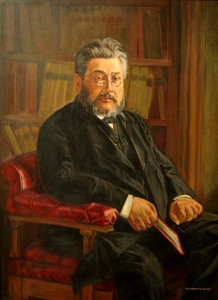 “We are often told (I mean those of us who are commonly nicknamed by the title of Calvinists—and we are not very much ashamed of that; we think that Calvin, after all, knew more about the Gospel than almost any man who has ever lived, uninspired), we are often told that we limit the atonement of Christ, because we say that Christ has not made a satisfaction for all men, or all men would be saved. Now, our reply to this is, that, on the other hand, our opponents limit it: we do not.
 Now, beloved, when you hear any one laughing or jeering at a limited atonement, you may tell him this.