

Miscellaneous Quotes (43)

I know that I am completely justified.
His blood and righteousness
My beauty are, my glorious dress.
I want no other garments,
save Jesus’ doings, and his imputed righteousness. – Charles Spurgeon

Francis Schaeffer:

Once I was flying at night over the North Atlantic. It was in 1947, and I was coming back from my first visit to Europe. Our plane, one of those old DC4’s with two engines on each wing, was within two or three minutes of the middle of the Atlantic. Suddenly two engines on one wing stopped. I had already flown a lot, and so I could feel the engines going wrong. I remember thinking, if I’m going to go down into the ocean, I’d better get my coat. When I did, I said to the hostess, “There’s something wrong with the engines.” She was a bit snappy and said, “You people always think there’s something wrong with the engines.” So I shrugged my shoulders, but I took my coat. I had no sooner sat down, than the lights came on and a very agitated co-pilot came out. “We’re in trouble,” he said. “Hurry and put on your life jackets.”

So down we went, and we fell and fell, until in the middle of the night with no moon we could actually see the water breaking under us in the darkness. And as we were coming down, I prayed. Interestingly enough, a radio message had gone out, an SOS that was picked up and broadcast immediately all over the United States in a flash news announcement: “There is a plane falling in the middle of the Atlantic.” My wife heard about this and at once she gathered our three little girls together and they knelt down and began to pray. They were praying in St Louis, Missouri, and I was praying on the plane. And we were going down and down.

Then, while we could see the waves breaking beneath us and everybody was ready for the crash, suddenly the two motors started, and we went on into Gander. When we got down I found the pilot and asked what happened. “Well,” he said, “it’s a strange thing, something we can’t explain. Only rarely do two motors stop on one wing, but you can make an absolute rule that when they do, they don’t start again. We don’t understand it.” So I turned to him and I said, “I can explain it.” He looked at me: “How?” And I said, “My Father in heaven started it because I was praying.” That man had the strangest look on his face and he turned away.

Schaeffer then makes his point:

. . . What one must realize is that seeing the world as a Christian does not mean just saying, “I am a Christian. I believe in the supernatural world,” and then stopping. It is possible to be saved through faith in Christ and then spend much of our lives in [unbelief]. We can say we believe in a supernatural world, and yet live as though there were no supernatural in the universe at all. It is not enough merely to say, “I believe in a supernatural world.”

Christianity is not just a mental assent that certain doctrines are true. This is only the beginning. This would be rather like a starving man sitting in front of great heaps of food and saying, “I believe the food exists; I believe it is real,” and yet never eating it. It is not enough merely to say, “I am a Christian”, and then in practice to live as if present contact with the supernatural were something far off and strange. Many Christians I know seem to act as though they come in contact with the supernatural just twice – once when they are justified and become a Christian and once when they die. The rest of the time they act [in unbelief]. – Francis Schaeffer, ‘The Universe and Two Chairs’

“Though hell is not the same for all, and exists in degrees (Luke 12:47), any unhappiness that lasts forever is unfathomable.” – John Piper
Continue reading
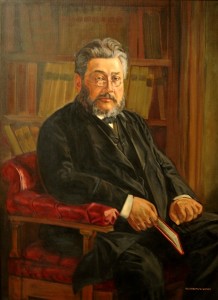
Spurgeon on 1 John 5:1

Charles Spurgeon preaching on 1 John 5:1 makes the point that men believe, not of their own power, but as a result of the work of regeneration in the hearts of men:
We must now pass on to show that wherever it exists it is the proof of regeneration. There never was a grain of such faith as this in the world, except in a regenerate soul, and there never will be while the world standeth. It is so according to the text, and if we had no other testimony this one passage would be quite enough to prove it. “Whosoever believeth that Jesus is the Christ is born of God.”

“Ah!” I hear thee say, poor soul, “the new birth is a great mystery; I do not understand it; I am afraid I am not a partaker in it.”

You are born again if you believe that Jesus is the Christ, if you are relying upon a crucified Saviour you are assuredly begotten again unto a lively hope. Mystery or no mystery, the new birth is yours if you are a believer. Have you never noticed that the greatest mysteries in the world reveal themselves by the simplest indications.

The simplicity and apparent easiness of faith is no reason why I should not regard its existence as an infallible indication of the new birth within. How know we that the new-born child lives except by its cry? Yet a child’s cry—what a simple sound it is! how readily could it be imitated! a clever workman could with pipes and strings easily deceive us; yet was there never a child’s cry in the world but what it indicated the mysteries of breathing, heart-beating, blood-flowing, and all the other wonders which come with life itself.

Do you see yonder person just drawn out of the river? Does she live? Yes, life is there.

Why?

Because the lungs still heave.

But does it not seem an easy thing to make lungs heave? A pair of billows blown into them, might not that produce the motion?

Ah, yes, the thing is easily imitated after a sort; but no lungs heave except where life is. Take another illustration.

Go into a telegraph office at any time, and you will see certain needles moving right and left with unceasing click. Electricity is a great mystery, and you cannot see or feel it; but the operator tells you that the electric current is moving along the wire.

How does he know?

“I know it by the needle.”

How is that?

I could move your needles easily.

“Yes; but do not you see the needle has made two motions to the right, one to the left, and two to the right again? I am reading a message.”

“But,” say you, “I can see nothing in it; I could imitate the clicking and moving very easily.”

Yet he who is taught the art sees before him in those needles, not only electric action, but a deeper mystery still; he perceives that a mind is directing an invisible force, and speaking by means of it.

Not to all, but to the initiated is it given to see the mystery hidden within the simplicity. The believer sees in the faith, which is simple as the movements of the needle, an indication that God is operating on the human mind, and the spiritual man discerns that there is an inner secret intimated thereby, which the carnal eye cannot decipher.

To believe in Jesus is a better indicator of regeneration than anything else, and in no case did it ever mislead. Faith in the living God and his Son Jesus Christ is always the result of the new birth, and can never exist except in the regenerate. Whoever has faith is a saved man.

HT: Mike Porter

Spoken 110 years ago…

Geerhardus Vos, in a 1902 address to Princeton Seminary as the school kicked off its 90th year, with words still relevant today:

No one will deny that in the Scriptural disclosure of truth the divine love is set forth as a most fundamental principle, nor that the embodiment of this principle in our human will and action forms a prime ingredient of that subjective religion which the Word of God requires of us.

But it is quite possible to overemphasize this one side of truth and duty as to bring into neglect other exceedingly important principles and demands of Christianity. The result will be that, while no positive error is taught, yet the equilibrium both in consciousness and life is disturbed and a condition created in which the power of resistance to the inroads of spiritual disease is greatly reduced. There can be little doubt that in this manner the one-sidedness and exclusiveness with which the love of God has been preached to the present generation is largely responsible for that universal weakening of the sense of sin, and the consequent decline of interest in the doctrines of atonement and justification, which even in orthodox and evangelical circles we all see and deplore. – Geerhardus Vos, “The Scriptural Doctrine of the Love of God,” in Redemptive History and Biblical Interpretation: The Shorter Writings of Geerhardus Vos (ed. Richard Gaffin; P&R, 1980), 426

Takeaway: To seek to exalt God’s love without placing it against the full range of who God is and must be nets out as a diminishing, not exaltation, of that love.

HT: Dane Ortlund