
 (1) There’s a variety of resources in this week’s Justification, the Church, the Sacraments, the Papacy and the Marian doctrines. Normally $17 it is just $5 in the online Friday sale. Perhaps you might consider ordering multiple copies to hand out to others who may be confused about these vital issues here
.
(2) “Do you mean by that, asks someone, that the saints in the Old Testament were not forgiven? Of course I do not. They were obviously forgiven and they thanked God for the forgiveness. You cannot say for a moment that people like David and Abraham and Isaac and Jacob were not forgiven. Of course they were forgiven. But they were not forgiven because of those sacrifices that were then offered. They were forgiven because they looked to Christ. They did not see this clearly, but they believed the teaching, and they made these offerings by faith. They believed God’s Word that He was one day going to provide a sacrifice, and in faith they held to that. It was their faith in Christ that saved them, exactly as it is faith in Christ that saves now. That is the argument.” – Martyn Lloyd-Jones, The Cross, The Vindication of God
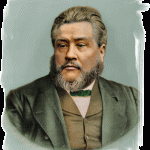
(3) Some C. H. Spurgeon quotes:
“When we shall see the dead rise from the grave by their own power, then may we expect to see ungodly sinners of their own free will turning to Christ.”
“My hope lives not because I am not a sinner, but because I am a sinner for whom Christ died; my trust is not that I am holy, but that being unholy, he is my righteousness. My faith rests not upon what I am, or shall be, or feel, or know, but in what Christ is, in what he has done, and in what he is now doing for me.”
“Regarding the gospel, make it your ambition to be a copyist, never an original.”
“Faith goes up the stairs that love has built and looks out the windows which hope has opened.”
“If there be one stitch in the celestial garment of our righteousness which we are to insert ourselves, then we are lost; but this is our confidence, the Lord who began will perfect. He has done it all, must do it all, and will do it all. Our confidence must not be in what we have done, nor in what we have resolved to do, but entirely in what the Lord will do.”
“In one word, the great pillar of the Christian’s hope is substitution. The vicarious sacrifice of Christ for the guilty, Christ being made sin for us that we might be made the righteousness of God in him, Christ offering up a true and proper expiatory and substitutionary sacrifice in the room, place, and stead of as many as the Father gave him, who are known to God by name, and are recognized in their own hearts by their trusting in Jesus-this is the cardinal fact of the gospel.”
“No man can do me a truer kindness in this world than to pray for me.”
 “It is the Holy Spirit’s role to always turn our eyes to Jesus and away from ourselves, for he is constantly trying to make us think of ourselves rather than Christ. satan insinuates, ‘Your sins are too many to be forgiven, you have no faith, you don’t repent enough, you will never be able to endure to the end, you don’t have the joy of God’s children, and your grasp on Jesus is weak and wavering.’ All these thoughts are about self, yet we will never find comfort or assurance by looking inside ourselves. The Holy Spirit turns our eyes away from self, telling us we are nothing – but that Christ is our “all in all” (1 Corinthians 15:28).”
 From the unknown author of The Epistle to Diognetus, Chapter 5, written perhaps between 117 and 225 AD, capturing the paradoxical nature of Christian identity and practice: