Tim Keller explains the difference between a moralistic reading of the Bible and a Jesus-Centered reading of the Bible:
We have said that you must preach the gospel every week-to edify and grow Christians and to convert non-Christians. But if that is the case, you cannot simply ‘instruct in Biblical principles.’ You have to ‘get to Jesus’ every week.
For example, look at the story of David and Goliath. What is the meaning of that narrative for us? Without reference to Christ, the story may be (usually is!) preached as: “The bigger they come, the harder they’ll fall, if you just go into your battles with faith in the Lord. You may not be real big and powerful in yourself, but with God on your side, you can overcome giants.”
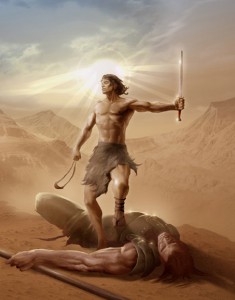 But as soon as we ask: “how is David foreshadowing the work of his greater Son”? We begin to see the same features of the story in a different light. The story is telling us that the Israelite’s can not go up against Goliath. They can’t do it. They need a substitute. When David goes in on their behalf, he is not a full-grown man, but a vulnerable and weak figure, a mere boy. He goes virtually as a sacrificial lamb. But God uses his apparent weakness as the means to destroy the giant, and David becomes Israel’s champion-redeemer, so that his victory will be imputed to them. They get all the fruit of having fought the battle themselves.
This is a fundamentally different meaning than the one that arises from the non-Christocentric reading.
There is, in the end, only two ways to read the Bible: is it basically about me or basically about Jesus? In other words, is it basically about what I must do, or basically about what he has done? If I read David and Goliath as basically giving me an example, then the story is really about me. I must summons up the faith and courage to fight the giants in my life. But if I read David and Goliath as basically showing me salvation through Jesus, then the story is really about him. Until I see that Jesus fought the real giants (sin, law, death) for me, I will never have the courage to be able to fight ordinary giants in life (suffering, disappointment, failure, criticism, hardship). For example how can I ever fight the “giant” of failure, unless I have a deep security that God will not abandon me? If I see David as my example, the story will never help me fight the failure/giant. But if I see David/Jesus as my substitute, whose victory is imputed to me, then I can stand before the failure/giant. As another example, how can I ever fight the “giant” of persecution or criticism? Unless I can see him forgiving me on the cross, I won’t be able to forgive others. Unless I see him as forgiving me for falling asleep on him (Matt.27:45) I won’t be able to stay awake for him.
In the Old Testament we are continually told that our good works are not enough, that God has made a provision. This provision is pointed to at every place in the Old Testament. We see it in the clothes God makes Adam and Eve in Genesis, to the promises made to Abraham and the patriarchs, to the Tabernacle and the whole sacrificial system, to the innumerable references to a Messiah, a suffering servant, and so on.
Therefore, to say that the Bible is about Christ is to say that the main theme of the Bible is, “Salvation is of the Lord” (Jonah 2:9).

 Dane Ortlund has outlined some very good, practical advice for both guest preachers and the Churches that invite them. He writes: Preached recently at a church that hosted me with remarkable thoughtfulness and it caused me to reflect on how inviting churches can host as well as my most recent experience, and also what should be the specific aims of a guest preacher. To be filtered through your own wisdom and good sense.