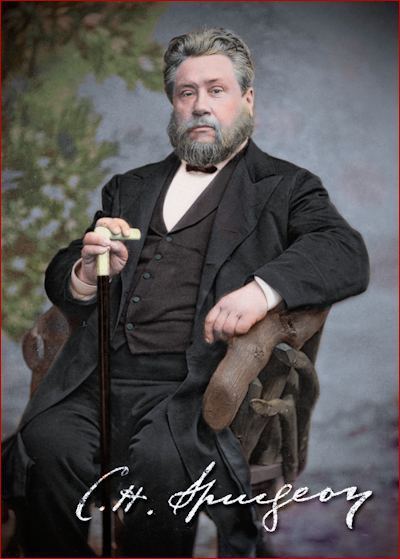
 Article: 10 Public Speaking Tips from Charles Spurgeon by Christian George (original source Edison-Bell Record Company recorded a two-minute audio clip of his son, Thomas, reading an excerpt of his father’s sermon. But Thomas’s voice was was “not quite that of Charles Spurgeon, not quite so strong and not quite so musical” (Fullerton, 167). Besides, Thomas took after his mother in countenance; his brother, Charles Jr., favored their father.
Charles Spurgeon spoke more quickly, too – 140 words per minute. His voice was described as “a silver bell” (The Eclectic Review, January-June, 1867) and “sweet and musical; with a rich under-current that always reminds us of the roll of the organ” (Falkirk Herald, February 6, 1868).
James Sheridan Knowles, an Irish actor who would have been Spurgeon’s elocution teacher at Stepney College, told his students:
[Spurgeon] is only a boy, but he is the most wonderful preacher in the world. He is absolutely perfect in his oratory; and, beside that, a master in the art of acting. He has nothing to learn from me, or anyone else. He is simply perfect. He knows everything. He can do anything. . . . Why, boys, he can do anything he pleases with his audience! He can make them laugh, and cry, and laugh again, in five minutes (Autobiography 1:354).
The actor was not exaggerating. In 1855, 21-year-old Spurgeon wrote in a letter to his brother, “I believe I could secure a crowded audience at dead of night in a deep snow” (Autobiography 2:99). The very next year, a biography was published in New York comparing the young preacher to George Whitefield. He was also compared to Sims Reeves – one of the most popular opera singers of the century.
So what was Spurgeon’s secret? How did the “Prince of Preachers” master the art of public speaking? Here are ten tips from Spurgeon’s lecture “On the Voice” (Lectures to My Students 11:117-135).
1. Posture Up!
“Do not speak with your hands in your waistcoat pockets so as to contract your lungs, but throw the shoulders back, as public singers do.”
“Do not lean over a desk while speaking, and never hold the head down on the breast while preaching. Upward rather than downward let the body bend.”
“Off with all tight cravats and button-up waistcoats; leave room for the full play of the bellows and the pipes.”
2. Speak with Your Mouth, Not Your Throat or Nose.
“Open wide the doors from which such godly truth is to march forth.”
“One of the surest ways to kill yourself is to speak from the throat instead of the mouth.”
“Evangelists have written of our Lord, ‘He opened his mouth and taught them.’”
“Avoid the use of the nose as an organ of speech, for the best authorities are agreed that it is intended to smell with.”
3. “R” ticulate.
“Abhor the practice of some men, who will not bring out the letter “r” such a habit is ‘vewy wuinous and wediculous, vewy wetched and wepwehensible.’”
“Take great care of the consonants, enunciate every one of them clearly; they are the features and expression of the words. . . . The vowels have a voice of their own, and therefore they can speak for themselves.”
“Excessively rapid speaking, tearing and raving into utter rant, is quite as inexcusable; it is not, and never can be powerful, except with idiots, for it turns what should be an army of words into a mob, and most effectually drowns the sense in floods of sound.” Continue reading →