
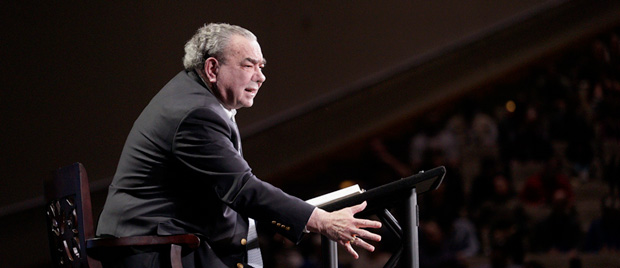
The Role of a Shepherd

Article by Dr. R. C. Sproul: What Does It Mean to Be a Shepherd Over the Flock? (original source here)

When we examine life in the early Christian church, we see a remarkable phenomenon recorded for us in the book of Acts. In Acts 8:1 we read, “At that time a great persecution arose against the church which was at Jerusalem; and they were all scattered throughout the regions of Judea and Samaria, except the apostles. And devout men carried Stephen to his burial, and made great lamentation over him.”

A little bit later in the text we read these words: “Therefore those who were scattered went everywhere preaching the word” (Acts 8:4). We notice here that the people described as going everywhere preaching the Word were not the apostles. They were the laity of the first-century church. The apostles remained in Jerusalem and were not numbered among those who fled during the great persecution.

It is obvious from this text in Acts that one of the functions of the leaders of the early church was to equip the laity so that the ministry of the gospel could be effected through their labors. This was a precursor of what Luther had in mind in the sixteenth century when he advocated the doctrine of the “priesthood of all believers.” In that doctrine, Luther did not intend to obscure the distinction between laity and clergy but simply intended to point out that all Christians are to be involved in fulfilling the mission of the church.

At the same time, the New Testament makes it clear that there are those appointed to be leaders in the local church, and they are called by various names, but in the main we think of the pastor as the leader of the local church. The supreme paradigm, or model, for pastoral ministry is seen in the work of Jesus Himself.

One of the titles that the New Testament bestows upon Him is that of the Good Shepherd. The metaphor of the shepherd who cares for his flock becomes then the metaphor that defines the work of the local pastor. But what does it mean to be a shepherd over the flock?

In the first place, to be a shepherd over the flock of sheep means that it is the shepherd’s responsibility to lead the sheep. If anyone has observed the behavior of sheep who are left unguided, without the care and constant supervision of a shepherd, he is aware that sheep tend to move willy-nilly in all directions without any order to their movement. They are prone to getting lost, getting injured, and being left in a state of vulnerability unless they are cared for by a shepherd. So it is with the flock of Christ. It is the chief responsibility of the pastor, who is the shepherd, to lead the sheep.

One of the great tragedies in the church of the twenty-first century, particularly in Protestantism, is that while pastors are given the responsibility for leading their congregations, rarely do they receive a level of authority that matches that responsibility. For the most part, they are considered hirelings by the governing boards of the local church, whether it be a board of elders, deacons, or a consistory. So that the pastor, in being subordinate to the elder board, always has to keep one eye on his supervisors before he takes the reigns to lead the flock of Christ. This is one of the reasons why so many pastors have compromised the preaching of the gospel. They have been so fearful that they would lose their jobs by being bold in their preaching and passionate in their concern for the sheep that they keep one eye on the sheep and the other eye on those who hire and fire them. This is not the biblical model.

From Old Testament times beginning with Moses into the New Testament, those who were called to be elders and deacons were to be placed in a position to give aid and assistance to the shepherd, who was given the authority and responsibility to lead the flock. Some pastors are very effective in leading without that authority simply by the sheer force of their personality or the skills they have in leading.

Secondly, the shepherd is responsible to feed the sheep. This was set forth with great emphasis in Jesus’ discourse with Peter after the resurrection, when He inquired of Peter’s love for his Master. Jesus three times gave the mandate to Peter to feed His sheep — to tend the flock. Sheep without food soon grow thin, weak, emaciated, and sickly — ultimately perishing.

It is the first responsibility of the pastor to make sure that the sheep under his care are fed, nourished, and nurtured by the whole counsel of the Word of God. The New Testament rebukes the believer who is satisfied with milk and flees from serious learning of the things of God by avoiding the difficult digestion of the meat of the Word of God. But a good shepherd weans his sheep from the elemental principles of milk that is given to babes, and he gives them a diet that will cause them to become strong and fully equipped to do the ministry of the gospel. That feeding is given at the responsibility of the pastor.

Thirdly, the pastor is called to tend the flock. Following again John’s imagery from nature, when a sheep is wounded or becomes ill, it is to be noticed by the good shepherd, who takes that sheep from the flock and gives the special attention needed by the sheep to be restored to fullness of health. So it is that the good pastor is one who knows the aches, the pains, the joys, and the sorrows of each member of his congregation, so that he can tend to their needs and so that they aren’t overcome by physical maladies or by spiritual and psychological distress. He is there to encourage the sheep and to see to it that they grow to the fullness of maturity in the life of Christ, conforming to Christ’s very image.

It is the responsibility of the pastor to equip the sheep by teaching them and training them. There is a difference between teaching and training.

Teaching involves the imparting of information from one person to another.

Training requires more hands-on participation, showing someone how to master a particular skill.

It is not enough for a pastor simply to communicate information through expositional preaching or to explain the doctrines of the faith to his flock. He is also called to see to it that they are trained in certain skills necessary for growth in the faith. It is the pastor’s responsibility to teach his sheep how to pray, how to worship, how to evangelize, how to be engaged profitably in the mercy ministries of the church.

In all of these enterprises, the pastor is to mirror and reflect the ministry of Jesus Himself, who gave of Himself completely to those given to Him by the Father. So the pastor must see his congregation as a flock of sheep that is entrusted to him by the Father and by the Lord Jesus Christ, that he may help the saints become all that they can become in the ministry of the gospel.


The Pastor’s Purpose

Article “What’s the Purpose of … Pastors?” by Tim Challies (original source here)

The Bible knows nothing of lone Christians, of believers who are willfully independent from a local church. Rather, Christians gather in communities to worship together and serve one another. And as God commands his people to gather in community, he also commands them to be led—led by men called and qualified as pastors or elders (terms the Bible uses interchangeably). As we progress through a series of questions about things we as Christians often take for granted, we now come to the question of church leadership and ask, “What’s the purpose of pastors?”

Common Views of Pastors
In the church today we find a number of common views of the role and purpose of pastors. Unfortunately, some of these, though perhaps well-intentioned, are unbiblical. Here are two prominent views that both fall short of what the Bible teaches.

The first is the pastor as CEO. According to this view, the pastor’s primary purpose is to keep his organization (i.e., his church) running smoothly and growing steadily. Like the Chief Executive Officer within a corporation, he must apply sound business principles to his operation and will find success when he satisfies the desires of church attendees and experiences numerical growth. Those who hold this view claim that the “pastor as shepherd” view threatens to stunt the growth of a church and is impractical for the challenges of our day. Though shepherding care is good and necessary, it should be carried out by church members or ministry leaders so the pastors can focus on the challenges of leadership. Carey Nieuwhof explains, “Saying the model of pastor-as-CEO is bad for the church is like saying leadership really doesn’t matter. It’s also saying business should get all the best leaders. … If all we do is recruit pastors who love to care for people until they die, the church will die.” The task of the pastor, he says, is to lead, “to take people where they wouldn’t otherwise go.”

The second view is the pastor as priest. According to this view, the pastor is a kind of spiritual guru whose purpose is to take sole or primary responsibility for all of the church’s ministry. In that way, he serves as a kind of mediator between God and his people.

While few evangelicals would actually vocalize their adherence to this view, many tacitly hold it when they only go to their pastor for prayer and spiritual care. They may feel that the prayer and ministry of church members are somehow less effective than the prayer and ministry of their pastor. This view may also affect evangelism, as believers downplay their own ability to share the gospel and instead only focus on bringing unbelieving friends to church to hear the pastor, as if this is the only means through which God works.

Addressing the Error
While it is true that the wise pastor will learn practical strategies for leadership, and while it is true that all truth is God’s truth, the pastor as CEO view has dangerous implications for pastoral ministry. In Jeramie Rinne’s powerful critique, he insists that this view eventually and inevitably reinterprets the church through a business or organizational lens. It is true, of course, that churches “have business aspects. Churches often use financial officers and budgets, employees and personnel policies, facilities and insurance, workflow diagrams and goals, bylaws and committees.” All of these are within the scope of a healthy church. But “the problem arises when these businesslike elements become part of a comprehensive business model for the congregation that ignores biblical teaching. It might look something like this: pastor = president/CEO; staff = vice presidents; members = shareholders/loyal customers; visitors = potential customers.”

John Piper has also warned of the danger of this view, saying, “The professionalization of the ministry is a constant threat to the offense of the gospel. It is a threat to the profoundly spiritual nature of our work. I have seen it often: the love of professionalism kills a man’s belief that he is sent by God to save people from hell and to make them Christ-exalting, spiritual aliens in the world.” This view teaches Christians to interpret and evaluate churches like businesses. It teaches them to evaluate pastors like they evaluate CEOs, so their performance becomes more important than their character. They fail to consider that of all the biblical qualifications for pastors, there is just one related to skill. All the others are related to his godly character.

Meanwhile, the pastor as priest model neglects a key doctrine recovered by the Protestant Reformers: the priesthood of all believers. While Luther and the other Reformers affirmed the office of the elder or pastor, they also emphasized that, through Christ, we are all ministers of the gospel and all have access to God. God continues to call men to pastoral ministry, but he also calls every Christian to minister to one another. This view minimizes the New Testament’s emphasis on the role of the pastor as the one who equips believers so they can carry out the work of the ministry. Ephesians 4:11-12 expresses this: “And he gave the apostles, the prophets, the evangelists, the shepherds and teachers, to equip the saints for the work of ministry, for building up the body of Christ.” The truth is, we are all ministers. Some are set apart to lead as pastors, but we are all called to minister.

What the Bible Says about Pastors
The Bible assures us that pastors exist to shepherd God’s people in local churches until Christ returns (1 Peter 5:1-5). The calling of the pastor is inextricably tied to the biblical metaphor of a shepherd tending to his flock of sheep. Alexander Strauch says, “If we want to understand Christian elders and their work, we must understand the biblical imagery of shepherding. As keepers of sheep, New Testament elders are to protect, feed, lead, and care for the flock’s many practical needs.”

Pastors shepherd God’s people by protecting them. One of a pastor’s foremost responsibilities is to protect his sheep, for just like sheep need the protection of a shepherd, God’s people need the protection of pastors. Paul’s farewell address makes it clear that this includes protection from false teachers: “Pay careful attention to yourselves and to all the flock, in which the Holy Spirit has made you overseers, to care for the church of God, which he obtained with his own blood” (Acts 20:28). It also includes protection from their own sinfulness, which is why a pastor is called to a ministry of exhortation—of calling people away from behavior that is dishonoring to God and toward behavior that is pleasing to him (Titus 2:15). It is why pastors eventually confront ongoing, unrepentant sin and enforce church discipline (Matthew 18:15-20).

Pastors shepherd God’s people by feeding them. A shepherd not only protects his sheep from danger, but he also cares for them by feeding them. “The Lord is my shepherd, I shall not want,” says David. “He makes me lie down in green pastures. He leads me beside still waters” (Psalm 23:1-2). The shepherd provides for the sustenance of his sheep. Similarly, pastors must feed God’s people with the spiritual food and drink they need—the Word of God. The pastor’s ministry is a Word-based ministry in which he uses the Word for preaching, teaching, and counseling. “He must hold firm to the trustworthy word as taught, so that he may be able to give instruction in sound doctrine and also to rebuke those who contradict it” (Titus 1:9).

Pastors shepherd God’s people by leading them. Sheep are wandering creatures who are prone to meander out of safety and into all kinds of danger. They need a shepherd who will lead and guide them. In much the same way, Christians need pastors who will provide leadership. This is a specific form of leadership, though, that better equips them to fulfill the ministry to which God has called them. They carry out this leadership by setting an example in godly character, knowing that the pastor’s standard for character is really the standard for every Christian. “Shepherd the flock of God that is among you … being examples to the flock” (1 Peter 5:2-3).

Pastors shepherd God’s people by caring for them. Sheep that are ill or in distress rely upon their shepherd to tend to them. And when God’s people are distressed or uncertain, they rely on their pastors to bring comfort, instil wisdom, and offer prayer. “Is anyone among you sick? Let him call for the elders of the church, and let them pray over him, anointing him with oil in the name of the Lord” (James 5:14). The pastor has a special function in caring for the people in his charge.

Conclusion
God’s church needs pastors. It needs pastors who will function not first as priests or CEOs, but as shepherds—shepherds who will protect God’s people; feed them spiritual food; lead them by modeling godly character; and care for them in life’s temptations, trials, and triumphs.

Ultimately, pastors exist to “care for the church of God, which he obtained with his own blood” (Acts 20:28).

On When to Resign as a Pastor

Article: On Knowing When to Resign by D. A. Carson, research professor of New Testament at Trinity Evangelical Divinity School in Deerfield, Illinois, and general editor of Themelios. (original source here)

Certain kinds of questions come my way by email fairly regularly—every few weeks, every couple of months. One of these regulars runs something like this: “How do I know when it is time to resign?” If this is being asked by a pastor who is still young, it is usually prompted by a difficult situation that he longs to flee.

Circumstances of that sort are so diverse that I won’t attempt to address them here. What I have in mind is the pastor who poses this question at the age of 55, or 60, or 65, or 70. This pastor is wondering when it is time to lay down the burden of local church ministry, and consider something else—itinerant ministry, perhaps, or teaching overseas for a while, or working with a mission agency, or half-time pastoral work, perhaps as someone else’s associate. Are there any biblical and theological principles that should shape our reflection on these matters?

(1) In one sense, this is the right question to ask. Here is not someone who has reached some long-awaited ideal retirement age and is looking for an excuse to withdraw from ministry in favor of buying an RV to spend the next couple of decades alternating between fishing lakes and visiting grandchildren. After all, there is no well-articulated theology of retirement in Scripture. Rather, this is a serious question from someone who has borne the heat of the day, and who, for various reasons, wonders if it is not only permitted but right to ask if it is time to move on.

(2) In recent years, I’ve been passing on what I’ve picked up from a few senior saints who have thought these things through. The most important lesson is this: Provided one does not succumb to cancer, Alzheimer’s, or any other seriously debilitating disease, the first thing we have to confront as we get older is declining energy levels. Moreover, by “declining energy levels” I am referring not only to the kind of declining physical reserves that demand more rest and fewer hours of labor each week, but also to declining emotional energy without which it is difficult to cope with a full panoply of pastoral pressures. When those energy levels begin to fall is hugely variable (at age 45? 65? 75?), as is also how fast they fall. But fall they will!

It follows that if one attempts at age 85 to do what one managed to accomplish at age 45, a lot of it will be done badly. Frustrations commonly follow: old-man crankiness, rising resentments against the younger generation, a tendency to look backward and become defensive, even an unwitting destruction of what one has spent a lifetime building up.

Three things follow:

As long as God provides stable energy levels, one should resist the glitter of common secular assumptions about retirement—e.g., that there is (or should be) a universal retirement age, that somehow your work entitles you to a retirement free from all service, that the end of life should be dominated by pleasurable pastimes emptied of self-sacrifice and service. This is not to argue there is no place for, say, time devoted to creative tasks of one sort or another; it is to argue that it is sub-Christian to imagine that our service across the decades entitles us to a carefree retirement.

Once energy levels start to decline (whenever that might be), then, assuming that neither senility nor some other chronic disease is taking its toll, the part of wisdom is to stop doing some things so that with one’s remaining energy one can tackle the remaining things with enthusiasm and gusto. I can think of two or three senior saints who have become wholly admirable models in this regard. In their late 60s, they slowly started to put aside one task after another, with the result that, now in their early 90s, they can still do the one or two remaining things exceptionally well. One of them, for instance, will still preach, but never more than once a day. And he won’t fly anywhere: travel to the place he is to preach is either by car (with someone driving him), or by train. But when he does preach, you can close your eyes and listen to a man thirty or forty years younger.

There is another element in such decisions that is partly subjective, partly temperamental, partly a reflection of one’s sense of call—and of the ways these various factors interact with one another. John Calvin died on May 27, 1564, at the age of 54. All his life he held himself to the most rigorous, punishing schedule. That stunning self-discipline, a reflection of his passion for the glory of God and for the promotion of the gospel, was used by God to make the man astonishingly productive.

On the other hand, all the biographies I have read of him speculate that if in his latter years he had slowed down a little, he might have lived a good deal longer—and had he lived another decade or two, still with stable health, he may well have produced a great deal more.

But who are we to tell John Calvin what he should have done? Human motives are usually mixed. On the one hand, there is something hauntingly exemplary about a person who wants to burn out for Christ, to waste no time, to serve others, “… fill the unforgiving minute / With sixty seconds’ worth of distance run” (Kipling); on the other hand, there may be a wee touch of workaholism in such a stance, in which our very self-identity is tied to the number of hours we put in or the number of things we produce.

On the one hand, it might be a careful and thoughtful stewarding of our declining energies that makes a wise calculation about dropping certain responsibilities so as to maintain more important priorities; on the other hand, who is to deny that there may also be a touch of entitlement, or a cooling of youthful ardor, a dangerous love of mere ease? Each of us will have to give an answer to our own beloved Master, who knows us better than we do. It is probably not too much to suggest that if we are temperamentally drawn to one or the other of these extremes, we should be especially diligent to explore our motives most carefully.

(3) All things being equal (and of course, they never are), one should not leave one’s ministry until one or more of the following conditions is met:

One has to leave for moral reasons. Sadly, such failures are not restricted to young pastors. The older one gets, the more one should pray for grace to finish well.

Serious health issues mean that one can no longer discharge one’s pastoral duties fruitfully, with no realistic hope of returning to full strength (e.g., What is the prognosis after a serious stroke?).

One is clearly called by God to some other ministry. All of the usual complex factors have to be borne in mind. Continue reading