
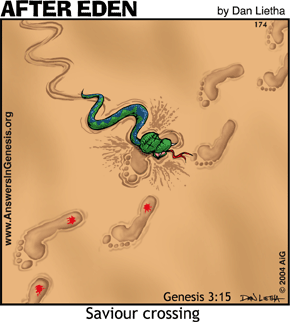
 Genesis 3:15 “I will put enmity between you and the woman, and between your offspring and her offspring; he shall bruise your head, and you shall bruise his heel.”
From an article by Nicholas T. Batzig found one of the leading Southern Presbyterian theologians of the 19th Century, set down 8 points of interpretion of Genesis 3:15 in his biblical-theological masterpiece “Discourses of Redemption.” In short, Robinson was seeking to highlight what our first parents could have known from the first preaching of the Gospel (what he called “the Gospel creed”) when he wrote:
Thus it will be seen, on careful analysis of these words, and deducing the truths embodied by implication in them, that they set forth these eight points of the gospel creed.
1. That the Redeemer and Restorer of the race is to be man, since he is to be the seed of the woman.
2. That he is, at the same time, to be a being greater than man, and greater even than Satan; since he is to be the conqueror of man’s conqueror, and, against all his efforts, to recover a sinful world which man had lost; being yet sinless, he must therefore be divine.
3. That this redemption shall involve a new nature, at “enmity” with the Satan nature, to which man has now become subject.
4. That this new nature is a regeneration by Divine power; since the enmity to Satan is not a natural emotion, but, saith Jehovah, “I will put enmity,” &c.
5. This redemption shall be accomplished by vicarious suffering; since the Redeemer shall suffer the bruising of his heel in the work of recovery.
6. That this work of redemption shall involve the gathering out of an elect seed a “peculiar people” at enmity with the natural offspring of a race subject to Satan.
7. That this redemption shall involve & perpetual conflict of the peculiar people, under its representative head, in the effort to bruise the head of Satan, that is, “to destroy the works of the Devil.”
8. This redemption shall involve the ultimate triumph, after suffering, of the woman’s seed ; and therefore involves a triumph over death and a restoration of the humanity to its original estate, as a spiritual in conjunction with a physical nature, in perfect blessedness as before its fall.
Such, then, is the gospel theology here revealed, in germ, through the very terms of the curse pronounced upon the destroyer of the race. It will be seen that here are all the peculiar doctrines of salvation, by grace, which every Christian accepts, who exercises the faith which is unto salvation. And in the broader and higher sense of the terms, Moses, as truly as Mark at the opening of his evangel, might have prefixed to this third chapter of Genesis the title, “The beginning of the gospel of Jesus Christ the Son of God.”
 When it comes to how we preach when unbelievers are present to hear us (which I assume is any time we preach), there is a big difference between the approach of Ken Ham (of Answers in Genesis) and that of well known pastor, Andy Stanley (son of Charles Stanley).
 It is a subtle, but important distinction. I approve the desire to think God’s thoughts after Him. I fear though that I am sometimes tempted to approve God’s thoughts only when they agree with mine. A few weeks ago during a Question and Answer time at Ligonier’s annual conference I honestly answered a question as to my views on the age of the earth. I’m a young earth guy. Have been for twenty years. Though there were other young earth guys on the panel, and all the gentlemen on the panel are in my judgment fine, godly men, I found myself humbled by the enthusiastic support of the young earthers in the crowd, as if I had taken some sort of odd, bold and prophetic stand.
 Now it may well be that we young earthers are the geo-centrists of our day. It may well be that the best, most faithful understanding of Genesis is a Framework view, or some other view that requires an old earth. In short, I could be wrong. Geology, however, biology, astro-physics will not be how I come to know I am wrong. It would take the Bible to do that.