Even so, come Lord Jesus

Jonathan Edwards, preaching on Sept. 19, 1746, at the ordination service of Samuel Buell, the dear friend of David Brainerd:

In that resurrection morning, when the Sun of Righteousness shall appear in the heavens, shining in all his brightness and glory, he will come forth as a bridegroom; he shall come in the glory of his Father, with all his holy angels.

And at that glorious appearing of the great God, and our Savior Jesus Christ, shall the whole elect church, complete as to every individual member and each member with the whole man, both body and soul, and both in perfect glory, ascend up to meet the Lord in the air, to be thenceforth forever with the Lord. That will be a joyful meeting of this glorious bridegroom and bride indeed. Then the bridegroom will appear in all his glory without any veil: and then the saints shall shine forth as the sun in the kingdom of their Father, and at the right hand of their Redeemer. . . .

Then will come the time, when Christ will sweetly invite his spouse to enter in with him into the palace of his glory, which he had been preparing for her from the foundation of the world, and shall as it were take her by the hand, and lead her in with him: and this glorious bridegroom and bride shall with all their shining ornaments, ascend up together into the heaven of heaven; the whole multitude of glorious angels waiting upon them: and this Son and daughter of God shall, in their united glory and joy, present themselves together before the Father; when Christ shall say, ‘Here am I, and the children which thou hast given me’: and they both shall in that relation and union, together receive the Father’s blessing; and shall thenceforward rejoice together, in consummate, uninterrupted, immutable, and everlasting glory, in the love and embraces of each other, and joint enjoyment of the love of the Father.

–Jonathan Edwards, ‘The Church’s Marriage to Her Sons, and to Her God,’ in The Works of Jonathan Edwards, Vol. 25: Sermons and Discourses, 1743-1758 (Yale University Press, 2006), 183-84

Common Grace and the End of the World

Justin Taylor writes:

John Murray’s definition of “common grace” is perhaps the most concise and helpful one available:

every favour of whatever kind or degree, falling short of salvation, which this undeserving and sin-cursed world enjoys at the hand of God (Collected Works, II:96).

Sam Storms has written a very helpful overview of the doctrine, originally written in light of Hurricane Katrina and its damage. He summarizes the biblical evidence under four headings:

1.God exercises restraint on sin and evil.
2.God freely suspends the immediate manifestation of his divine wrath due unto sin.
3.God holds in check the destructive tendencies that are part of the curse of sin upon nature.
4.God bestows upon both nature (see esp. Ps. 65:9-13; 104:10-30; 145:1-16; 136:25) and humanity manifold blessings both physical and spiritual that fall short of redemption itself.

At the end of the essay, he looks at what this means for the end of the world. If you’ve ever been confused about the way in which the Bible seems to talk about things getting worse and worse, while also talking about things getting better, here is an introduction to what Storms thinks is the biblical perspective:

As we approach the second coming of Christ, whether that be one year or one-thousand years in the future, I believe the presence and power of common grace will progressively diminish. The restraining power of the Spirit on the sinful souls of men and women, as well as on the natural creation, will incrementally weaken. The manifestation of human sin and wickedness and unbelief will therefore expand.

Common grace is much like the emergency break on a car that is parked on a steep incline. The weight of the car, together with the force of gravity, would naturally result in its descent down the road and its eventual crash. But the emergency break resists and impedes this otherwise natural inclination. So, too, with human sin. The Holy Spirit is like an emergency break on the human heart. But one day, perhaps imperceptibly and certainly in gradual fashion, the restraint on the sinful and depraved inclination of the human soul will be removed.

But here is the good news. I also believe that together with the progressive withdrawal of common grace will be a corresponding increase of special grace! The people of God will experience fresh and ever-increasing manifestations of divine favor and power and blessing and anointing simultaneously with the withdrawal of the Spirit’s common grace work of curbing the sinful impulses of the lost. This is why there will be an increase of wickedness and persecution (and, yes, martyrdom) in the world at large at the same time there is an increase of righteousness and perseverance in the church in particular.

My “theory” (which I do believe has Scriptural support) is that the Church will experience great revival, ever-increasing impartations of supernatural power, unprecedented expressions of love and unity, all the while she is being oppressed and persecuted and increasingly hated by the unbelieving world. Special grace will intensify even as common grace will diminish.

I should also point out that this process will culminate eternally in what we know as heaven and hell. Heaven is the unabated overflow of special grace. Hell is the utter absence of even common grace. Forever.

So what should be the Christian’s response to Katrina and the devastation she wrought? We should, no pun intended, flood the people who are suffering with expressions of kindness and compassion and generosity, knowing that such devastation could as easily fall on us (cf. Luke 13:1-5). As the Spirit’s provision of common grace diminishes, may the recipients of his special grace overflow in the goodness of Jesus to the glory of God the Father.

616, the Number of the Beast?

Daniel B. Wallace, Ph.D writes:

There has been a flurry of interest in the number of the Beast in Canadian and American newspapers of late. The reason for the interest is that the Beast’s number might not be 666.

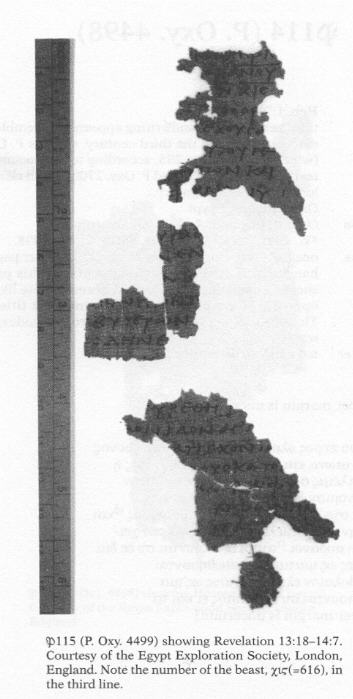
A few years ago, a papyrus of Revelation was discovered. It was badly damaged, having only about twenty fragments that spanned nine chapters. One fragment, in particular, is of interest. About the size of a postage stamp, it includes part of Revelation 13.18. There we read, “This calls for wisdom: Let the one who has insight calculate the beast’s number, for it is man’s number, and his number is 666” (NET Bible). But the papyrus (known as P115) has a different number here: 616.

I saw the fragment four years ago at the Ashmolean Museum of Oxford University. It was published over six years ago; just now it is making its way into popular literature as though it were a new discovery. When I looked at the fragment, the curator had to slice open its case because the verse in question was on the backside. He told me that no one had asked to see the fragment since it had been published. I looked at it under a microscope to make sure that the wording had not been tampered with. But even with the naked eye, it was quite legible. I am inclined to the view that the original wording here was 616, but a lot of work is needed to determine this. Although this is the earliest fragment for this portion of Revelation (third or fourth century), the fragment’s textual affinities and general reliability still need to be examined fully.

Further, the number 616 was known in antiquity and was discarded in the second century. Irenaeus, the patristsic commentator, wrote a chapter on the number of the beast, arguing that in the better manuscripts of Revelation that he had seen the number was 666 instead of 616. To be sure, his perspective was theologically motivated (he gave the interpretation of 666 as striving for perfection [represented by the number 7] but never able to achieve it). But the fact that he was writing in the second century tells us that BOTH numbers existed at that time. It may well have been Irenaeus’ input that caused scribes to alter the text to 666 if 616 was in the exemplar that they used.

Indeed, we know of one other manuscript (Codex C, from the fifth century) that has 616, and two others used to exist (codices 5 and 11) that had this number. But the point here is that one cannot simply appeal to the earliest manuscript and assume that the case is settled. Textual criticism is not done in such a simplistic manner. Date is indeed important, but there are several other factors involved. The Center for the Study of New TestamentManuscripts has begun to investigate whether this is the authentic number of Revelation. It will take scores of hours of research, and the results will not be certain. But if 616 is indeed the number of the beast, it will certainly have interesting implications. In the least, it will send seven tons of popular Christian literature to the flames!