
A Summary of My Eschatological Convictions

The Bible tells one story centering on the Person of the Lord Jesus Christ. It unfolds through God’s covenantal purposes and moves toward the consummation of all things in Him. The categories below are simply an attempt to summarize how I understand that story and its culmination.


The Positional Framework

Amillennial

I understand the millennium of Revelation 20 as the present reign of Christ between His first and second comings (Rev. 20:1–6). Christ is already enthroned at the right hand of the Father and reigns now with all authority in heaven and on earth (Matt. 28:18; Acts 2:33–36; 1 Cor. 15:25–26). I therefore reject the idea of a distinct future earthly millennial kingdom following the return of Christ.

Partial Preterist

I understand many of the signs and judgments in passages such as Matthew 24 to have had a real first-century fulfillment in the events surrounding AD 70, marking the end of the old covenant order (Matt. 24:1–34; Luke 21:20–24, 32). At the same time, I affirm a future, visible, bodily return of Christ at the end of history, along with the resurrection of the dead and the final judgment (Acts 1:11; John 5:28–29; 1 Thess. 4:16–17; Rev. 1:7).

Covenantal

My framework is rooted in the 1689 London Baptist Confession and the broader Reformed understanding of Scripture and redemptive history. I understand the Bible to reveal one coherent plan of redemption centered in Christ, in whom all the promises of God find their Yes and Amen (Luke 24:27, 44; 2 Cor. 1:20; Gal. 3:16; Heb. 1:1–3).

Two-Age Model

I understand the New Testament’s eschatology to be governed by the biblical pattern of this age and the age to come (Matt. 12:32; Mark 10:30; Luke 18:29–30; Eph. 1:20–21). This present age continues until the return of Christ, while the age to come arrives in fullness at the consummation.

Already / Not Yet

The relationship between these two ages is central to the whole framework. In Christ, the age to come has already broken into history, though its fullness still awaits consummation (Heb. 6:5). Believers already taste the powers of the world to come, have already been raised with Christ in principle, and already belong to the new creation, yet still await the resurrection body and the full renewal of all things (Rom. 8:23; 2 Cor. 5:17; Eph. 2:4–6; Col. 3:1–4).

Non-Dispensational

I reject any division of redemptive history into separate divine programs for two peoples of God. Instead, I affirm one redeemed people of God across both Testaments, in keeping with a classic covenantal understanding (Rom. 11:17–24; Gal. 3:28–29; Eph. 2:11–22). The church is not a parenthesis in the plan of God, but the gathered people of God in union with the Messiah.

One Future Bodily Return, One General Resurrection, One Final Judgment

I believe that the return of Christ, the resurrection of the dead, and the final separation of the righteous and the wicked occur together at the end of the age (Dan. 12:2; John 5:28–29; Matt. 13:39–43, 49–50). These realities belong to the last day, the final trumpet, the harvest, and the consummation (1 Cor. 15:22–26, 51–52; 2 Thess. 1:6–10). Hyper-preterism, or full preterism, is therefore ruled out and must be rejected as heretical, because it denies essential future realities plainly taught in Scripture.

Further Clarifications

Three further clarifications follow from all of this. Scripture interprets current events, not vice versa (2 Pet. 1:19–21). No future rebuilt temple is required, since Christ is the true Temple and His people are God’s temple in Him (John 2:19–21; Eph. 2:19–22; 1 Pet. 2:5). And Christ’s second coming will be universal, visible, and cosmic, not secret, localized, or merely symbolic (Acts 1:11; Matt. 24:27; 1 Thess. 4:16–17; Rev. 1:7).


The Church as the Fulfilled People of God in Christ

Christ at the Center of All God’s Purposes

These positional convictions are not ends in themselves. They are grounded in a larger biblical reality: the New Testament presents one people of God, gathered at last in and through the Lord Jesus Christ (John 10:16; 11:51–52; Eph. 2:14–16). The church is not a parenthesis in the plan of God, nor a temporary interruption in a supposedly separate program for ethnic Israel. This does not erase ethnic Jews as a distinct people group, but it does mean that covenant membership and the saving promises of God are found only in Christ. The church is the fulfilled people of God in Christ, made up of all who belong to Him by faith, Jew and Gentile alike (Gal. 3:28–29; Eph. 2:19–22).

This is because Christ Himself stands at the center of all God’s saving purposes. He is the promised Son of David (Luke 1:32–33), the true King (Matt. 28:18), the true Seed of Abraham (Gal. 3:16), the true Temple (John 2:19–21), the final Sacrifice (Heb. 10:10–14), the great High Priest (Heb. 4:14–16), the faithful Israelite (Matt. 2:15; Isa. 49:3–6), and the heir of all the promises of God (2 Cor. 1:20). Everything the old covenant anticipated finds its fulfillment in Him. Therefore, all who are united to Christ share in what He has accomplished and inherit what He has secured (Rom. 8:16–17; Gal. 3:29).

We Have a King

Christ is our King. After His resurrection and ascension, He was exalted to the right hand of the Father and now reigns from heaven with all authority in heaven and on earth (Matt. 28:18; Acts 2:33–36; Eph. 1:20–22). His reign is not postponed to some future earthly arrangement. It is a present reality. The risen Christ now governs all things for the sake of His people (1 Cor. 15:25; Eph. 1:22–23).

We Have a Kingdom

Because Christ is King, He has a kingdom. Yet His kingdom is not earthly in origin, nor is it confined by national borders, political structures, or ethnic lines (John 18:36; Rom. 14:17). It is the saving reign of God breaking into history through the Messiah (Matt. 12:28; Mark 1:14–15). Entrance into this kingdom comes not through physical descent from Abraham, but through the new birth (John 1:12–13; 3:3, 5). What was once foreshadowed in old covenant forms is now revealed in its greater and spiritual reality in Christ.

We Are His People

The church is the gathered people of God in Christ. Jesus came to gather into one the children of God scattered abroad (John 11:51–52). He has one flock and one Shepherd (John 10:16). In Him the dividing wall has been broken down, so that Jew and Gentile alike are reconciled in one body through the cross (Eph. 2:14–16). The church is not a secondary people of God. It is the covenant people of God brought to fulfillment in the Messiah (Gal. 3:28–29; Eph. 2:19–22).

Christ Is the True Shepherd, Sacrifice, Priest, and Temple

Christ is the Shepherd of His people. He gives eternal life to His sheep and lays down His life for them (John 10:9–11, 27–28). He is the once-for-all sacrifice who takes away sin (Heb. 7:27; 9:12, 26; 10:10–14). He is our great High Priest, who intercedes for us in the presence of God (Heb. 4:14–16; 7:25; 1 John 2:1). And He is the true Temple, the dwelling place of God with man (John 2:19–21; Col. 2:9), in whom all the old covenant shadows reach their fulfillment.

Because believers are united to Christ, the church is now the temple of God. Built on the foundation of the apostles and prophets, with Christ Jesus Himself as the cornerstone, the church is a holy dwelling place for God by the Spirit (Eph. 2:19–22). Believers, individually and corporately, are living stones in this spiritual house (1 Cor. 3:16–17; 2 Cor. 6:16; 1 Pet. 2:5).

We Have True Worship

Jesus made clear that the age of worship centered on a physical location was coming to an end (John 4:21). In the new covenant, worship is no longer tied to Jerusalem or to a physical temple, but is offered in Spirit and truth through Christ (John 4:23–24; Phil. 3:3). This is not less real worship, but more. The shadows have given way to the substance (Col. 2:16–17; Heb. 8:1–6).

We Are Abraham’s Offspring in Christ, Not by Ethnicity

The promises made to Abraham were never merely about ethnicity. They were ultimately centered in Christ, the true Seed (Gal. 3:16). All who belong to Christ by faith are counted as Abraham’s children and heirs according to promise (Gal. 3:7, 29; Rom. 4:11–17). Abraham himself looked forward to Christ’s day and rejoiced (John 8:56). Thus, the family of Abraham is defined not by bloodline, but by union with the Messiah through faith.

The New Testament confirms this by teaching that outward covenant markers never guaranteed saving membership among the people of God (Rom. 9:6–8). True circumcision is a matter of the heart, wrought by the Spirit (Rom. 2:28–29; Phil. 3:3). This does not erase ethnic distinctions in the ordinary sense, but it does mean that covenant identity before God is no longer defined by race, genealogy, or old covenant boundary markers. In Christ, what matters is a new creation (Gal. 6:15; Col. 2:11–12).

We Are the Holy Nation

Jesus warned that the kingdom would be taken from unfaithful leaders and given to a people producing its fruits (Matt. 21:43). Peter applies old covenant covenantal language directly to the church, calling believers a chosen race, a royal priesthood, a holy nation, and a people for God’s own possession (1 Pet. 2:9–10; cf. Ex. 19:5–6). This is not because the church exists apart from Israel’s story, but because in Christ that story has reached its fulfillment.

We Are the New Covenant People

The new covenant is realized in Christ and belongs to those who are united to Him by faith (Jer. 31:31–34; Luke 22:20; Heb. 8:6–13). The Jewish remnant that believed in Jesus entered into that covenant reality in the apostolic age, and believing Gentiles were then brought in as full fellow heirs (Acts 2; Acts 10; Eph. 3:4–6). The result is one body, one flock, one temple, one people (Eph. 2:19–22; 4:4–6).

A Needed Clarification

This position does not erase ordinary ethnic distinctions, nor does it encourage arrogance toward ethnic Jews (Rom. 11:18–21). It does mean that the saving promises of God are fulfilled only in Christ, and that both Jew and Gentile must come to God through Him by faith in the Messiah (John 14:6; Acts 4:12; Rom. 10:12–13). Ethnic Israel has no separate saving track or parallel covenant destiny apart from Christ, but neither should this truth ever be expressed with pride, contempt, or dismissiveness. There is no need to rebuild old covenant shadows once the substance has come (Col. 2:16–17; Heb. 8:13).

We Have an Inheritance

The inheritance of God’s people is no longer to be understood in narrow old covenant, typological terms. The land itself pointed forward to something greater. In Abraham, the promise expanded to embrace the world (Rom. 4:13), and in Christ the final inheritance is the kingdom of God, eternal life, the resurrection, and the new creation (Matt. 5:5; Heb. 11:13–16; Rev. 21:1–7). The old covenant order has reached its fulfillment in Christ and has therefore passed away as a covenantal administration (Heb. 8:13). Its types and shadows have served their purpose. The substance belongs to Christ, and all who are His share in that inheritance (Col. 2:17; Gal. 3:29).


The Main Point

The church should not be understood as a detached entity running alongside Israel in a separate divine plan. Nor should Christ be fitted into a system that leaves old covenant structures standing as though they were still awaiting their true meaning. Rather, Christ is the fulfillment of all that came before, and the church is the gathered people of God in Him (Luke 24:27, 44; 2 Cor. 1:20; Eph. 2:11–22).

He is the true King (Matt. 28:18). He brings the true Kingdom (Mark 1:14–15). He is the true Temple (John 2:19–21). He is the true Sacrifice (Heb. 10:10–14). He is the true High Priest (Heb. 4:14–16). He is the true Seed of Abraham (Gal. 3:16). He is the heir of all the promises (2 Cor. 1:20).

And because we are united to Him by faith, we are His people, His flock, His temple, His priesthood, and heirs with Him of the world to come (Rom. 8:16–17; Gal. 3:29; 1 Pet. 2:5, 9).

In short: Christ has come, Christ now reigns, Christ is coming again. His people are one. His promises are fulfilled in Him. The best is still ahead.

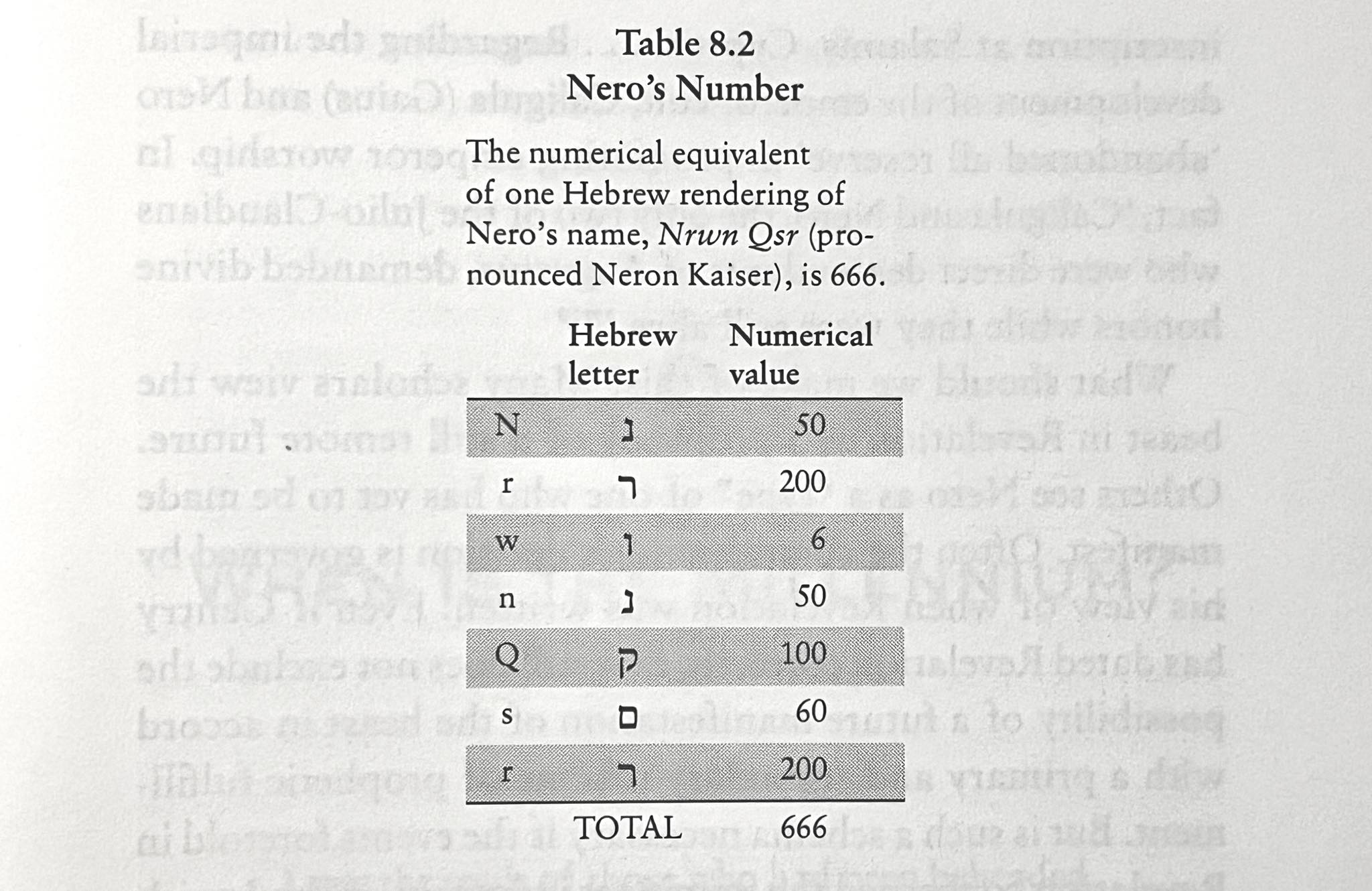
Nero and 666

Interesting: From R.C. Sproul‘s “The Last Days According to Jesus,” p. 203:

More on this from Sproul in the above mentioned book.

Dr. Sproul addresses the question, “Are we living in the end times described in the book of Revelation?” here.

The Future Resurrection of the Body

Jason L. Bradfield writes (on facebook):

Gary DeMar and Kim Burgess dropped the first of their podcasts on 1 Corinthians 15 today. If either of them turned this in at Whitefield Theological Seminary, it’d get an F. It’s that bad. I immediately got to typing and here is my quick reaction:

– The Same Old Word-Game on Mellō

Gary (and Kim) is still stuck insisting that mellō always means “about to,” even though he’s never proven it and has flat-out ignored my challenge to him on Acts 26:22.

They do the same thing with the word parousia. Now, a person may agree that every use of parousia refers to the same event, but it’s one thing to demonstrate that exegetically, and quite another to assume it because you’ve bought into this strange notion that words in Scripture can only ever mean one thing.

That’s not scholarship; that’s laziness.

– Twisting the Creeds: The False Claim About the Nicene “Correction”

It gets worse. They actually claim that the Nicene Creed corrected the Apostles’ Creed by changing “resurrection of the body” to the supposedly more “biblical” phrase, “resurrection of the dead.” As if the body isn’t even in view in 1 Corinthians 15! From verse 35 through verse 44, Paul uses the Greek word sōma (“body”) ten times. Yet Kim goes so far as to say that “resurrection of the flesh” is a “contradiction in terms.”

How? Of course, Kim never explains how. The only way he could possibly arrive at that conclusion is if he treats flesh (sarx) the same way they treat mellō; as if it only has one meaning everywhere it appears. But “flesh” in Scripture clearly has a range of meanings.

– Christ’s Resurrection Was of the Flesh

And what then are we to do with Christ’s resurrection, which these men claim to affirm? Christ’s resurrection was bodily. It was of the flesh. His fleshly body died and rose again.

“As they were talking about these things, Jesus himself stood among them, and said to them, ‘Peace to you!’ But they were startled and frightened and thought they saw a spirit. And he said to them, ‘Why are you troubled, and why do doubts arise in your hearts? See my hands and my feet, that it is I myself. Touch me, and see. For a spirit does not have flesh and bones as you see that I have.'” (Luke 24:36–39)

“For a spirit (pneuma) does not have flesh (sarx) and bones (osteon) as you see I have.”

Obviously, then, “resurrection of the flesh” is not a “contradiction in terms.”

– The Historical Record: No Evidence of a Bodiless Creed

There’s absolutely no evidence that the Nicene Creed was “correcting” the Apostles’ Creed to avoid the idea of flesh being involved in the resurrection. And if that were their intent, it would actually be a denial of the Apostles’ Creed itself; a point that completely flies over DeMar’s head. You can’t redefine a doctrine and then claim to affirm it.

The hyper-preterist claim that the 381 Creed was a “corrective” to deny bodily resurrection has no support in the sources whatsoever.

On every front—creed manuscripts, council records, and patristic theology—the early Church consistently taught that bodies will rise again. The phrase “resurrection of the dead” in the Nicene Creed was always understood in full continuity with “resurrection of the body” or “resurrection of the flesh,” not as a covert denial of a physical resurrection.

The Fathers used dead and body/flesh interchangeably in reference to the same hope. The idea that Nicaea (or Constantinople) quietly erased bodily resurrection is historical revisionism of the worst kind.

– The “Burros of Berea” Problem

And all of this follows a rather dishonest admission from Gary at the start of the episode. He claims he was dragged into this controversy because of comments he made years ago on the Burros of Berea podcast.

According to him, he was merely describing that some people believe you receive your resurrection body at death, and he supposedly just said he “had no problem” with that view. He insists he wasn’t rejecting the traditional view; just acknowledging another perspective.

But the dishonesty lies in the fact that Gary was specifically asked what he personally believes:

“When your body takes its last breath, what is your belief?”

He answered, and I quote:

“I believe that when you die, you go to be with the Lord, and you get a new body at that time.”

Here’s the recording: https://www.reformation.blog/…/gary-demar-denies-the…

So no, Gary wasn’t simply pointing out what others believe. He explicitly said that he believes that very thing. He denied the resurrection of the body in that podcast—plain and simple—and now he’s trying to rewrite history as if he didn’t.

– “It Doesn’t Affect Worldview”? Think Again

What makes this even more absurd is his claim in this latest episode that he didn’t have a problem with that belief because, in his words,

“…to me, it’s not a factor in terms of worldview thinking. What happens when we die doesn’t come into play in terms of how we’re living out the Christian faith in the world in which we live today.”

Oh, really? Ever read 1 and 2 Peter, Gary? Or Romans 8? Or Philippians 3?

I would argue, and have argued in our sermon series, that the hope of bodily resurrection is precisely the foundation for how we live as Christians in the world today. It’s not some detached doctrinal curiosity; it’s the heartbeat of Christian ethics and endurance.

Peter grounds the entire moral and pastoral force of his letters in the certainty of the coming judgment and the future resurrection. The call to holiness, perseverance, and hope flows directly out of that eschatological reality.

“He has caused us to be born again to a living hope through the resurrection of Jesus Christ from the dead, to an inheritance that is imperishable, undefiled, and unfading, kept in heaven for you, who by God’s power are being guarded through faith for a salvation ready to be revealed in the last time.” (1 Peter 1:3–5)

In 1 Peter 1:13-16, the imperative “set your hope fully” is explicitly future-oriented. Holiness in the present is the ethical outworking of fixing one’s hope on the eschatological revelation of Christ. Peter’s “therefore” shows that eschatology drives ethics.

“Therefore, preparing your minds for action, and being sober-minded, set your hope fully on the grace that will be brought to you at the revelation of Jesus Christ.”

In 1 Peter 1:17-21, Peter ties obedience in this life to the coming judgment. The believer’s conduct is shaped by the knowledge that the Father will judge impartially; a future eschatological reckoning.

“If you call on him as Father who judges impartially according to each one’s deeds, conduct yourselves with fear throughout the time of your exile…”

In 1 Peter 2:11-12, the “day of visitation” is a future day of divine judgment or vindication. Present moral purity and good works serve evangelistic and eschatological purposes.

“Beloved, I urge you as sojourners and exiles to abstain from the passions of the flesh, which wage war against your soul. Keep your conduct among the Gentiles honorable, so that when they speak against you as evildoers, they may see your good deeds and glorify God on the day of visitation.”

In 1 Peter 4:7-10, Peter explicitly links ethical behavior—sobriety, prayer, and love—to eschatological imminence. The nearness of “the end” demands alert, holy living. And no, we’re not ignoring the so-called “time texts,” such as verse 7. Kim and Gary keep slanderously accusing us of that, but it’s simply false.

“The end of all things is at hand; therefore be self-controlled and sober-minded for the sake of your prayers. Above all, keep loving one another earnestly, since love covers a multitude of sins. Show hospitality to one another without grumbling. As each has received a gift, use it to serve one another, as good stewards of God’s varied grace:”

In 1 Peter 4:12-13, present suffering is interpreted through the lens of future glory. The eschatological revelation of Christ’s glory gives meaning and endurance to persecution.

“Beloved, do not be surprised at the fiery trial when it comes upon you to test you, as though something strange were happening to you. But rejoice insofar as you share Christ’s sufferings, that you may also rejoice and be glad when his glory is revealed.”

In 1 Peter 5:1-4, pastoral faithfulness and humility are sustained by the expectation of Christ’s future appearing and reward. Again, eschatology shapes vocation and character.

“When the chief Shepherd appears, you will receive the unfading crown of glory.”

In 2 Peter 1:10-11, ethical diligence leads to eschatological assurance. Present godliness confirms the believer’s readiness for entry into Christ’s eternal kingdom.

“Be all the more diligent to confirm your calling and election, for if you practice these qualities you will never fall. For in this way there will be richly provided for you an entrance into the eternal kingdom of our Lord and Savior Jesus Christ.”

Furthermore, Peter makes it unmistakably clear that false doctrine and moral corruption go hand in hand. The heretics he describes in 2 Peter 2–3 are not merely confused interpreters; they are willful deceivers whose denial of the Lord’s return is directly linked to their immoral lifestyle.

In 2 Peter 2, their character and conduct are on full display: they are “bold and willful” (2:10), “slaves of corruption” (2:19), and “blots and blemishes” (2:13). Their theology accommodates their lusts. They deny “the Master who bought them” (2:1) and twist the promise of His coming into an excuse for sin. Their doctrinal deviation is moral at its root. They scoff at judgment because they love their own depravity.

Peter ties the progression together in 2 Peter 3:3–4:

“Scoffers will come in the last days with scoffing, following their own sinful desires. They will say, “Where is the promise of his coming? For ever since the fathers fell asleep, all things are continuing as they were from the beginning of creation.””

They dismiss the Second Coming because it threatens their autonomy. The denial of eschatological judgment becomes the license for unrestrained living.

Peter answers their cynicism by reminding believers of two things: the certainty of divine judgment (3:7) and the patience of God in salvation (3:9). The same God who once judged the world by water will again judge by fire. Far from being delayed, the Lord’s timing is merciful, giving room for repentance before the final reckoning.

In other words, to scoff at the Second Coming is to scoff at holiness itself. When false teachers erase the future return of Christ, they remove the moral horizon that keeps the church sober, humble, and watchful.

And Peter could not be any clearer than 2 Peter 3:10-14:

“But the day of the Lord will come like a thief, and then the heavens will pass away with a roar, and the heavenly bodies will be burned up and dissolved, and the earth and the works that are done on it will be exposed. Since all these things are thus to be dissolved, what sort of people ought you to be in lives of holiness and godliness, waiting for and hastening the coming of the day of God, because of which the heavens will be set on fire and dissolved, and the heavenly bodies will melt as they burn! But according to his promise we are waiting for new heavens and a new earth in which righteousness dwells. Therefore, beloved, since you are waiting for these, be diligent to be found by him without spot or blemish, and at peace.”

Having exposed the false teachers’ denial of judgment, Peter brings his letter to a climactic close by grounding true Christian living in the certainty of that judgment and the promise of renewal. The destruction of the old and the creation of the new are not speculative curiosities — they are moral imperatives.

Eschatology is not an appendix to doctrine; it is the heartbeat of Christian ethics. The same certainty that “all these things will be dissolved” also guarantees that there will be “new heavens and a new earth in which righteousness dwells.” Those twin truths — dissolution and renewal — demand lives marked by holiness, godliness, diligence, and peace.

Future righteousness defines present conduct. The believer’s anticipation of the coming age shapes his moral integrity in this one. We live as citizens of the world to come, waiting for what God has promised, and our purity now is the visible evidence that our hope is genuine.

That is why Peter closes his letter with this sober exhortation:

“You therefore, beloved, knowing this beforehand, take care that you are not carried away with the error of lawless people and lose your own stability. But grow in the grace and knowledge of our Lord and Savior Jesus Christ.” (2 Peter 3:17–18)

Sound doctrine and sound living rise and fall together. A distorted eschatology always leads to ethical collapse, just as we see today among those who, like Gary and Kim, scoff at the promise of Christ’s appearing while claiming to defend biblical consistency.

To argue, as Gary does, that the resurrection and the new heavens and new earth have no bearing on our present lives is not merely misguided, it is spiritually disastrous. Peter would have called such reasoning blindness. The entire moral framework of Christian faithfulness rests on the certainty of future resurrection and renewal.

“If the dead are not raised, “Let us eat and drink, for tomorrow we die.” Do not be deceived: “Bad company ruins good morals.” Wake up from your drunken stupor, as is right, and do not go on sinning. For some have no knowledge of God. I say this to your shame.” (1 Corinthians 15:32-34)

The apostles never treat the promise of the new creation as a minor point for debate. For them, it is the engine that drives Christian perseverance and purpose. The coming reality of resurrection gives meaning to obedience, courage to suffering, and direction to hope. Because this world will be dissolved and remade, believers live now as heirs of that world, walking in holiness and hope.

To detach Christian ethics from eschatology is to strip Christianity of its horizon. Without the expectation of bodily resurrection, holiness becomes optional, suffering loses its context, and hope collapses into sentimentality.

Peter’s eschatology does not pull believers away from faithful living; it propels them into it. It sanctifies our present engagement in the world by fixing our eyes on the one to come. The creation itself will be freed from corruption; righteousness will dwell upon a renewed earth; and our resurrected bodies will share in that glory. The future is not irrelevant to the present. It defines it.

To deny that connection, as Gary does, is to preach a Christianity without resurrection power and a faith without forward motion.

And this is precisely what Peter warns against. The false teachers of his day scoffed at the coming judgment and therefore abandoned holiness. Their denial of Christ’s return was not an innocent exegetical error; it was a moral rebellion disguised as theology. Once the expectation of resurrection and renewal is stripped away, the call to righteousness loses its urgency, and corruption rushes in to fill the vacuum.

That same pattern repeats itself today. Those who mock the future hope of Christ’s appearing — while boasting of their “consistency” — reveal that their theology serves their desires, not the text. And Peter would have recognized them instantly.