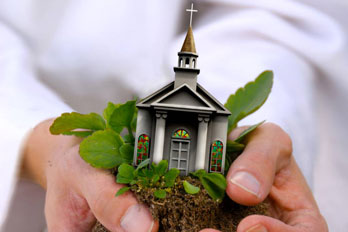
Can We Have Jesus without the Church?

Article by Brett McCracken, senior editor for the Gospel Coalition and the author of Hipster Christianity and Gray Matters. He also writes regularly for Christianity Today and his website, BrettMcCracken.com. He lives with his wife in Southern California where he serves as an elder at Southlands Church. (original source here)

Do Not Cut Yourself Off from the Body of Christ

Ephesians 5 is often looked to as an instructive passage for marriage, and it is. But I think it is also an instructive passage about the church, especially in an age where many evangelicals have a take-it-or-leave-it ecclesiology somewhere between “I love Jesus but not the church” and “I’ll go to church but only as long as it meets my needs.”

When Paul says “Christ is the head of the church, his body,” it is a statement of union, of one-flesh connectedness. A head is necessarily connected to a body. The head directs the body and has authority over the body but also needs a fully functioning body for effective movement in the world. In a profoundly mysterious way, Christ has humbly attached himself to an imperfect body (those who believe in him) and loved this body, filling it with his sanctifying Spirit so that it will be perfected for that future moment of “without spot or wrinkle” glory. In the meantime the church is still imperfect.

Sadly, the still-imperfect nature of the church proves too challenging for some. They prefer to be “spiritual but not religious.” They embrace Jesus but ditch the church, oblivious to the fact that in so doing they are creepily embracing a decapitated head. Or those who do recognize the importance of the biblical idea of church simply redefine “church” on their terms. These are the people who love saying, “You don’t go to church. You are the church.” This is Donald Miller, who says he connects with God more outside of church and says “the church is all around us, not to be confined by a specific tribe.”1 This is Rob Bell, who now believes church is simply doing life in a beach community with one’s “little tribe of friends” (“We’re churching all the time”).2

But how much can we really grow when we define church on our terms, within the framework of our preferences and proclivities and with a “tribe” of people who “connect with God” most by surfing and enjoying craft beer together? As R. C. Sproul says, “It is both foolish and wicked to suppose that we will make much progress in sanctification if we isolate ourselves from the visible church.”3

Or listen to Spurgeon, who is (God bless him) characteristically blunt about the matter:

I believe that every Christian ought to be joined to some visible Church—that is his plain duty according to the Scriptures. God’s people are not dogs, otherwise they might go about one by one. They are sheep and, therefore, they should be in flocks.4 Continue reading

The Marks of a True Church

Question: What are the marks of a true church? I have heard people say there are three: 1. The preaching of the gospel takes place. 2. The sacraments are rightly administered. 3. Church discipline is exercised.

I can see that all of these are biblical components. But are these all we should look for? What about prayer, love, evangelism, discipleship and practical care for people, etc?

Thanks for your question. Of course, many sects call themselves a “church.” Such has always been the case throughout Church history. Because of this, the Protestant Reformers in coming to understand the true Gospel of Christ, sought to help people distinguish between true and false churches. Since early on in Church history Christians have used the Apostles’ Creed and the Nicene Creed as summaries of the faith, to be affirmed by all Christians. If a Church has a problem affirming these basic doctrines found in these catholic creeds (the word catholic here means universal, meaning that all orthodox Christians would affirm these truths) it leads me to think that they do not embrace true and sound doctrine. If a Church cannot affirm essential truths such as the Trinity or the full deity and humanity of Christ, then it is embracing something else, and anything else is a heresy.

A heretical church by very definition cannot be a true church. It is vital that we get our doctrine right on the essentials of the faith. We only have to read Galatians chapter 1 to realize that if a church preaches another gospel, it comes under the anathema (the eternal curse) of God. That is why Martin Luther called the doctrine of sola fide (justification by faith alone) the article upon which the church stands or falls.

The Reformers were clear: The one true holy and apostolic church is present where (1) the word of God (and the Gospel) is preached and taught; (2) the sacraments of the church are rightly administered (namely baptism and the Lord’s Supper) and (3) church discipline is faithfully exercised. By implication, this third mark necessarily requires the presence of godly leadership (elders) who provide a safe place for the sheep to grow in Christ and who can ward off any wolves who seek to devour (see Acts 20). That is why Christians simply getting together for fellowship, though wonderful, without the oversight and care of elders, it does not consititute the gathering of a true Church. Christ, the Chief Shepherd has established His under shepherds for the care, protection and spiritual well being of His precious sheep (see Hebrews 13:17).

Other things are vital for church life as you rightly observed. We could add many more things to your list in fact. However these things flourish only where the three marks of the church are present.

For instance, lets talk about love. Love is absolutely vital for the health of a local church, yet we need to ask “how do we distinguish true Christian love from all imitations?” We do so by being exposed to the word of God. When God’s word is rightly preached and taught it actually cultivates true Christian love amongst the flock. It is a function of faithful shepherds of God’s church to (at certain times) bring caring, Christ like and Biblically based discipline to the church’s members, both as an act of love and as a means of cultivating genuine and authentic love among the church’s members.

I heard a good illustration some time back that I feel is worth sharing. Think of the three indispensable elements of a house: a foundation, a frame, and a roof. Many things may be installed in a house, such as couches, chairs, curtains, sinks, toilets, a bath or shower, a washer and dryer, an oven, electrical wiring, beds and so on. I am sure we agree that the list could be endless. Yet though I may have all of these things in a yard somewhere, I really don’t have a house until I have the three essentials elements of a foundation, a frame, and a roof.

There are many essential elements for healthy church life. Yet unless the Word of God is rightly preached and taught, the sacraments rightly administered, and church discipline is faithfully exercised, there is no true church present. Where these marks are absent, true holiness will be absent too. If even one of these three marks are missing it should not be considered to be a true church of Christ.

Belgic Confession:

Article 29: The Marks of the True Church

We believe that we ought to discern diligently and very carefully, by the Word of God, what is the true church– for all sects in the world today claim for themselves the name of “the church.” We are not speaking here of the company of hypocrites who are mixed among the good in the church and who nonetheless are not part of it, even though they are physically there. But we are speaking of distinguishing the body and fellowship of the true church from all sects that call themselves “the church.” Continue reading

What is a Church Covenant?

Article: Membership Matters – What is Our Church Covenant? By Matt Schmucker who was the founding executive director of 9Marks. He now organizes several conferences, including Together for the Gospel and CROSS, while serving as an elder at Anacostia River Church in Washington, D.C. (original source here)

INTRODUCTION

Professional athletic teams usually write a “moral clause” into their players’ contracts that will negate the financial package if the player fails to display at least a modicum of morally upright behavior. A few years back Jason Kidd was traded by the Phoenix Suns because he was charged with spousal abuse. Jason Kidd’s poor behavior off the court was reflecting poorly on the Phoenix Suns, and the Suns were concerned enough about the public reputation of their organization that they appealed to the moral clause in Kidd’s contract and disassociated themselves from him.

Back in the ‘80s IBM had a detailed dress code to which they required all their salesmen to adhere–dark suit, white shirt, dark tie. They wanted you to know when you were dealing with an IBM man; they wanted a certain image to be associated with their organization so that their corporate identity would have positive associations, and so that their corporate reputation would be excellent in the eye of the public.

These two examples underscore the importance of who we say we are, who we identify with, and how that public message and identification relate to how we actually live. In other words, we have to practice what we preach. And if this is true of the corporate world of computers and athletics, how much more is it true of the church corporately and of the Christian individually?

James warns us that “If anyone considers himself religious and yet does not keep a tight reign on his tongue, he deceives himself and his religion is worthless” (Js 1:26).

In other words, if you profess to be a Christian, but you don’t live a changed life, you should take no comfort in your faith. John says “We know that we have come to know him IF we obey his commands” (1John 2:3). In short, how we live matters. In this class, we’re particularly focused on how we live together as members of a local church.

WHAT IS A ‘CHURCH COVENANT’?

A church covenant can be described in five different ways.

A church covenant is a promise – a promise made to God, to a local church, and to one’s self.

A church covenant is a summary of how we agree to live. While our statement of faith is a good summary of what we believe, our church covenant is a summary of how we agree to live – more importantly, it is a summary of how God would have us live. It does not include every explicit command regarding obedience, but it does give a general summary of what it means to live as a disciple of Christ.

A church covenant is a sign of commitment – a commitment to God, to His church, and to personal holiness.

A church covenant is an ethical statement. Historian Charles W. DeWeese writes, “A church covenant is a series of written pledges based on the Bible which church members voluntarily make to God and to one another regarding their basic moral and spiritual commitments and the practice of their faith” (Baptist Church Covenants, p. viii). One theologian calls church covenants the “ethical counterpart to confessions of faith.”

A church covenant can be an important part of applying a Christian worldview to every aspect of our lives. Inherent in the purpose of a church covenant is the understanding that church membership involves being held accountable to live in a manner consistent with a common understanding of Scripture.

A church covenant is a biblical standard. A church covenant is helpful in a church that is practicing Biblical church discipline. As members of a church, we exhort one another to live holy lives, and we challenge brothers and sisters persisting in sin.

WHERE DO COVENANTS COME FROM?

Now that we know what church covenants are, where do they come from? Well, not from the Bible–not, at least, in the sense of being able to turn to the Book of Covenants chapter 3. But we do see examples of covenants both in the Old and the New Testament–covenants between God and man, and between man and man. Moses gives a covenant from God to the people of Israel. Ezra and Nehemiah do so as well. And in the NT we find that “Christ is the mediator of a new covenant, which is the new covenant in Christ’s blood”. Primarily, church covenants come from the understanding that churches are to be composed of people who are truly born again. This is what we call regenerate church membership.

In the 16th century, men and women of deep conviction broke away from the Roman Catholic Church to form congregations who understood the importance of the doctrine known as justification by faith alone in Christ alone. No longer did baptism or membership bring supposed new life. Joining and being part of a church was no longer a civic duty or just part of growing up. It was becoming what it was always intended to be – a response of faith to the truth of the gospel. And in this response of faith we gain the most amazing callings: children of the living God, ambassadors of Christ, a royal priesthood; we become the bearers of God’s name in the world. Listen to God’s word on this issue. “I will show the holiness of my great name, which has been profaned among the nations, the name you have profaned among them. Then the nations will know that I am the Lord, declares the sovereign Lord, when I show myself holy through you before their eyes” (Ezek 36:23). We are called to be living witnesses of God’s holiness!

Continue reading