
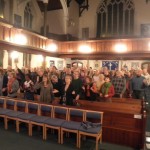
 From the I know, but notice the five parts of this definition:
• a group of Christians;
• a regular gathering;
• a congregation-wide exercise of affirmation and oversight;
• the purpose of officially representing Christ and his rule on earth—they gather in his name;
• the use of preaching and ordinances for these purposes.
Just as a pastor’s pronouncement transforms a man and a woman into a married couple, so the latter four bullet points transform an ordinary group of Christians spending time together at the park—presto!—into a local church.
The gathering is important for a number of reasons. One is that it’s where we Christians “go public” to declare our highest allegiance. It’s the outpost or embassy, giving a public face to our future nation. And it’s where we bow before our king, only we call it worship. The Pharaohs of the world may oppose us, but God draws his people out of the nations to worship him. He will form his mighty congregation.
The gathering is also where our king enacts his rule through preaching, the ordinances, and discipline. The gospel sermon explains the “law” of our nation. It declares the name of our king and explains the sacrifice he made to become our king. It teaches us of his ways and confronts us in our disobedience. And it assures us of his imminent return.
Through baptism and the Lord’s Supper, the church waves the flag and dons the army uniform of our nation. It makes us visible. To be baptized is to identify ourselves with the name of the Father, the Son, and the Holy Spirit, as well as to identify our union with Christ’s death and resurrection (Matt. 28:19; Rom. 6:3-5). To receive the Lord’s Supper is to proclaim his death and our membership in his body (1 Cor. 11:26-29; cf. Matt. 26:26-29). God wants his people to be known and marked off. He wants a line between the church and the world.
What is the local church? It’s the institution which Jesus created and authorized to pronounce the gospel of the kingdom, to affirm gospel professors, to oversee their discipleship, and to expose impostors. All this means, we don’t “join” churches like we join clubs. We submit to them.
 “Church membership is a formal relationship between a local church and a Christian characterized by the church’s affirmation and oversight of a Christian’s discipleship and the Christian’s submission to living out his or her discipleship in the care of the church.”