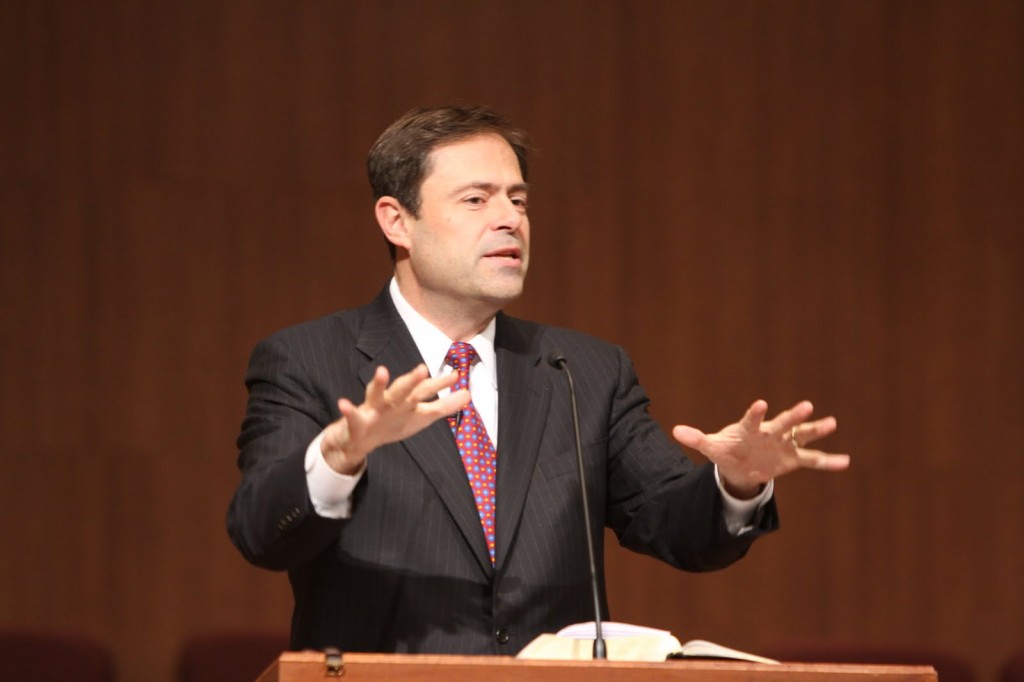
 Article: Why You Will Join the Wrong Church by Sam Emadi (original source here)
Samuel Emadi is a member of Third Avenue Baptist Church in Louisville, Kentucky and a PhD candidate in biblical studies at the Southern Baptist Theological Seminary. He also serves as the director of theological research for the president of the Southern Seminary.
The most read New York Times article from 2016 had nothing to do with politics, culture wars, or comic book movies. Instead, the most-read article of 2016 was all about commitment.
The piece, titled “Why You Will Marry the Wrong Person,” was written by Alain de Botton. In it, de Botton takes shots at our culture’s idea that the ultimate foundation for commitment in marriage is romantic affection, that feeling of compatibility that means the other person will finally fulfill my needs and make me truly happy.
We all know this is misguided, so much so that de Botton predicts every married person will eventually find inadequacies so severe in their spouse that it will prompt them to ask, “Did I marry the wrong person?” He humorously notes, the relational arc of a marriage leans away from idealistic romantic sizzle as “maddening children . . . kill the passion from which they emerged.”
CHURCH AND OUR CULTURE
As I read de Botton’s article, I couldn’t help but see how much of our culture’s view of love and commitment mirrors how many Christians view church membership. Many Christians’ broken relationships with their churches resemble patterns of the divorce culture and its attendant assumptions about authority, love, and compatibility.
Almost every Christian knows what it’s like to question whether they joined the “right church.” After an initial “honeymoon stage,” we begin to see our church’s problems with greater clarity than we see its strengths. The sermons start to seem too intellectual, or not intellectual enough. The church begins budgeting for ministries that don’t seem deserving of the dollar figure on the spreadsheet. The small groups don’t meet our needs in the ways we’d hoped.
More personally, the needs of other church members begin to encroach increasingly on our own personal freedoms. Some members sin against us—even without knowing just how deeply we’ve been wounded. Without even realizing it’s happening, we begin to wonder whether our local assembly is the “right” place for us. Of course, we remind ourselves that there’s no such thing as a perfect church—something we’ve even told our fellow church members. And yet, we can’t help but grapple with the nagging question: “Did I join the wrong church?”
“DID I JOIN THE WRONG CHURCH?”
The problem with this question is that it assumes church life shouldn’t be hard. It assumes the “honeymoon stage” should continue in perpetuity or that something has gone awry if we experience significant disappointment or hurt from our relationships with other members or the church’s leadership.
But these assumptions reveal a deep and unthinking commitment to consumerism: only if the perks of membership outweigh its inconveniences will we think it’s worth it to stick it out. Regrettably, many Christians seem trapped in a perpetual cycle of this type of cost-benefit analysis.
I’ve found that Christians most often push eject on their membership not because they’re upset at the church’s budget or because they disagree on matters of polity. Instead, Christians leave their churches for the same reason people leave their marriages: a lack of relational depth and affection. In other words, many Christians leave their churches because they just don’t seem compatible with the church or because the relationships leave them feeling a little dry.
Personal relationships, however, were never meant to serve as the foundation for our sense of church commitment. If we pursue relationships as the foundation of our belonging, we’re more likely to be inescapably trapped in the consumerism and “met-needs” mentality at the heart of our divorce culture. However, instead of valuing consumerism, the Bible roots our membership in the idea of a covenant, which offers an infinitely superior alternative.
COVENANT PRECEDES COMMUNITY
Tim Keller notes in his book on marriage that a covenant “creates a particular kind of bond . . . a relationship far more intimate and personal than a merely legal, business relationship. Yet at the same time, it is far more durable, binding, and unconditional than one based on mere feeling and affection. A covenant relationship is a stunning blend of law and love.”
When the Bible speaks about the church, it refers to it as a covenant community. Church members aren’t just part of a shared interest group. They’re covenanted to one another by a sacred promise to oversee one another’s membership in the kingdom and faithfulness to King Jesus (Matt. 18:15–20). The New Testament unfolds the details of that sacred promise: We regularly gather together (Heb. 10:24–25), bear one another’s burdens and sorrows (Gal. 6:2), encourage one another (Heb. 3:12–14), pray for one another (Jas. 5:16), and forgive one another (Col. 3:13). Many churches helpfully formalize these biblical instructions into a church covenant, a set of promises members make to one another when they enter into membership.
These covenant obligations are the foundations of our church commitment and should function as the backbone to church life. Covenant precedes community. We might even say covenant creates community. The covenant promises members make to one another blossom into the life-giving relationships our hearts crave.
Rooting commitment in our covenant promises doesn’t mean that church relationships are nothing but soulless duty. Instead, covenant commitments are the food that nourishes our relationships with other members. The more we hold ourselves to our covenant promises, the more our relationships blossom and endure through seasons of difficulty. Again, as de Botton perceptively notes in his article, “Compatibility is an achievement of love, it must not be its precondition.” The world argues that affection is pre-requisite to commitment. But the biblical picture is actually quite the opposite: commitment and service create affection.
I’m amazed at how this principle works out even in my own life. A few years ago, after a couple in our church had a baby, my wife and I signed up through the church’s member care ministry to bring them a meal. Our act of service, however, wasn’t rooted in a pre-existing relationship with this couple. In fact, we barely knew them. We simply wanted to be faithful to our covenant promises to “bear one another’s burdens.” Yet that service, rooted in our covenant commitment, ultimately blossomed into a sweet friendship between our two families. We weren’t expecting a relationship to bloom, but that’s what happens when you hold yourself to covenant promises, even with people you barely know.
COVENANTS CARRY YOU THROUGH SUFFERING
The reason God roots the most important relationships in the world—like marriage and church membership—in covenants is to ensure they endure through fire. Have you ever noticed how traditional marriage vows were designed to ensure couples prepare to love one another well in the midst of suffering? Couples pledge themselves to one another even in “poverty” and “sickness” until parted by death.
This same expectation of future trials also marks the promises church members make to one another. We pledge to “bear one another’s burdens,” (Gal. 6:2) and patiently bear with and forgive the sins of our brothers and sisters who wrong us (Col. 3:13; Eph. 4:32). If we make our covenant commitments the ground of our life and relationships in the church, we come to expect the rough patches and prepare to face them with godliness.
While our affections for our church and its members can be fickle, easily dissipating as soon as circumstances shift unfavorably, our covenant commitments never fade. As Keller notes, covenants are by their very nature oriented toward the future. They “are not a declaration of present love but a mutually binding promise of future love.” In some sense, the whole point of a covenant is to pledge our love and fidelity for the rough times ahead. Thus, covenants carry us through suffering. Once more, de Botton incisively notes, “Choosing whom to commit ourselves to is merely a case of identifying which particular variety of suffering we would most like to sacrifice ourselves for.”
FOR YOUR OWN GOOD, STICK WITH THE “WRONG” CHURCH
Joining a church, like seeking a spouse, is daunting. Loving others makes us vulnerable and committing ourselves to a church immerses us in the needs of other sinners. Eventually, every congregation will find a way to get under our skin, frustrate us, or even wound us—and we will do the same to them.
Our relationships will ebb and flow, as will our affection for the church. But the solution is not always looking for a better fit. Instead, we renew our passion and reignite our sense of belonging by holding ourselves to our membership covenant—sacred promises that bind even the “wrong” people together.