
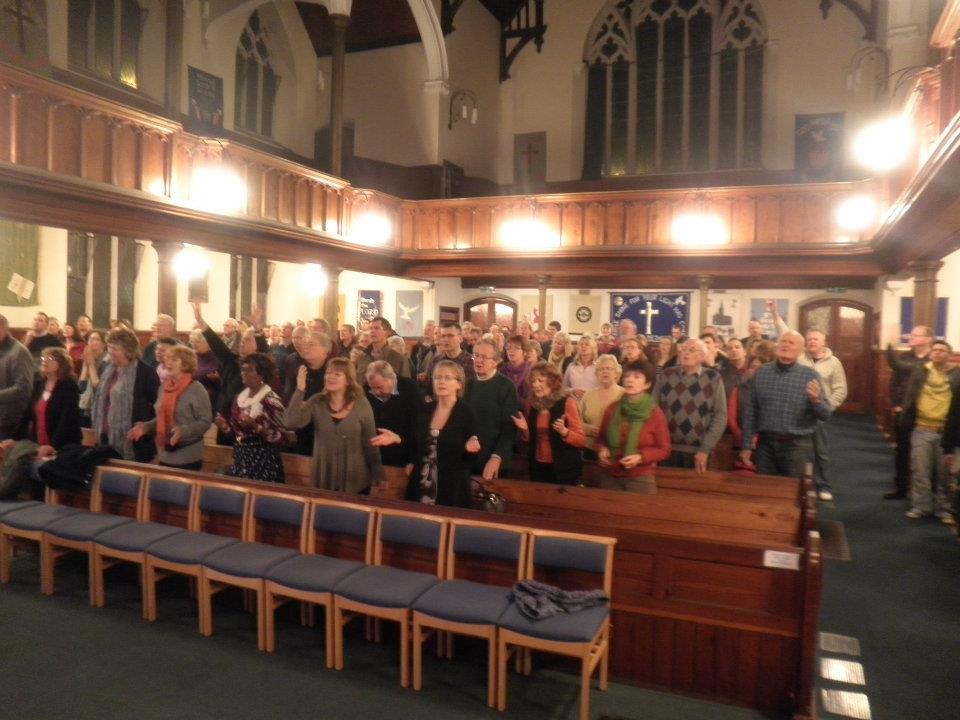
Doing Church Away from Church isn’t Church

Article: Doing Church Away from Church isn’t Church by Eric Davis (original source here)

Maybe you’ve heard it. “We can’t make it to church today, so we’ll just do church as a family.” “I can just do church on a hike this morning in God’s creation.” “The church is really the people, so we can do church wherever. God is everywhere, after all.”

Do we really need to go to a building on a certain day for it to count as doing church? If so, isn’t that legalistic?

It’s becoming increasingly popular to fashion new ways to “do church.” But how do we discern what does and does not constitute going to church? God’s word has plenty of wisdom on the issue.

In short, my hike or a Bible open in my living room with the kids is not church. Here are a few reasons why doing church away from church isn’t church.

1. We wouldn’t approach other areas of life like that.

To assert that we can do church away from church is an unparalleled way to approach life events. Do we approach other areas of life like that?

Husbands, next time you’ve scheduled a family day, just before it happens, tell your wives, “Honey, I’m actually going to do our family time on a solo-camping trip. But I’ll think about you and the kids while I’m sitting out there with the dog and my knife cramming Spam in my mouth. It still counts as family time, right? We don’t have to be all legalistic, honey.”

I wonder if we would use the “church-away-from-church-still-counts” jive towards other things in life, like missing the game, our daughter’s ballet, our hobby, or that movie we really want to see. “I’m going to forsake my daughter’s ballet, but I’ll do the ballet by remembering the moves I saw her practice in the living room last week.” “I’m going to miss hunting with the crew today, but I’ll do hunting by watching hunting YouTubes at home.” “I won’t make it to the premiere of that movie, but I’ll do the movie by watching the preview again on my phone.”

A YouTube video isn’t hunting with the crew. Meditating on her grande jeté is not attending my daughter’s ballet. Watching the preview on my six-inch screen isn’t doing the movie premiere. And doing church at home, in the car, or on a hike is not doing church.

2. Since we are not God, we cannot redefine things that are God’s.

If we are the head of an organization, then we can choose to define things in that organization. If you are the founder of a company, you can define your company’s goals. You can define standards for your employees, because you are over the thing.

Christ is the head of the Church (Eph. 1:22-23). He bought the Church with his life (Acts 20:28). He birthed the Church into being. It’s his Church (Matt. 16:18). So, he gets to say how things go. When he lays out things for his Church, that’s how they need to be.

Christ has specified how things look for his kind of church. And there are no verses which say, “Well, if you want to alter this thing that I’ve specified, go for it.” So it is when it comes to doing church God’s way. He is so great and worthy that it is reasonable for us to submissively and carefully approach what he says about church. We’ll look at some of what that means below.

3. Worship of God is not a self-determined endeavor.

Much of the Bible begins with God laying out what it means, and does not mean, to worship him. One take-away from Exodus and Leviticus is, “Wow. This glorious God does not leave the details of worship up to us.” That’s because one of the great problems with humanity is that depravity renders us unable and unwilling to worship him correctly. We have manufactured 10,000 ways of worship. And every one of them is profane and idolatrous.

Not once in the history of humanity has a person or people devised the correct way to worship the true God. That’s why we need the Bible. Whenever man takes the self-determined approach to worshiping God, he makes an idol. In his grace, God prescribes worship to sinful man for good reason.

“You shall not do as they do in the land of Egypt, where you lived, and you shall not do as they do in the land of Canaan, to which I am bringing you. You shall not walk in their statutes” (Lev. 18:3).

“And you shall not walk in the customs of the nation that I am driving out before you, for they did all these things, and therefore I detested them” (Lev. 20:23).

Consider those Old Testament times. With all of those blood sacrifices, couldn’t someone just offer up a sacrifice at home? Wouldn’t that be good enough as long as they meant well and thought about God? Those who offered a sacrifice away from the tabernacle were to be killed (Lev. 17:8-9).

The point is that proper worship of God is not a self-determined endeavor. God has not left it up to me to decide what defines obediently gathering as the church for corporate worship.

4. Church means something specific in the New Testament.

Not once in the New Testament does God refer to an individual or parents and their kids as the/a church. Individuals are called by their name. Families are called households. But they are not called “church” or said to be doing church. An arbitrary group of Christians is neither called church, as in the gathered body for corporate worship. Continue reading


Why Community Isn’t Enough

Adriel Sanchez is the pastor of North Park Presbyterian Church (PCA) in San Diego, California. He has a Master of Arts in Biblical Studies and a Master of Arts in Theological Studies. Here’s an article he wrote entitled, “A Pastor’s Letter to His Young Self: Why Community Isn’t Enough” (original source here)

I have a confession. When I was in college, even though I was studying to become a pastor, I didn’t have any real affiliation with a particular church. Sure, I went to church every Sunday, but I wasn’t a member of any one church. Church was something I enjoyed, and I would visit different churches, depending on how I was feeling on a given Sunday. My real commitment was not to a church but to a close group of friends that I had made at my Christian college. This friendship community was great, because we could have long talks about theology, culture, and politics, without disagreeing too much. In my mind, this close group of friends was my church community, so joining a church didn’t make much sense to me.

Fast forward almost a decade later, and my opinion about church and community has significantly changed. Now, having been a pastor for a few years, there are three ways I would challenge the “college me” and any other people today who have a similar outlook.
So, without further ado, here is a letter to my college self about the differences between a “friendship community” and a “gospel community,” which is a local church:

Dear Adriel in college:

First, your friendship community doesn’t display the power of the gospel like an actual church community would. In your friendship community, the community is created out of shared interests. Your friendship community looks a lot like you and likes all the same things you like. That’s normal and natural (we all gravitate toward people who are like us), but the community that God creates is supernatural. God gets to pick your brothers and sisters, and he often brings people into the family who don’t look—or think—like you do. Friendship communities will dissolve when some of the friends within the community enter a new stage of life or change personally. Gospel communities aren’t based on life stages or personal preference but on a common Savior. When this Savior brings people together who are very different and unites them in love, it displays the power of the gospel in a way that your friendship community doesn’t. Continue reading

Can We Have Jesus without the Church?

Article by Brett McCracken, senior editor for the Gospel Coalition and the author of Hipster Christianity and Gray Matters. He also writes regularly for Christianity Today and his website, BrettMcCracken.com. He lives with his wife in Southern California where he serves as an elder at Southlands Church. (original source here)

Do Not Cut Yourself Off from the Body of Christ

Ephesians 5 is often looked to as an instructive passage for marriage, and it is. But I think it is also an instructive passage about the church, especially in an age where many evangelicals have a take-it-or-leave-it ecclesiology somewhere between “I love Jesus but not the church” and “I’ll go to church but only as long as it meets my needs.”

When Paul says “Christ is the head of the church, his body,” it is a statement of union, of one-flesh connectedness. A head is necessarily connected to a body. The head directs the body and has authority over the body but also needs a fully functioning body for effective movement in the world. In a profoundly mysterious way, Christ has humbly attached himself to an imperfect body (those who believe in him) and loved this body, filling it with his sanctifying Spirit so that it will be perfected for that future moment of “without spot or wrinkle” glory. In the meantime the church is still imperfect.

Sadly, the still-imperfect nature of the church proves too challenging for some. They prefer to be “spiritual but not religious.” They embrace Jesus but ditch the church, oblivious to the fact that in so doing they are creepily embracing a decapitated head. Or those who do recognize the importance of the biblical idea of church simply redefine “church” on their terms. These are the people who love saying, “You don’t go to church. You are the church.” This is Donald Miller, who says he connects with God more outside of church and says “the church is all around us, not to be confined by a specific tribe.”1 This is Rob Bell, who now believes church is simply doing life in a beach community with one’s “little tribe of friends” (“We’re churching all the time”).2

But how much can we really grow when we define church on our terms, within the framework of our preferences and proclivities and with a “tribe” of people who “connect with God” most by surfing and enjoying craft beer together? As R. C. Sproul says, “It is both foolish and wicked to suppose that we will make much progress in sanctification if we isolate ourselves from the visible church.”3

Or listen to Spurgeon, who is (God bless him) characteristically blunt about the matter:

I believe that every Christian ought to be joined to some visible Church—that is his plain duty according to the Scriptures. God’s people are not dogs, otherwise they might go about one by one. They are sheep and, therefore, they should be in flocks.4 Continue reading