
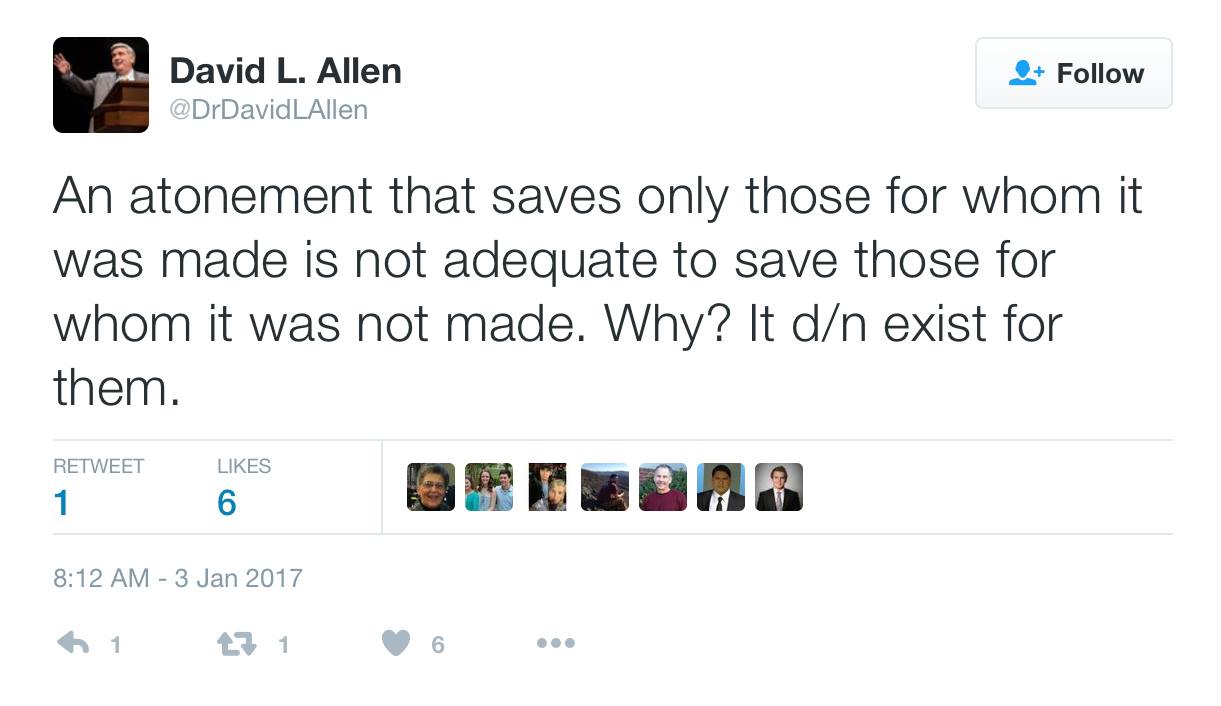
God’s Intention in the Atonement

allen Dr. James White responds:

Let’s think about Dr. Allen’s claim here: there is an obvious presupposition that needs to be exposed and challenged. First, not those who are not His sheep. The once-for-all (temporal, not distributive use) sacrifice perfects those for whom it is made. The Father gives a specific people to the Son, the Son’s death brings about the salvation of each and every one of them, without fail (John 6:39). So there is harmony and consistency between the intention and will of the Father in the salvation of the elect, and the work of the Son in being personally united to the elect so that His death is their death, His resurrection their resurrection. Of course, if such a harmony exists, there is no room for the centerpiece of the synergistic universe: the autonomous will of the creature, man. So this consistency, this harmony, must be denied.

Next, note the assertion “is not adequate to save those for whom it was not made.” See the poorly hidden assumption? Why would the atonement have an intention other than that which is consistent with the actions of each of the members of the Godhead in their work of redemption? Why would the atonement have a different scope and purpose than that redemptive will of the Father? (Which is why synergists must assert a universal *redemptive* will of the Father and deny the specificity of the elect). In other words, why would the Father make personal, effective provision through union with the Son for those who will remain justly under His wrath? The assumption here is that there is some kind of justice issue involved *in the extension of grace* and that if the Father does not make *equal salvific provision* for each and every person, He is unjust. So make sure to note what this means: grace cannot be free, cannot be specific, cannot actually save—this is the watchword of the synergist, whether Roman or non. james-white031
Allen is playing on the discussion of term “adequacy” in reference to the atonement, confusing, as almost all synergists and universal atonement advocates do, the fact that there is no inherent limitation upon the *efficacy* of the atonement with the reality that the atonement is purposeful and harmonious with the election of the Father and the application of the Spirit (harmonious action of the Triune God). The idea is to place in the mind of the reader the false suggestion that by making the atonement consistent with the decree of election and the application by the Spirit we are introducing a fundamental *flaw* or *weakness* or *limitation* in the atonement’s power, when in reality, just the opposite is the case. Once we realize what the atonement is (a true propitiatory sacrifice) and once we realize how the Son is doing the will of the Father in the salvation of the elect, we see not only the atonement’s great power and perfection, we also see the grave dangers that flow necessarily from the synergistic viewpoint that renders the atonement potential, impersonal, and theoretical.

The Five Points

Article by Stephen Rees (original source for example 1, 2, 3]. But the five points are not the starting point in understanding and worshipping God. Believers should be more interested in God himself than in what he does for us. God is worthy to be praised because of who he is: one God in three persons, ‘infinite, eternal and unchangeable in his being, wisdom, power, holiness, justice, goodness and truth’. If I were asked which is the most important doctrine for Christians to believe, I would say unhesitatingly, the doctrine of the Trinity: that doctrine underlies all other Christian doctrines, including the doctrines of salvation. I would prefer to hear believers praising God joyfully for the love that has existed eternally between the three persons, than for the mercy we have received from him. Isolating the five points from the whole biblical presentation of God’s being can be dangerous.

The 5 points: important and providential

And yet the five points are important. They do give us a clear and systematic overview of what the Bible says about God’s plan of salvation. And a number of you have said how helpful it’s been to hear the plan of salvation presented in this systematic way.

How did the five points come to be formulated in the first place? By a strange and wonderful providence of God. We only have that five-point outline because of the attempts of false teachers to undermine the teaching of God’s Word. By God’s overruling, their attacks on the truth led to this wonderfully clear summary of the Bible’s teaching on God’s plan of salvation.

Many people assume that it was Calvin who first listed out the five points (they’re often labelled ‘the five points of Calvinism’). But it was not Calvin who first drew up this 5-point presentation. I have mentioned several times over recent weeks that the five points were first drawn up at a great conference of preachers and theologians held in the Dutch city of Dort in 1618/19. That conference was called to answer a group of false teachers who were spreading their unbiblical ideas into the Reformed churches of the Netherlands. The false teachers drew up a list of five issues that they wanted discussed. The church leaders who had gathered took those issues one by one and answered them under five headings. And Bible-believing Christians have been using those headings ever since.

Arminius and his followers

We call the false teachers Arminians. They were followers of Jacobus Arminius, a Dutch minister who was appointed as professor of theology at Leiden University in 1603. As a minister in the Reformed church, Arminius had vowed to uphold the teaching of the Belgic Confession and the Heidelberg Catechism – these were the two documents that summarised the teaching of the Reformed Churches of the Netherlands. But Arminius had come to doubt what those documents teach about God’s plan of salvation. Those who listened to him preach began to suspect that secretly he had turned away from the teaching of the Bible and the churches. But he denied it. When he was invited to become professor at Leiden, again he vowed that he would be faithful to the Confession and the Catechism. He did not keep that vow. Rather he used his position to spread the false doctrines that he had come to believe. He did it in subtle ways, trying to hide just how far he had moved from the truths he had been appointed to teach. But through his influence, many of the students who listened to his lectures were persuaded to turn away from the teaching of the Bible, and of the reformed churches. Continue reading

Calvinism Is…

calvinist02“Calvinism is a whole world-view, stemming from a clear vision of God as the whole world’s Maker and King. Calvinism is the consistent endeavor to acknowledge the Creator as the Lord, working all things after the counsel of his will. Calvinism is a theocentric way of thinking about all life under the direction and control of God’s own word. Calvinism, in other words, is the theology of the Bible viewed from the perspective of the Bible – the God-centered outlook which sees the Creator as the source, and means, and end, of everything that is, both in nature and in grace. Calvinism is thus theism (belief in God as the ground of all things), religion (dependence on God as the giver of all things), and evangelicalism (trust in God through Christ for all things), all in their purest and most highly developed form. And Calvinism is a unified philosophy of history which sees the whole diversity of processes and events that take place in God’s world as no more, and no less, than the outworking of his great preordained plan for his creatures and his church.”

– Excerpt from J.I. Packer’s Introduction to “The Death of Death in the Death of Christ” by John Owen

https://www.monergism.com/thethreshold/articles/onsite/packer_intro.html