
 [Abraham] received the sign of circumcision as a seal of the righteousness that he had by faith while he was still uncircumcised” (v. 11a). – Romans 4:9–12
God uses means to convey grace to His people. While our understanding of the sacraments is firmly rooted in the teaching of the New Testament, the altar call (as used in most Churches today) is not. It actually is a very recent development in Church history.
The Roman Catholic Church teaches that there are seven sacraments:
• Baptism (Christening)
• Confirmation
• Holy Eucharist
• Penance (Confession)
• Anointing of the Sick (known prior to the Second Vatican Council as Extreme Unction (or more literally from Latin: Last Anointing), then seen as part of the “Last Rites”)
• Holy Orders
• Matrimony (Marriage)
Protestant (Evangelical) Churches teach that there are two sacraments: baptism and the Lord’s Supper.
In an over-reaction to Roman Catholicism, many Protestant/Evangelical Churches downplay sacraments altogether. Yet to do so violates Scripture itself. God is aware of our weakness and our need to be reassured of our standing with Him. God promises that we are His in the Gospel, and He confirms His favor toward us through baptism and the Lord’s Supper. Yes, God invites believing sinners to come to Him — not to an altar — but to a baptistry (where the water of baptism is applied) and to a communion table (where bread and wine are given to struggling sinners to remind them of God’s favor and to strengthen weak faith).
Summarizing the teaching of Scripture, the Heidelberg Catechism (Question 65) defines the two sacraments of baptism and the Lord’s Supper as: “holy signs and seals for us to see. They were instituted by God so that by our use of them he might make us understand more clearly the promise of the gospel, and might put his seal on that promise.” And what is the promise of the Gospel? “To forgive our sins and give us eternal life by grace alone because of Christ’s one sacrifice finished on the cross.”
Sacraments are tangible signs and seals of God’s invisible grace promised to His people in the Gospel. They are given by God to confirm that faith already given through the preaching of the Gospel. Just as the altar call seemed to be the logical outcome of a sermon — the Word often calls us to do something — so too the preaching of the Gospel and the administration of the sacraments are intimately connected.
What God promises to us in the Gospel (the forgiveness of sins) is confirmed in baptism and the Lord’s Supper. The Gospel is both promised and then made visible when the Word is preached and when the sacraments are administered.
Yet, there is one huge difference between the altar call and the Reformed understanding of the sacraments. In the altar call the qualification was “if you truly meant it,” which made the subjective state of the sinner the critical factor in whether or not one actually benefited from going forward. In both sacraments, however, the emphasis falls squarely upon God’s sovereign oath: “I will be your God and you will be my people,” an oath that can be paraphrased as God stating to struggling sinners, “I really mean it!”
In the sacraments of baptism and the Lord’s Supper, the emphasis falls squarely upon what God has done for sinners in the person of His Son, Jesus Christ, and not upon the strength of a sinner’s faith.
Circumcision was a sign — a visible act that pointed beyond itself to an invisible reality. This invisible reality was the fact that Abraham was cut out from the world and set apart unto God through faith alone (Gen. 15:6; 17). It was a visible reminder of the Lord’s promise to cut out of this fallen world a people for Himself. Circumcision, Romans 4 also reveals, was a seal. In the ancient world, a seal marked off ownership — people knew to whom an object belonged based on the seal affixed to it. Thus, circumcision was the mark of God’s ownership, tangible proof that those who bore the mark actually belonged to the Lord and would inherit all His promises if they had faith in Him.
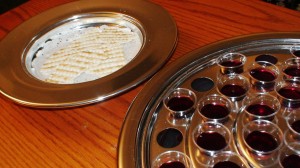 “[As with circumcision, the new covenant sacraments are also visible and tangible ways in which we are reminded of God’s promises and marked off as His people. Baptism and the Lord’s Supper have no inherent power to make us the children of God. That is, the performance of these rites themselves does not benefit us if we have no faith. We can access the grace available in them only if we believe the gospel. In fact, if we receive the sacraments without faith, we call down curses upon ourselves (1 Cor. 11:27–30).
John Calvin writes in his famous Institutes that a sacrament “is an external sign, by which the Lord seals on our consciences his promises of good-will toward us, in order to sustain the weakness of our faith, and we in turn testify our piety towards him, both before himself and before angels as well as men” (4.14.1). Using elements that we can taste, see, and touch, the sacraments help us, as embodied creatures, to understand spiritual realities. In turn, when we participate in the sacraments, we testify to our faith in God’s promises before a watching world.
In what way do the Scriptures represent the sacraments of the church as being different from other practices, such as the reading of Scripture or prayers, which are not sacramental? What constitutes a sacrament? There are four elements (Boice):
1. The sacraments are divine ordinances instituted by Christ himself.
2. The sacraments are ordinances in which material elements are used as visible signs of God’s blessing.
3. The sacraments are means of grace to the one who rightly partakes of them.
4. The sacraments are seals, certifications or confirmations to us of the grace they signify. The sacraments are God’s seal on the attestation that we are his children and are in fellowship with him.
 From the what church membership is, as well as what baptism represents. I tried to briefly answer those questions in previous posts. Let me try to answer this question with a story. Let’s call this story…