 Continued from he articulated a quite foolish notion. In fact, not only is this argumentation foolish on Russell’s part, it is sinful. Russell has to use something for which he can give no reason or foundation for existing (the laws of logic) to try to argue that the only logical “reason” for their being in existence, God Himself, does not in fact exist. God does exist because of the impossibility of the contrary. Let me explain.
Science declares that the universe is here, and that it is definitely something, and that it had a definite beginning. Though science affirms that there was a time or a point in space (big bang theory) when we can’t go back any further and predicate anything, it still affirms that the universe had a beginning. What was the universe before it had a beginning? Well, it is hard to say scientifically, except that there was a time when it was not. Yet even so, I think we must all conclude that there was a time when this universe was not, before it came into being. Science tries to steer as far away from the idea of an Eternal Universe, as much as is possible because all the evidence points to a time when it came into being i.e. a beginning. So both the atheist and the Christian needs to have a rational explanation as to why there is in fact something, and not nothing.
Why is that? Well try for a moment to imagine nothing. Now I grant you that it is very hard to think of nothing, because nothing is not a thing – it is no-thing. But go with me in your imagination to the time when there was nothing.
What would happen if it (nothing) was left alone for 10 minutes? How about 10 years? How about a few billion? Would nothing change into something given enough time to do so?
No, of course not. It doesn’t really matter how long nothing is left to be by itself – nothing cannot change into something, no matter how long it is left to become something. If there ever was a time when there was nothing, all there would be today would be nothing, for “out of nothing, nothing comes.”
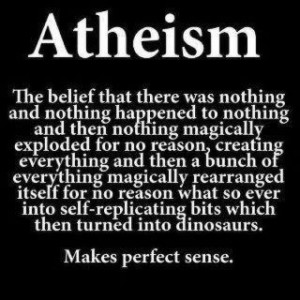
How does the atheist explain this something (everything around us), when science today affirms there was a time when there was nothing? Well lets look at a mathematical formula. The atheist would have to believe that:
Nothing + No One = Everything
This is absurdity in the extreme, I am sure you will agree Tony.
So what formula does the Christian propose?
The opening declaration of the Bible is that “In the beginning (when there was nothing), God created the heavens and the earth.” This is creation ex nihilo or “out of nothing.” God has always existed, and so when we speak of a time when there was nothing, I am referring to the physical material realm. God is a Spiritual Being, who existed eternally before anything came into being. What would this look like as a mathematical formula? It is a proposition that is both rational and satisfying. The Christian believes that:
Nothing + God = Everything
When we add God to the formula it makes this a valid and rational argumentation. God, being God, can obviously make something out of nothing. When there was no light, God said, “Light be!” and light was. Again, God created everything, out of nothing.
The clear teaching of the Bible in Romans 1 is that mankind is made in the image of God and knows of God’s existence but suppresses (holds under) that knowledge. The fact that Russell knows anything at all is due to his unacknowledged dependence upon the suppressed truth about God within him. The truth is that no one is morally neutral before God. Men are culpable because God’s existence, His power and Godhead are clearly seen and understood. Scripture declares that this knowledge of God “is manifest in them for God has shown it to them.” Therefore, all of mankind, including Bertrand Russell is “without excuse,” or literally “without an apologetic” as they rationalize the clear evidence within them and all around them. All argumentation against the knowledge of God then is pure and simple rebellion. The fear of the Lord is the beginning of knowledge, and despite his brilliance, Russell has not started in the realm of true knowledge, because it begins in dependence and the fear of the Lord.
I find it fascinating that instead of honoring the Creator, Russell propagated the worship of creation, just the very thing Romans 1 says happens when suppression of God’s truth takes place. He entreats men to “worship at the shrine that his own hands have built; undismayed by the empire of chance…” (Why I am not a Christian; p. 115,116)
I am sure Tony that you noticed, when reading Russell’s essay that he resorted to arguing ad hominem (against the man) as he directed everyone’s attention to the personal character flaws of Christians. Even if these charges were accurate, which I do not believe they are, the fact would remain that he resorted to arguing against a truth claim on the basis of the defects of the person/s that held that claim. For a person of Russell’s intellectual prowess, this is not acceptable at all, and I am sure Russell would be upset at any person who would try to do such a thing himself. He simply should have known better.
He attacked the Christians for their cruelty, for the wars they have waged, for the inquisitions, etc. but isn’t it amazing that Russell didn’t even stop to acknowledge the atrocities perpetrated by those who have not made a profession of faith in Christ. Russell didn’t mention the atrocities of Stalin or Genghis Khan, for example. No, these things were just swept under the carpet. Of course, he didn’t mention the great good done by Christians – the schools and hospitals built by Christians, and the care they have shown for the poor, etc.
There are other holes in Russell’s arguments. One obvious one is that he presumed to know the motivation of someone in becoming a Christian – even the motivation of all Christians, including those who lived in ages past. He did this based on a miniscule sampling of his own experiences with them. Then Russell goes on to use double standards in his arguments against the Christians. Russell tried to show that there was an emotional factor in a person becoming a Christian.
It is here, that I would have to acknowledge that Christians do have emotional reasons for accepting Jesus Christ as Savior and Lord. I accept that one motivation would be the fear of not doing so – the result being an eternal punishment in hell. I would have to agree with him that there is dread, and dread alone, awaiting those who do not believe in Christ. With Christ there is an endless hope, without Him, there is a hopeless end!
Continued in Part 3

 Continued from as a Christian, want the claims I have embraced about Christ to be true, and I accept the fact that I want that desperately. I would be absolutely devastated if the claims of Christ were proven to be untrue. I would have no reason for living. But Tony, Russell is not being honest with us is he? Why? Because there is an equally obvious emotional factor behind atheism!
 If there is anything else I can help you with, or if I can clarify any of these things further, just let me know and I’ll be happy to try to answer any questions you have or else I can point you to resources that I think would be of help to you. I look forward to hearing good news about you when I call. Keep the faith Tony!