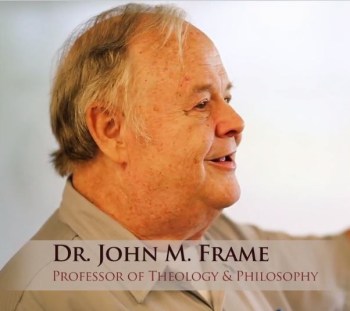
 Three Articles: How to Believe in God in the 2000s by John M. Frame (original source here)
1. Why It Is Hard to Believe in God Today
1 Cor. 1:18-25
Many people are telling us that it’s just too hard for people today to believe in the God of Christianity. We have to face it that the leading opinion makers of our culture– the academics, the media people, the politicians, the scientists– for the most part find Christianity utterly incredible. Not just slightly incredible, but utterly incredible. Not even worth considering. Way out in left field.
Two hundred years ago, there was a period in intellectual history known as the “Enlightenment.” During that period, scholars proudly proclaimed all the wonderful things the human mind could accomplish, if only it could set itself free from bondage to religion. The human mind, they said, should be autonomous (that means “self-legislating”), subject only to its own authority. Intellectual autonomy was the highest principle of the Enlightenment.
The Enlightenment, of course, was not really anything new. The same attitude, the same emphasis on autonomy, was present two thousand years earlier in Greek philosophy, four hundred years earlier among the Renaissance humanists, and has existed whenever and wherever people have tried to carry on the work of the mind without God. From a biblical viewpoint, it is simply the attitude of unbelief. It’s the attitude that says “My mind is my own.”
For people who claim autonomy, the biblical message of salvation is irrelevant. Who needs salvation from sin? For one thing, the would-be autonomous thinker says, we are not sinners; for we decide what sin is, and we’re not guilty of it. And if we have any imperfections, we will either leave them alone or else deal with them the way we deal with everything else: by autonomous thought.
So, during and since the Enlightenment, more and more philosophers, scientists, historians, psychologists, economists, political theorists, even the main body of theologians, denied the authority of the Bible. They scoffed at the idea that God created the heavens and the earth, that man fell into sin through Adam’s disobedience, that God worked miracles on earth, that the Son of God came to earth as a man, that he lived a perfect life, shed his blood for sin, and rose from the dead. How, they asked, can modern people believe in such ancient, barbaric ideas? Humanity has come of age! We cannot any longer believe in angels, devils, miracles, resurrections from the dead, blood atonement, an infallible book?
Fifty years ago, the theologian– theologian, mind you,– Rudolf Bultmann, said that one cannot believe in angels and demons if he uses a telephone and travels in an airplane. I’m not sure what using the telephone and traveling in airplanes has to do with the existence of angels and demons. He never said exactly what the connection was; these people never did. Evidently he thought it was obvious. He kept saying, over and over, that Christianity would have to come to terms with the Enlightenment. Today, Bultmann is gone; he knows better now. But his attitudes are still very much with us.
Now some people will tell you that things have changed today from fifty years ago. Some will say that around the 1960s the intellectual world shifted from “modern” to “postmodern.” While the moderns were very proud of their intellectual powers, the postmoderns recognize that intellect isn’t everything; indeed, they’re even inclined to be skeptical or relativistic. They deny that the human intellect can discover final or absolute truth. And, besides the intellect, postmoderns say, intuition and feeling have their rights, too. While the moderns were skeptical about the supernatural, we’re told, the postmoderns appreciate the supernatural. Along with science, they have come to appreciate the religions of the Far East and of Native Americans. They have come to appreciate meditation, psychic phenomena; even sometimes astrology, channeling, tarot cards and past-life regression as paths to truth.
Does this mean that the postmoderns are more open to the Bible than the moderns were? Are they more favorable to the idea that the Son of God came to earth in human history, that he taught with absolute authority, worked miracles, lived a sinless life and offered his body as a blood atonement? Are they willing to bow the knee before the risen and ascended Jesus Christ as the only Lord and Savior of men?
Certainly not. For under the skin they too are Enlightenment people. They do not intend to bow the knee to anyone; particularly, they do not want to bow the knees of their mind. The difference between modern and postmodern is that while the moderns followed the autonomous secular intellect, the postmoderns add that they have a right also to follow their autonomous intuition and feeling. They will accept, now and then, some strange beliefs; but only on their own inner criteria. What they believe they believe on their own authority. Indeed, that lust for autonomy is more powerful than ever. The postmodernist rejects the idea of absolute truth, so that he can be even more autonomous, so that he can be even freer in choosing his beliefs for himself.
And some postmoderns,– the New Age monists, to use Peter Jones’s terminology– look within themselves to find God: not the God of the Bible, but the God of their own inner selves, the God which is their own inner selves. This is the ultimate autonomy, the self as God, the very worship of self.
So the postmoderns, like the moderns, find Christianity quite incredible. The reason is that the God of Christianity will not bow to the autonomous mind of man. Believing in the biblical God and believing in one’s own autonomy are absolutely contradictory, totally at odds with one another. You cannot do both. The God of the Bible is the sovereign Lord of heaven and earth. He will not permit himself to be found by a human intellect that shakes its fist in pride and says, “I will be the final judge of truth and right.” No two views can be further apart than believing in the biblical God and believing in human autonomy. To one who believes in his own autonomy, Christianity will always seem totally ridiculous, utterly foolish, not worth considering. The believer in human autonomy has already denied the God of the Bible. He cannot even consider the evidence. He cannot even believe in the possibility of the Bible being true.
It is not, you see, as though the moderns and postmoderns have studied the evidence objectively and come to a reasoned conclusion that God does not exist. Rather, they reject the biblical God from the outset of their investigation. The unbeliever starts with the idea that Christianity can’t be true. He cannot take the evidence seriously. He knows that if the evidence does prove the Bible, then he will have to bow the knee, including the knee of his mind. And he will not seriously consider that. Oh, he may be polite in a conversation about religion. But in the final analysis, he is not an unbiased party to the discussion. He has already made up his mind. For him, the discussion is over. For he will not, he cannot, seriously question the autonomy of the human mind.
The claim of autonomy; that’s what makes Christianity so hard for people to believe today. That is why Christian views of the family, of sex, of education, of justice, of the sanctity of human life are increasingly marginalized in modern society. Our secularized society looks at us with increasing condescension and pity. They do not listen to our arguments; they don’t take us seriously. Our positions are simply incredible. They violate the main premise of secular thought, the premise of autonomy, man’s right to be the final judge of truth and falsity, right and wrong.
You can argue any crazy idea and get a hearing from Oprah or Phil. But try to get some serious attention for the Lordship of Jesus, or the reality of the Resurrection, or even the Ten Commandments. No, you’ll be told; those are “religious” views. We can’t consider them as part of the public dialogue. You may believe them privately, but don’t promote them on TV; don’t teach them in school; don’t mention them in a political campaign. If you dare to proclaim the relevance of Scripture to society, well, then, you are a fanatic. You are trying to force your religion down people’s throats. (Never mind that Christians can say the same things about secularists with equal plausibility.) Of course, some religious views are o.k.: transcendental meditation is o.k.; native American spirituality is o.k.; Islam and Buddhism should be given a place in any public forum. Only biblical Christianity is excluded. Continue reading →