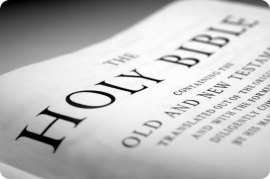
5.8 Billion and Counting

bibleWycliffe Reports 5.8 Billion People Now Have Access to Bible


An estimated 5.8 billion people now have all or some of the Holy Bible translated into their first language, and the Bible is now in more than 2,800 different languages, according to a recent announcement by Wycliffe Bible Translators USA.

“Last year, Wycliffe Global Alliance reported that 4.9 billion people could access at least part of the Bible in their first language. This year the number has grown to 5.8 billion,” Bob Creson, president and CEO of Wycliffe, told The Christian Post. “This represents tremendous progress toward our goal of starting a translation project in every language needing one by 2025.”

Creson also told CP that technological advances in areas like translation are “a critical role in speeding up the translation process.”

“Software like Adapt It automates some parts of the translation process, dramatically cutting down the time required to produce first drafts in related languages,” said Creson.

“We have also adapted a cluster-project model for translating. Rather than developing each translation independently, cluster projects bring similar languages together so translators can share skills and insights with each other.”

Wycliffe Global Alliance, which is comprised of over 120 organizations from more than 60 nations including Wycliffe USA, broke the statistics in a press release.

“There are about 7000 languages in active use and at least one book of Scripture exists in almost 2,900 of these languages,” noted WGA. “At least 1.3 billion people do not have the full Bible available in their first language. Over 634 million of these have the New Testament; others have portions or at least some level of work begun.”

The Wycliffe organization credited efforts like YouVersion’s Bible App, Faith Comes by Hearing audio Scriptures and the “JESUS” film in using twenty-first century technology to reach out to remote regions.

“Though there has been astounding progress toward complete global Bible access, there is a lot of work to be done to reach the 1.3 billion people around the world without the full Bible,” commented Creson to CP. “God has been faithful in bringing the people and technology required to complete this mission, and we’re confident that someone alive today will start the last new Bible translation project.”

Unequally Yoked

yoke“Do not be unequally yoked with unbelievers. For what partnership has righteousness with lawlessness? Or what fellowship has light with darkness? What accord has Christ with Belial? Or what portion does a believer share with an unbeliever?” – 2 Corinthians 6:14-15

The following is an excerpt from an article written by Steve Camp “be in the world and not of the world.” Rightly understanding its truth has a profound impact in how we live, engage culture, and most importantly with whom we partner with in ministry.

… let me begin by stating what this passage is not teaching with the hopes of producing clarity on this important subject.

1. It is not a call to isolationism. This is not Paul’s call for all Christians to create an alternative society whereby we only by gas from Christian gas companies; pay taxes to Christian governments; drive cars made by Ichthus Motors; or purchase groceries from Galilean Grocers. Christians working for nonbelievers in an employee/employer relationship is not prohibited by Scripture. Doing business and trade with nonbelievers is not prohibited by Scripture. Being involved in community projects and events with nonbelievers is not prohibited by Scripture. But what is prohibited, is any kind of partnership in a spiritual enterprise or ministry involving making Christ known, preaching of the Word, evangelism, worship, the furtherance of the local church, etc. I will unfold that in just a minute.

2. It is not a call to divorce your unsaved spouse. This passage isn’t specifically addressing the marriage issue (though it would apply) for the Apostle Paul has already given the command in 1 Corinthians 7:39 to “marry only in the Lord.” Considering marriage is the most intimate and binding of all human relationships, it would go without saying that it should be reserved for only believers to marry other believers. BUT, if you are married to a nonbeliever, the Apostle is not giving you an automatic out here. You are not to divorce your unbelieving spouse, but remain in that union praying for their regeneration.

3. And, it is not a call to avoid contact with nor having fellowship with nonbelievers. Paul again tells us for that to happen we would have to go “out of this world” (1 Cor. 5:9-10). How are we to love our neighbor if we don’t have contact with them? How can we serve them and do good works to them if we are not involved with their lives?
So those are three things that the Apostle is not meaning by the command: “do not be unequally yoked with nonbelievers.”

Paul … draws this analogy, however, not from the usage of the Greek term but from a concept back in Deuteronomy 22:10. When God was laying out prescriptions for the conduct of His people, He gave them a lot of prescriptions that on the surface are not particularly spiritual, they had to do with the uniqueness of Israel’s life. But some of them were very practical and wise and one of the things that He instructed them, recorded in Deuteronomy 22:10 is that they were not to plow with an ox and an ass yoked together. And the reasons for that are obvious. Those two animals have two different natures. They don’t have the same gait, they don’t have the same disposition, they don’t have the same strength. They don’t have the same kind of instincts, completely different natures. You can’t yoke them up and expect to plow a straight furrow.

To then “yoke” with a nonbeliever in a spiritual enterprise or ministry of any kind would be counterproductive wouldn’t it? Christians are new creations; walk in a newness of life; have different goals and purposes in living as born again followers of Jesus Christ. We live to please Him in all things and not ourselves. We see this world as not our home, but the land of our sojourning. Our lives have been separated from this world and unto Christ to now do His will, according to His Word, by His Spirit, in living out His gospel. It is undeniable – we are a new people. Therefore, Paul is giving a basic tenant for Christian living in whatever we do for the Lord; it cannot be in partnership with nonbelievers.

6 Truths About Sickness

sicknessBrian Najapfour fever, incurable disease, chronic ailment, or terminal illness like cancer. And since sickness is a part of our existence, understanding it properly is of great importance. Therefore, in this post we will examine what the Bible teaches about illness.

1. Sickness is a consequence of original sin; and in this sense, sickness is a punishment from God for sin.
In Genesis 2:17 God commanded Adam not to eat of the tree of the knowledge of good and evil, for in the day that he eats of it he shall surely die. Adam disobeyed God. And the moment he sinned, his body started dying. His body became subject to illness. God punished Adam for his sin. If Adam had not sinned, there would be no death, there would be no sickness.

Hence the presence of sickness shows the reality of sin in this world. Sickness exists because sin does. In the new heaven and new earth there will be no sickness because there will be no sin (Rev. 21:4). Sickness is a sad reminder of the fall of Adam, our federal representative. It is one of the effects of original sin.

2. Your sickness may be a consequence of your personal sin; and in this sense, your sickness is a chastisement from the Lord.
In James 5:14-15 the author asks, “Is anyone among you sick? Let him call for the elders of the church, and let them pray over him…And if he has committed sins, he will be forgiven.” Here it is possible that the person is sick because of particular sin in his life. Writing to the Corinthian church, Paul proclaims,

27 Whoever, therefore, eats the bread or drinks the cup of the Lord in an unworthy manner will be guilty concerning the body and blood of the Lord. 28 Let a person examine himself, then, and so eat of the bread and drink of the cup. 29 For anyone who eats and drinks without discerning the body eats and drinks judgment on himself. 30 That is why many of you are weak and ill, and some have died (1 Cor. 11:27-30).

Notice the connection between sickness and sin here. Many members of the Corinthian church are sick because of their sin regarding the ordinance of the Lord’s Supper.

It is therefore possible that God has given you infirmity in order to chastise you (Heb. 12:6). Perhaps it is a consequence of your irresponsible care of your body (e.g. bad diet). Nevertheless, in this context, affliction comes to us from the loving hand of God. Affliction is like a rod that God uses to bring back his wandering sheep to the fold.

3. Your sickness may not be a consequence of your personal sin; and in this sense, your sickness is a test from the Lord.
The word “if” in James 5:15 also allows the possibility that the sick person has not committed sins and in this way his sickness is not a result of his personal sin. Job is an excellent example of this truth (Job 2:4-7).

Sickness became an instrument in the hand of God to mold Job into the person that God wanted him to be. Sickness became a blessing for Job, for it brought him closer to God. The wheelchair- bound Joni Eareckson Tada once declared, “Suffering provides the gym equipment on which my faith can be exercised.”

4. Sickness can be a consequence of the personal sin of another person.
2 Samuel 12:15 tells us that “the Lord afflicted the child that Uriah’s wife bore to David, and he became sick.” David’s child died as a result of his sin concerning Bathsheba and Uriah. David committed adultery and murder. It is thus possible for a child to suffer the consequence of his parents’ sins. It is possible that your child is sick because of your sin.

5. Sickness can neither be a consequence of our personal sin, nor a consequence of the personal sin of another person. In this sense, sickness is simply a demonstration of God’s absolute sovereignty.
Remember the man born blind in John 9:1-3. In that passage the disciples asked Jesus, “Rabbi, who sinned, this man or his parents, that he was born blind?” Jesus replied, “It was not that this man sinned, or his parents, but that the works of God might be displayed in him.” No one sinned. God is simply practicing his absolute prerogative to do whatever pleases him. And his purpose in doing this is to display His sovereignty—to remind us that we do not control our health. He does!

6. Sickness comes to us from God ultimately for His glory and for our good.
In John 11 when Jesus heard that Lazarus was sick, he said, “This illness does not lead to death. It is for the glory of God, so that the Son of God may be glorified through it.” Whatever kind of sickness you have, pray that through it God may be glorified.

While sickness is for God’s glory, it is also for our good. Paul notes in 2 Corinthians 12:7, “So to keep me from becoming conceited because of the surpassing greatness of the revelations, a thorn was given me in the flesh…to keep me from becoming conceited.” In short, God has given Paul “a thorn in the flesh” in order to keep him from the sin of pride.

Maybe God has given you that illness that you have in order to keep you from pride. And God may not heal you in order that you may learn more to depend on his grace (2 Cor. 12:9). Once you have learned the lesson, you can sing with the psalmist, “It is good for me that I was afflicted, that I might learn your statutes” (Psalm 119:71).