
You ARE in the ministry!

Steve Camp writes: Ministry isn’t something you join, it’s someone you are. If you know the Lord you ARE in ministry – 24/7, 365. This isn’t for a few paid professionals, but for the entire body of Christ. (Eph 4:16, 1 Peter 4:10-11). Here are 12 ways you can serve, pray, and honor the Lord this week in using your spiritual gifts for Him in serving others. LETS GO!

Every Christian Is In Full-time Ministry

And they devoted themselves to the apostles’ teaching and the fellowship, to the breaking of bread and the prayers. And awe came upon every soul, and many wonders and signs were being done through the apostles. And all who believed were together and had all things in common. And they were selling their possessions and belongings and distributing the proceeds to all, as any had need. And day by day, attending the temple together and breaking bread in their homes, they received their food with glad and generous hearts, praising God and having favor with all the people. And the Lord added to their number day by day those who were being saved. – Acts 2:42-47

The following represents some key pillars of what should define ministry for any true believer in the Lord Jesus Christ. I certainly haven’t arrived at these things in my own life and ministry. But they are there as key signposts to remind us all of what is important vs. what is urgent. May they be an encouragement to you and be used by God to strengthen you as you serve Him in the sphere of influence He has sovereignly placed you today.
Take Heaven By Storm,
Steve

12 Essentials of Christian Ministry for All Believers in Jesus Christ

pray fervently:

praying at all times in the Spirit, with all prayer and supplication. To that end keep alert with all perseverance, making supplication for all the saints, -Eph. 6:18

study carefully:

Now these Bereans were more noble than those in Thessalonica; they received the word with all eagerness, examining the Scriptures daily to see if these things were so. -Acts 17:11

embrace fidelity:

And we also thank God constantly for this, that when you received the word of God, which you heard from us, you accepted it not as the word of men but as what it really is, the word of God, which is at work in you believers. -1 Thess. 2:13

contend earnestly:

Beloved, although I was very eager to write to you about our common salvation, I found it necessary to write appealing to you to contend for the faith that was once for all delivered to the saints. -Jude 3

live missionally:

and thus I make it my ambition to preach the gospel, not where Christ has already been named, lest I build on someone else’s foundation, -Romans 15:20

serve sacrificially:

So if there is any encouragement in Christ, any comfort from love, any participation in the Spirit, any affection and sympathy, complete my joy by being of the same mind, having the same love, being in full accord and of one mind. Do nothing from rivalry or conceit, but in humility count others more significant than yourselves. Let each of you look not only to his own interests, but also to the interests of others. -Phil. 2:1-4

teach faithfully:

But as for you, teach what accords with sound doctrine. Older men are to be sober-minded, dignified, self-controlled, sound in faith, in love, and in steadfastness. Older women likewise are to be reverent in behavior, not slanderers or slaves to much wine. They are to teach what is good, and so train the young women to love their husbands and children, to be self-controlled, pure, working at home, kind, and submissive to their own husbands, that the word of God may not be reviled. Likewise, urge the younger men to be self-controlled. Show yourself in all respects to be a model of good works, and in your teaching show integrity, dignity, and sound speech that cannot be condemned, so that an opponent may be put to shame, having nothing evil to say about us. -Titus 2:1-8

love unconditionally:

Love is patient and kind; love does not envy or boast; it is not arrogant or rude. It does not insist on its own way; it is not irritable or resentful; it does not rejoice at wrongdoing, but rejoices with the truth. Love bears all things, believes all things, hopes all things, endures all things. Love never ends. -1 Cor. 13:4-8a

walk obediently:

Remind them to be submissive to rulers and authorities, to be obedient, to be ready for every good work, to speak evil of no one, to avoid quarreling, to be gentle, and to show perfect courtesy toward all people. -Titus 3:1-2

repent daily:

Pay attention to yourselves! If your brother sins, rebuke him, and if he repents, forgive him, and if he sins against you seven times in the day, and turns to you seven times, saying, ‘I repent,’ you must forgive him.” -Luke 17:3-4

worship continually:

Through Him [Jesus] then let us continually offer up a sacrifice of praise to God, that is, the fruit of lips that acknowledge his name. -Hebrews 13:15

and watch expectantly:

Henceforth there is laid up for me the crown of righteousness, which the Lord, the righteous judge, will award to me on that Day, and not only to me but also to all who have loved his appearing. -2 Tim. 4:8
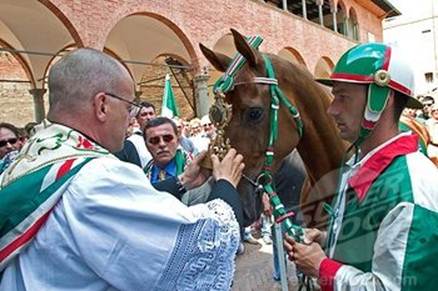

Priestly Blessing?

One day while he was at the track playing the ponies and all but losing his shirt, Mitch (a Protestant) noticed a Roman Catholic priest who stepped out onto the track and blessed the forehead of one of the horses lining up for the 4th race. Lo and behold, that horse—a very long shot—won the race!

Before the next race, as the horses began lining up, Mitch watched with interest as the old priest stepped onto the track again. Sure enough, the priest blessed the forehead of one of the horses. Mitch made a beeline for a betting window and placed a small bet on the horse. Again, even though it was another long shot, the horse won the race.

He collected his winnings and anxiously waited to see which horse the priest would bless next. He bet big on it, and it won. As the races continued, the priest kept blessing long shots, and each one ended up winning.

The punter was elated. He made a quick dash to the ATM, withdrew all his savings, and awaited the priest’s blessing that would tell him which horse to bet on.

True to his pattern, the priest stepped onto the track for the last race and blessed the forehead of an old nag that was the longest shot of the day. This time the priest blessed the eyes, ears, and hooves of the old nag. The punter knew he had a winner and bet every cent he owned on the old nag.

He watched dumbfounded as the old nag came in last. In a state of shock, he went to the track area where the priest was. Confronting him, he demanded, “Father! What happened? All day long you blessed horses and they all won. Then in the last race, the horse you blessed lost by a mile. Now, thanks to you I’ve lost every cent of my savings!”

The priest nodded wisely and said, “My son, that’s the problem with you Protestants—you can’t tell the difference between a simple blessing and last rites!”

priest-horse

The Arminian Understanding of “Faith”

Sproul_blog2The following is an excerpt from R.C. Sproul’s book, Willing to Believe

The classic issue between Augustinian theology and all forms of semi-Pelagianism focuses on one aspect of the order of salvation (ordo salutis): What is the relationship between regeneration and faith? Is regeneration a monergistic or synergistic work? Must a person first exercise faith in order to be born again? Or must rebirth occur before a person is able to exercise faith? Another way to state the question is this: Is the grace of regeneration operative or cooperative?

Monergistic regeneration means that regeneration is accomplished by a single actor, God. It means literally a “one-working.” Synergism, on the other hand, refers to a work that involves the action of two or more parties. It is a co-working. All forms of semi-Pelagianism assert some sort of synergism in the work of regeneration. Usually God’s assisting grace is seen as a necessary ingredient, but it is dependent on human cooperation for its efficacy.

The Reformers taught not only that regeneration does precede faith but also that it must precede faith. Because of the moral bondage of the unregenerate sinner, he cannot have faith until he is changed internally by the operative, monergistic work of the Holy Spirit. Faith is regeneration’s fruit, not its cause.

According to semi-Pelagianism regeneration is wrought by God, but only in those who have first responded in faith to him. Faith is seen not as the fruit of regeneration, but as an act of the will cooperating with God’s offer of grace.

Evangelicals are so called because of their commitment to the biblical and historical doctrine of justification by faith alone. Because the Reformers saw sola fide as central and essential to the biblical gospel, the term evangelical was applied to them. Modern evangelicals in great numbers embrace the sola fide of the Reformation, but have jettisoned the sola gratia that undergirded it. Packer and Johnston assert:

“Justification by faith only” is a truth that needs interpretation. The principle of sola fide is not rightly understood till it is seen as anchored in the broader principle of sola gratia. What is the source and status of faith? Is it the God-given means whereby the God-given justification is received, or is it a condition of justification which is left to man to fulfill? Is it a part of God’s gift of salvation, or is it man’s own contribution to salvation? Is our salvation wholly of God, or does it ultimately depend on something that we do for ourselves? Those who say the latter (as the Arminians later did) thereby deny man’s utter helplessness in sin, and affirm that a form of semi-Pelagianism is true after all. It is no wonder, then, that later Reformed theology condemned Arminianism as being in principle a return to Rome (because in effect it turned faith into a meritorious work) and a betrayal of the Reformation (because it denied the sovereignty of God in saving sinners, which was the deepest religious and theological principle of the Reformers’ thought). Arminianism was, indeed, in Reformed eyes a renunciation of New Testament Christianity in favour of New Testament Judaism; for to rely on oneself for faith is no different in principle from relying on oneself for works, and the one is as un-Christian and anti-Christian as the other. In the light of what Luther says to Erasmus, there is no doubt that he would have endorsed this judgment.”

I must confess that the first time I read this paragraph, I blinked. On the surface it seems to be a severe indictment of Arminianism. Indeed it could hardly be more severe than to speak of it as “un-Christian” or “anti-Christian.” Does this mean that Packer and Johnston believe Arminians are not Christians? Not necessarily. Every Christian has errors of some sort in his thinking. Our theological views are fallible. Any distortion in our thought, any deviation from pure, biblical categories may be loosely deemed “un-Christian” or “anti-Christian.” The fact that our thought contains un-Christian elements does not demand the inference that we are therefore not Christians at all.

I agree with Packer and Johnston that Arminianism contains un-Christian elements in it and that their view of the relationship between faith and regeneration is fundamentally un-Christian. Is this error so egregious that it is fatal to salvation? People often ask if I believe Arminians are Christians? I usually answer, “Yes, barely.” They are Christians by what we call a felicitous inconsistency.

What is this inconsistency? Arminians affirm the doctrine of justification by faith alone. They agree that we have no meritorious work that counts toward our justification, that our justification rests solely on the righteousness and merit of Christ, that sola fide means justification is by Christ alone, and that we must trust not in our own works, but in Christ’s work for our salvation. In all this they differ from Rome on crucial points. Continue reading