
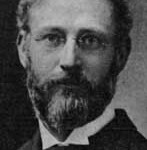
Spoken 110 years ago…

Geerhardus Vos, in a 1902 address to Princeton Seminary as the school kicked off its 90th year, with words still relevant today:

No one will deny that in the Scriptural disclosure of truth the divine love is set forth as a most fundamental principle, nor that the embodiment of this principle in our human will and action forms a prime ingredient of that subjective religion which the Word of God requires of us.

But it is quite possible to overemphasize this one side of truth and duty as to bring into neglect other exceedingly important principles and demands of Christianity. The result will be that, while no positive error is taught, yet the equilibrium both in consciousness and life is disturbed and a condition created in which the power of resistance to the inroads of spiritual disease is greatly reduced. There can be little doubt that in this manner the one-sidedness and exclusiveness with which the love of God has been preached to the present generation is largely responsible for that universal weakening of the sense of sin, and the consequent decline of interest in the doctrines of atonement and justification, which even in orthodox and evangelical circles we all see and deplore. – Geerhardus Vos, “The Scriptural Doctrine of the Love of God,” in Redemptive History and Biblical Interpretation: The Shorter Writings of Geerhardus Vos (ed. Richard Gaffin; P&R, 1980), 426

Takeaway: To seek to exalt God’s love without placing it against the full range of who God is and must be nets out as a diminishing, not exaltation, of that love.

HT: Dane Ortlund

Two marriage myths, busted

Dan Phillips debunks a couple of myths, believed by many people today:

As I continue in my announced intent to share a few bits of Biblical wisdom on marriage, it seems good to start by dispelling a couple of myths. Call me a Biblical “mythbuster.”

First: it takes two to create marital problems. No, it doesn’t. It only takes one.

It feels embarrassing even to have to say that, it’s such a Biblically obvious point — but the notion of necessarily democratically-shared liability is so widespread that some air-clearing is necessary.

I think I’ll call this the Democratic Causality Myth. How do I know it’s a myth? The same way I know anything really important: the Bible. Didn’t you read 1 Peter 2:19-20?

For this is a gracious thing, when, mindful of God, one endures sorrows while suffering unjustly. 20 For what credit is it if, when you sin and are beaten for it, you endure? But if when you do good and suffer for it you endure, this is a gracious thing in the sight of God.

There you go: it is possible to suffer, not only in spite of doing good, but precisely for doing good. Peter expressly envisions a relationship where Party A causes suffering to Party B, and the latter not only did not “have it coming to him,” but was specifically doing what he ought to be doing.

Peter’s not done with that theme. Note that he says in 3:14a, “even if you should suffer for the sake of righteousness, you are blessed.” There it is again: suffering precisely because one had done what was right.

Of course, we could add a heap of Scriptures, and they’d take us back to our Lord Himself, amid the Beatitudes: “Blessed are those who are persecuted for righteousness’ sake, for theirs is the kingdom of heaven” (Matt. 5:10).

The assumption that all suffering must be immediately traceable to some specifically causative wrongdoing is simply not Biblical. It is to join hands and nod along with Job’s divinely-discredited friends, as they doggedly pursue the etiology of Job’s suffering, sure that he’d brought it on himself somehow.

So if we grant this for all of life, is there some force-field that un-trues the truth when it comes to marriage? Is it only in marriage that we must always split blame for suffering 50-50? I’d like to see that logic diagrammed.
Continue reading