 “We are not aware of our impotence, we are not aware of our weakness, and of our need for power. As long as we think we can organise [revival], there is no hope for us. The beginning of revival is to realise that without this manifestation of God’s power we can do nothing. We have got to get back to that position, in which the apostle Paul so constantly found himself. I am never tired of quoting it. It is the text, more than any other, that needs to be held before every section of the Church today. ‘And I was with you in weakness and in fear and much trembling, and my speech and my message were not in plausible words of wisdom, but in demonstration of the Spirit and of power, that your faith might not rest in the wisdom of men but in the power of God.’ (1 Cor. 2:3-5)” – Martyn Lloyd-Jones, Revival (Crossway, 1987), 182
“Is everything sad going to come untrue?” – Sam Gangee to Gandalf, The Lord of the Rings (chapter 4, Book Six)
“[Some mortals] say of some temporal suffering, “No future bliss can make up for it,” not knowing that Heaven, once attained, will work backwards and turn even that agony into a glory.” – C. S. Lewis, The Great Divorce, chapter 9.
“He who testifies to these things says, ‘Surely I am coming soon.’ Amen. Come, Lord Jesus!” – Revelation 22:20
“The Christian faith is not true because it works; it works because it is true.” – Os Guinness
“For to me to live is Christ, and to die is gain.” – Philippians 1:21. Jonathan Edwards, preaching on this text – “If it be so that your death is your gain, be exhorted to wean your hearts more and more from the world. If your gain consists not in staying in the world but in going out of it, how important is it to set your hearts upon it as if it consisted in it.
Will you set your hearts upon the things of this life when your gain consists not in this life but in the next? Where your treasure is, there will your heart be also.
Is death gain to you?
Be entirely resigned to God’s will while living or dying: you are always safe in either of these conditions, for you to live is Christ and to die is gain. . . . And seeing it is so that you are got into such a happy estate and condition that either by life or death you obtain your great end, cast yourself upon God’s hands: let his will be your will, knowing that whether you are to die in youth or in old age, this year or next, today or tomorrow, whether a natural or violent death, by sickness or by accident, whether at home or abroad, whether an easy or a painful death; yet let it come when, how, and where it will, it will be your unspeakable gain.” – Jonathan Edwards, ‘Dying to Gain,’ in The Works of Jonathan Edwards, Vol. 10, Sermons and Discourses 1720-1723 (ed. Wilson Kimnach; Yale University Press, 1992), 590
Lloyd-Jones, preaching on Acts 1:11 – “You can be sure of this – all who belong to the Lord Jesus Christ, who have seen the all-importance of the soul, who have seen their dread condition under the condemnation of the Law, who have committed themselves to him, taking upon themselves the scorn and sarcasm of the world, those who have counted all things loss for his sake, who have denied themselves and taken up their cross daily and followed him, those who have said, ‘I care not what happens to me as long as all is well between me and him’–these are they who will be with him in the new heaven and the new earth and will share and enjoy his glory forever and ever.” – Martyn Lloyd-Jones, Let Not Your Hearts Be Troubled (Crossway, 2009), 100-101
“Every time the gospel is preached it is as if God himself came in person solemnly to summon us.” – John Calvin
“…there is a difference between my identification of Romanism as a false religion and Mormonism’s definitional distinction from Christianity. Rome teaches heresy, not on the nature of God, or the deity of Christ, but on the gospel. This is the result of a long period of evolution. So Rome represents a departure from, apostasy from, the truth. Mormonism has never possessed the truth. It began, in its foundational documents and from the words of its founding leaders, as a direct attack upon the Christian faith. Rome’s heresy differs in nature, for while it maintains the truth in major areas (specifically, the doctrine of God), it has lost the life-giving element of the faith, that being the Gospel. Mormonism has never possessed the truth about God, Christ, the Spirit, creation, the Scriptures, or the gospel. These are important distinctions to be drawn and understood.” – Dr. James White

 “Jesus gained a supreme and ultimate victory over satan and his demons at both the cross and the resurrection – not just the resurrection. Of course, a dead Savior can’t save anyone. Jesus did need to rise from death and His resurrection vindicated all His claims (Rom 1:4). As Jesus bore the wrath of God for sin, neither satan nor his demons were laughing for even a moment. In fact though in the eyes of the world it was Jesus who looked like a public spectacle – a source of ridicule and scorn – yet, in the spiritual arena, Jesus was not losing, but winning, winning, winning and if we could see with spiritual eyes, it was the devil who was put to open shame. Jesus was able to say “It is finished” while still hanging on the cross (to say “paid in full”) and made the devil a public spectacle, as He cancelled all the sins of the people of God, He bore our sins in His body on the tree (1 Peter 2:24), and the Scripture reveals that the veil of the temple was torn in two on Good Friday (Matt 27:51), not resurrection Sunday, indicating that the wall of separation between God and man had been forever broken down. The cross of Jesus Christ was the consummate victory, and not a defeat in any way at all, and all the demonic host knew it! Though the serpent bruised His heel, Jesus crushed the serpent’s head (fulfilling Gen 3:15)! Hallelujah!”
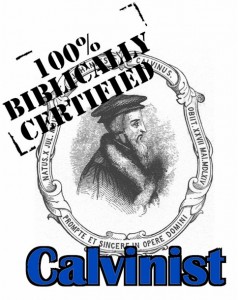 Around a decade ago I read Dr. Norman Geisler’s book “Chosen but Free” and followed it up with Dr. James’ White’s response in a book called “The Potter’s Freedom.” It became clear to me that one side wanted to exegete the texts of Scripture in detail, giving them the necessary respect; and quite honestly, in the course of time, Dr. White became a very good friend of mine, and I am very grateful to God for the very positive impact he’s had, and continues to have, in my life and ministry.
 The reason I say all this is because some time back it was fascinating for me to watch a 28 minute video by Dr. White on youtube, responding once again to Dr. Geisler’s “Parable of the Farmer.”