
 Traditions can be very strong. This truth is perhaps never more reflected than in how this particular verse is usually interpreted.
I recently asked an adult group to turn to Matthew 23:37 in their own Bibles and follow along with me. I told them to listen to my words while reading the text in front of them. I asked them to pay close attention to my words because I alerted them ahead of time that I would be omitting two important words from the text while I read it out loud. I told them that I wished to see if they could identify which two words I was omitting.
I read the verse out loud as follows:
“O Jerusalem, Jerusalem, the city that kills the prophets and stones those who are sent to it! How often would I have gathered you together as a hen gathers her brood under her wings, and you would not!”
There was silence from the group.
Then I repeated the process. As I completed the second reading I looked and saw heads buried in their Bibles, but no one spoke up. No one said a word.
I waited another 20 seconds and then said “alright, let me read it again,” and repeated the process.
What happened next?
Well, even when telling them to watch out for my intentional omission, it was only after my fourth reading through of the verse that one individual raised their hand to indicate they had the correct answer. Fourth time through one of the adults spotted the fact that I had omitted the words “your children” from the reading.
I acknowledged the correct answer and then the fifth time through, I read the text the way it actually reads in the Bible, this time emphasizing the words I had previously failed to include.
Matthew 23:37 actually reads:
“O Jerusalem, Jerusalem, the city that kills the prophets and stones those who are sent to it! How often would I have gathered YOUR CHILDREN together as a hen gathers her brood under her wings, and you would not!”
What difference does this all make? Everything in the world, as I will seek to explain.
Why did I conduct this exercise?
The answer is quite simple. I wanted them to become aware of the power of tradition. It is so powerful that even with warning ahead of time, we often read the text the way we have always interpreted the text rather than by allowing the words to speak for themselves. In this short but powerful exercise, I read the text the way people have understood the text by tradition, not the way the text actually reads, and the omission of the two words changes the interpretation entirely.
Most people assume four things about the text:
(1) Jesus here wanted to save the Jews He was speaking to here
(2) Though He desired to do this, He could not
(3) The reason for this was their stubborn refusal to allow themselves to be gathered. (Christ “would,” but they “would not.”)
(4) The conclusion: For the grace of God to achieve its objective in the salvation of souls, it is dependent upon the will of man. In spite of all the wooing and drawing desires and actions of God, God’s grace can never overcome the stubborn will of man unless man chooses to cooperate. God is often times left frustrated. Christ really tried His best to gather these people, even to the point of tears, but in the end, His will was thwarted by man’s resistance.
What I say now may shock you, but none of those four assumptions are true.
Continue reading
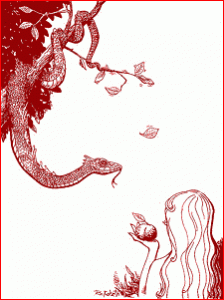 The question of evil is a big one and far bigger than most Christians realise. Dr. R. C. Sproul has outlined the issue very well.
 One of the most important approaches to the problem of evil is that set forth originally by Augustine and then later by Aquinas, in which they argued that evil has no independent being. Evil cannot be defined as a thing or as a substance or as some kind of being. Rather, evil is always defined as an action, an action that fails to meet a standard of goodness. In this regard, evil has been defined in terms of its being either a negation (negatio) of the good, or a privation (privatio) of the good. In both cases, the very definition of evil depends upon a prior understanding of the good. In this regard, as Augustine argued, evil is parasitic — that is, it depends upon the good for its very definition. We think of sin as something that is unrighteous, involving disobedience, immorality, and the like. All of these definitions depend upon the positive substance of the good for their very definition. Augustine argues that though Christians face the difficulty of explaining the presence of evil in the universe, the pagan has a problem that is twice as difficult. Before one can even have a problem of evil, one must first have an antecedent existence of the good. Those who complain about the problem of evil now also have the problem of defining the existence of the good. Without God there is no ultimate standard for the good.
 By John Piper: Website: www.desiringGod.org. Email: