Miscellaneous Quotes (18)

“It is a good thing for an uneducated man to read books of quotations.” – Winston Churchill

“A lie gets halfway around the world before the truth has a chance to get its pants on.” – Winston Churchill

“Nearly all men can stand adversity, give him power.” – Abraham Lincoln

“My people’s greatest need is for my own holiness.” – Robert Murray M’Cheyne

“Without Christ crucified in her pulpits, a Church is little better than a dead carcass, a well without water, a barren fig-tree, a sleeping watchman, a silent trumpet, a lighthouse without fire, a stumbling-block to weak believers, a comfort to unbelievers, a hot-bed for formalism, a joy to the devil, and an offence to God.” – J.C. Ryle

“Prayer is not overcoming God’s reluctance. It is laying hold of God’s willingness.” – George Mueller

“To touch the image of God is to touch God himself; to kill the image of God is to do violence to God himself.” – Anthony A. Hoekema, Created in God’s Image (Grand Rapids: Eerdmans, 1986), 16.

“Jesus produced mainly three effects: hatred, terror, adoration. There was no trace of people expressing mild approval.” – C.S. Lewis

“As creatures, we have no right or reason to expect that at every point we shall be able to comprehend the wisdom of our Creator.” – J.I. Packer

“Character is what we are when nobody sees us except God.” – John Blanchard

“To Satan no sight is beautiful but deformity itself, and no smell is sweet but filth and nastiness.” – John Calvin

“Did God not sometimes withhold in mercy what we ask, we should be ruined at our own request.” – Hannah More

“What have we time and strength for, but to lay out both for God? What is a candle made for, but to burn?” – Richard Baxter

“The gospel of justification by faith is such a shocker, such an explosion, because it is an absolutely unconditional promise. It is not an “if-then” kind of statement, but “because-therefore” pronouncement: because Jesus died and rose, your sins are forgiven and you are righteous in the sight of God! It bursts in upon our little world all shut up and barricaded behind our accustomed conditional thinking as some strange comet from goodness-knows-where, something we can’t really seem to wrap our minds around, the logic of which appears closed to us. How can it be entirely unconditional? Isn’t it terribly dangerous? How can anyone say flat out, “You are righteous for Jesus’ sake? Is there not some price to be paid, some-thing (however minuscule) to be done? After all, there can’t be such thing as a free lunch, can there?”

You see, we really are sealed up in the prison of our conditional thinking. It is terribly difficult for us to get out, and even if someone batters down the door and shatters the bars, chances are we will stay in the prison anyway! We seem always to want to hold out for something somehow, that little bit of something, and we do it with a passion and an anxiety that betrays its true source–the Old Adam that just does not want to lose control.” – Gerhard Forde, Justification by Faith: A Matter of Death and Life, pg. 24 Continue reading

Friday Round Up

FIVE ITEMS:

(1) Please keep our evangelistic outreach to Kerala, India in your prayers. Update make choices, and do the hard work of seeing those choices through. Too often, he writes, God’s people tinker around with churches, jobs, and relationships, worrying that they haven’t found God’s perfect will for their lives. Or—even worse—they do absolutely nothing, stuck in a frustrated state of paralyzed indecision, waiting…waiting…waiting for clear, direct, unmistakable direction. But God doesn’t need to tell us what to do at each fork in the road. He’s already revealed his plan for our lives: to love him with our whole hearts, to obey His Word, and after that, to do what we like. No need for hocus-pocus. No reason to be directionally challenged. Just do something. Paperback; 128 pages.”

For the month of July, Alistair Begg is making this book available for any size gift into his “Truth for Life” ministry. Its full title is “JUST DO SOMETHING – A LIBERATING APPROACH TO FINDING GOD’S WILL or how to make decisions without dreams, vision, fleeces, impressions, open doors, random Bible verses, casting lots, liver shivers, writing in the sky, etc.” Available here.

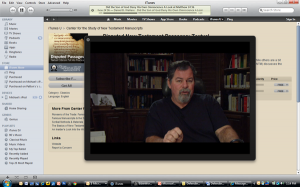
(3) If you are interested in learning something about the field of textual criticism but don’t know where to start, this will be right up your street. The Center for the Study of New Testament Manuscripts (CSNTM) is committed to helping others understand the reliability of our New Testaments, the history of translations, the study of the text, and significant figures who have made this possible. Beginning today, CSNTM is making a series of videos concerning New Testament manuscripts, textual criticism, history of the New Testament, and expert commentary on key verses available as a free download on iTunes U. Featured in the videos are interviews and footage shot around the world of important people involved in the work of the Center. Noted scholar, Dr. Daniel B. Wallace explains important aspects in the study of the text of the New Testament – found here.

Note: these short clip videos are free but only available through iTunes, yet I felt that the material is too good not to mention.

(4) Ligonier has some SUPER deals today in this week’s $5 Friday sale here. Remember, if you decide to purchase material, you can claim a further 10% discount on these and on ALL Ligonier products (as a reader of this blog) by using the coupon code EGRACE10.

(5) Last, but by no means least, please keep my dear friend Jim in your prayers (I mentioned his situation a few days ago on the blog here). The amazing news is that he has been removed from ICU and doctors are trying to ascertain whether or not his body might stand up to a heart transplant (if he qualifies for one). The journey has been amazing though – with his heart stopped for 15 minutes, there was a real fear he would simply be a vegetable mentally (that fear is well and truly dismissed as he is talking now). Just three days ago, his liver readings were so poor that the medical opinion was that he needed a very urgent liver transplant – but the readings are now so close to normal that doctors are not even worried about his liver anymore. We give great thanks to God as this is nothing short of miraculous, but lets keep praying. He is not completely out of the woods yet.

Paul and the Pagan Poets

From virginiahuguenot.blogspot.com

There are interesting passages in the New Testament that demonstrate the Apostle Paul’s willingness to employ verses from pagan poetry to speak Biblical truth. There may be others; some trace 1 Timothy 5.4 to a line from Terence (195/185–159 BC), Andria IV. Be that as it may, it is clear that Paul was learned in pagan poetry, and found good uses for it, even apart from the idolatrous intentions of the poets themselves. Without adopting the whole false system of belief represented by the sources he quoted, Paul with discernment and for godly purposes, was able, because of his familiarity with pagan poems, to find the good within and bring it to light to God’s glory.

Acts 17.28: For in him we live, and move, and have our being; as certain also of your own poets have said, For we are also his offspring.

This verse spoken during his famous speech at Mars Hill in Athens shows the apologetic use that such acquaintance with pagan poetry can provide. The first quote seems derived from a work on Crete by Epimenides in which he rebukes the Cretians for building a tomb to Zeus, whom he believed to be immortal.

Epimenides (6th century BC), Cretica:

They fashioned a tomb for thee, O holy and high one—
The Cretans, always liars, evil beasts, idle bellies!
But thou art not dead: thou livest and abidest forever,
For in thee we live and move and have our being.

Paul also may have in mind Cleanthes, who said something similar.

Cleanthes (c. 330 BC – c. 230 BC), Hymn to Zeus:

Most glorious of the immortals, invoked by many names, ever all-powerful,
Zeus, the First Cause of Nature, who rules all things with Law,
Hail! It is right for mortals to call upon you,
since from you we have our being, we whose lot it is to be God’s image,
we alone of all mortal creatures that live and move upon the earth.

The latter quote seems to come from a work by Aratus again in praise of Zeus.

Aratus (c. 315 BC/310 BC – 240 BC), Phaenomena 1-5:

From Zeus let us begin; him do we mortals never leave unnamed;
full of Zeus are all the streets and all the market-places of men;
full is the sea and the havens thereof;
always we all have need of Zeus.
For we are also his offspring;

It is interesting to see how Paul borrowed expressions intended to glorify a false God, which his hearers would have recognized, and applied them to the true God. Eusebius records (Preparation for the Gospel 13.12) how Aristobulus of Paneas, a Jewish philosopher (c. 160 BC) had similarly quoted from the same beginning lines of Aratus, Phaenomena, but to demonstrate that the praise of Zeus was rightly given to God instead. Aristobulus thus: ‘It is clearly shown, I think, that all things are pervaded by the power of God: and this I have properly represented by taking away the name of Zeus which runs through the poems; for it is to God that their thought is sent up, and for that reason I have so expressed it.’ The apologetic purpose of Paul — and Aristobulus — thus finds truth in a pagan poem and employs it for godly ends.

1 Cor. 15.32-33: If after the manner of men I have fought with beasts at Ephesus, what advantageth it me, if the dead rise not? let us eat and drink; for to morrow we die. Be not deceived: evil communications corrupt good manners.

The phrase “let us eat and drink; for to morrow we die” may be an allusion to both Isa. 22.13 and Eccl. 8.15. However, it is not unreasonable to suppose that Paul may have had in mind the philosophy of Epicurus (341 BC – 270 BC), who put forth a similar view of life.

The phrase “evil communications corrupt good manners” is apparently a direct quote from either Menander or Euripides (John Milton attributes it to Euripides in the preface to his Samson Agonistes). Paul thus bears witness to the maxim of a heathen poet.

Menander (ca. 342–291 BC), Thais: Bad company corrupts good character.

Euripides (c. 480 BC – 406 BC) (fr. 609): Evil communications corrupt good manners.

Titus 1.12-13a: One of themselves, even a prophet of their own, said, The Cretians are alway liars, evil beasts, slow bellies. This witness is true.

The quotation here seems to be from Epimenides, cited already above, or perhaps from Callimachus. Again, Paul shows his extensive knowledge of pagan poetry, and selectively quotes as appropriate to demonstrate a true statement found within an idolatrous poem.

Callimachus (310/305–240 BC), Hymn I. To Zeus: “Cretans are ever liars.”

The Apostle Paul by these examples shows that indeed, as I have noted before, “all truth is God’s truth,” wherever we may find it. The words of Charles Spurgeon on this point are worth heeding.

Charles Spurgeon, Exposition of 1 Corinthians 15:

“Let us eat and drink; for tomorrow we die.” Oh! wicked Paul! to quote from a heathen poet! How disgraceful. If I were to repeat a verse, and it looked as if Shakespere or any profane author ever wrote such a thing, how criminal! say you. But I like good things wherever I find them. I have often quoted from the devil, and I dare say I shall often quote from his people. Paul quoted this from Meander, and another heathen poet, who wrote far worse things than have been written by modern poets, and if any of us who may have stored our minds with the contents of books we wish we had never read, and if there be some choice gems in them which may be used for the service of God, by his help we will so use them.