I have enjoyed Pastor Mike Bullmore’s ministry for a number of years. Prior to leading the launch of CrossWay Community Church in Kenosha County, Wisconsin in 1998, as well as chairman of the Practical Theology Department at Trinity Evangelical Divinity School in Deerfield, Illinois.
His sermon from April this year at the Gospel Coalition Conference was an outstanding model of how to preach the gospel of Christ from a book of the Old Testament:
Pastor John, could you explain the term “Zion”? The word seems to mean different things in the Bible.
You are right in suggesting that the word “Zion” has different meanings. The word has undergone a progressive series of usage as the Bible has unfolded.
The first time “Zion” is mentioned in Scripture is 2 Samuel 5:7 where we are told, “David took the stronghold of Zion (that is, the City of David).” The New Illustrated Bible Dictionary says, “Zion… was the name of the ancient Jebusite fortress situated on the southeast hill of Jerusalem at the junction of the Kidron Valley and the Tyropoeon Valley. The name came to stand not only for the fortress but also for the hill on which the fortress stood. After David captured “the stronghold of Zion” by defeating the Jebusites, he called Zion “the city of David” (1 Kings 8:1; 1 Chron 11:5; 2 Chron 5:2).”
Later on, Solomon built the awesome Temple structure on Mount Moriah (not the same hill as Zion) and moved the ark of the covenant there. This brought a new use to the word Zion as indicating the Temple itself and the surrounding area. Certain Psalms tells us this (2:6; 48:2; 11-12; 132:13).
It was not long until Zion became synonymous as a name for the city of Jerusalem, the land belonging to Judah and for the people of Israel. Isaiah 40:9 says, “Get you up to a high mountain, O Zion, herald of good news; lift up your voice with strength, O Jerusalem, herald of good news; lift it up, fear not; say to the cities of Judah, “Behold your God!”” Zech 9:13 speaks of the people of God as “the sons of Zion” indicating that the word had come to designate the entire people of Israel (Isa 60:14).
Zion is called the dwelling place of God (Psalm 9:11). The entire Psalm 48 is a song of celebration concerning Zion being the city of God. The first three verses read, “Great is the Lord and greatly to be praised in the city of our God! His holy mountain, beautiful in elevation, is the joy of all the earth, Mount Zion, in the far north, the city of the great King. Within her citadels God has made himself known as a fortress.”
Psalm 132: 13,14 – “For the Lord has chosen Zion; he has desired it for his dwelling place: “This is my resting place forever; here I will dwell, for I have desired it.”
Joel 3: 17 – “So you shall know that I am the Lord your God, who dwells in Zion, my holy mountain.”
There are at least then four uses of the word found in Scripture. Zion is a hill in Jerusalem; the city of Jerusalem itself; the people of God, as well as the dwelling place of God.
How do we determine how the word is being used in our Bibles? The answer is that whenever we encounter the word “Zion,” the context will tell us which usage is in play.
Having said all this, the New Testament gives us added insight into the word. In a passage in Hebrews 12 we are told:
“18 For you have not come to what may be touched, a blazing fire and darkness and gloom and a tempest 19 and the sound of a trumpet and a voice whose words made the hearers beg that no further messages be spoken to them. 20 For they could not endure the order that was given, “If even a beast touches the mountain, it shall be stoned.” 21 Indeed, so terrifying was the sight that Moses said, “I tremble with fear.” 22 But you have come to Mount Zion and to the city of the living God, the heavenly Jerusalem, and to innumerable angels in festal gathering, 23 and to the assembly of the firstborn who are enrolled in heaven, and to God, the judge of all, and to the spirits of the righteous made perfect, 24 and to Jesus, the mediator of a new covenant, and to the sprinkled blood that speaks a better word than the blood of Abel.”
What a revelation this is concerning what is taking place as we gather as the people of God. When we come together in worship on earth, we are also entering sacred space, into heaven itself, joining with Old testament saints, New testament saints, and all the holy angels, and into the immediate presence of God Himself… all are present in heavenly Zion.
Though a Church service may have only a few present in earth, it is actually a joining together of all the saints, for in the spiritual realm, there are always millions present – we join the heavenly host – the saints of all ages and the heavenly host of countless angels in festal array – in worship to our God.
In this sense, this is not heaven coming down to earth, but the exact opposite. Throughout the centuries, the Christian community have not always been the power players ina society. Certainly that is the case in many parts of the world today. The people of God have met (and continue to meet) in very mundane surroundings, perhaps few in number, huddled together under the threat of persecution and great affliction. Yet, when the local Church gathers, rather than heaven coming down, God allows the often tired earthly pilgrims to enter sacred space – for while physically present on earth, we join the heavenly choir.
As we gather as the local Church, our meeting may take place in a cathedral, with its grandiose architecture and splendor; or it might be in a hewn out cavern, in a barn or in the woods, and yet each of us join the gathered community in heaven, joining the service already in progress, in worship of our great King.
One day heaven will come down. Rev 21, 22 shows us that. But now, as we gather together to worship, we the Church enter sacred, holy, heavenly space. We have come to Mount Zion and to the city of the living God.
May this knowledge stir our hearts to join with Abraham, Isaac and Jacob; with Daniel, David, Moses and Isaiah, all in the worship of God. May we join with Ruth and Mary and Hannah; with Zechariah, Samson, Peter and Paul, Barnabas and John; with Polycarp and Jerome, with Athanasias and Augustine; with Luther, Calvin, Whitefield, Wesley, Edwards and Spurgeon; with Gabriel, Michael and all the holy angels; and with loved ones who have gone on to glory before us who stand in the presence of God – thousands upon thousands, and thousands upon thousands more. Lets join them in song, even now… we have come to Zion for this very purpose; to proclaim the praises of Him who has called us out of darkness into His marvellous light.
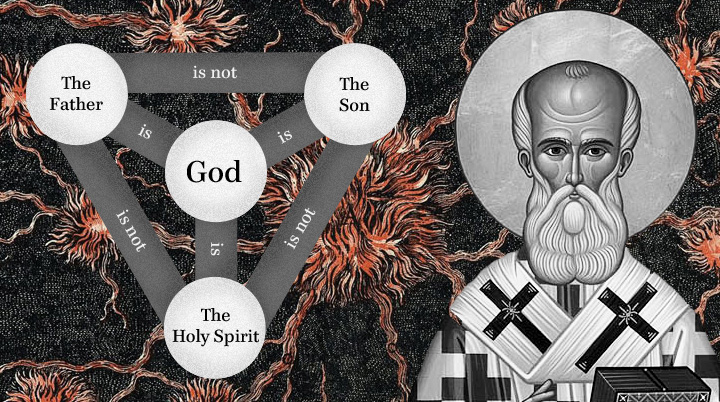
I love the Trinity. That’s because I love God, and God is a Trinity.
Very few people have a firm grasp of the concept of the Trinity. It is important therefore to determine what we as Christians mean by the term. The doctrine of the Trinity, stated simply is that there is one eternal being of God, and this one being of God is shared by three co-equal, co-eternal persons, the Father, the Son, and the Holy Spirit. God is therefore one in essense and three in personality.
It is necessary here to distinguish between the terms “being” and “person.” It would be a contradiction, obviously, to say that there are three beings within one being, or three persons within one person. There is no contradiction though because that is not what is being said at all. There is one eternal, infinite being of God, shared fully and completely by three persons, Father, Son and Spirit. One what and three who’s.
All the major cults today (Jehovah’s Witnesses, the Latter Day Saints or Mormons, etc.) contend that Christians have simply made up the concept of the Trinity, saying that the term is not even found in the Bible. Though it is true that the actual term cannot be found in Scripture, I would have to say, “so what?” for even the word “Bible” is not found in the Bible! The term “Bible” comes from the word biblos meaning “book,” and therefore means “the Book.” The Bible is not just “a” book but “the” book, because it is the very Word of Almighty God, and therefore the most important book anyone can ever read; for it is the only one that is inspired by God. (2 Tim. 3:16).
It is on the basis of Scripture itself that Christians throughout the centuries have professed belief in the Holy Trinity, affirming the fact that our one God is eternally existent in three Persons: the Father, the Son and the Holy Spirit, who are co-equal, co-existent and co-eternal. This is because the following three things are very clearly taught in Scripture:
(1) There is only one God, who is eternal and immutable (unchanging).
(Deut. 6:4; Isa. 43:10; Mal. 3:6; Mark 12:29; John 17:3; 1 Tim. 2:5; Jam. 2:19)
(2) There are three eternal Persons – the Father, the Son, and the Holy Spirit. These Persons are never identified with one another – that is, they are carefully differentiated as distinct Persons. The Father is not the Son, nor the Son the Holy Spirit, and nor is the Holy Spirit the Father.
(Matt: 3:13-17; 28:19; Luke 10:22; John 1:1, 2; 3:16, 17; 15:26; 16:7; 17:1-26; 2 Cor. 13:14)
(3) The Father, the Son, and the Spirit, are identified as being full Deity – that is, the Bible teaches the Deity of the Father, the Deity of Christ and the Deity of the Holy Spirit.
(Isa. 9:6; John 17:3; John 1:1, 18; 8:58; 20:28; Phil. 2:5-11; Col. 2:9; Titus 2:13; Heb 1:8; 2 Pet. 1:1; Acts 5:3, 4; 2 Cor. 3:17, 18)
From: A Faith to Confess: The Baptist Confession of Faith of 1689 – Rewritten in Modern English
CHAPTER 2 – GOD AND THE HOLY TRINITY
1.THERE is but one, and only one, living and true God. He is self-existent and infinite in His being and His perfections. None but He can comprehend or understand His essence. He is pure spirit, invisible, and without body, parts, or the changeable feelings of men. He alone possesses immortality, and dwells amid the light insufferably bright to mortal men. He never changes. He is great beyond all our conceptions, eternal, incomprehensible, almighty and infinite. He is most holy, wise, free and absolute. All that He does is the out-working of His changeless, righteous will, and for His own glory. He is most loving, gracious, merciful and compassionate. He abounds in goodness and truth. He forgives iniquity, transgression and sin. He rewards those who seek Him diligently. But He hates sin. He will not overlook guilt or spare the guilty, and He is perfectly just in executing judgment.
Gen. 17:1; Exod. 3:14; 34:6,7; Deut. 4:15,16; 6:4; 1 Kings 8:27; Neh.9:32,33; Ps. 5:5,6; 90:2; 115:3; Prov. 16:4; Isa. 6:3; 46:10; 48:12; Jer. 10:10; 23:23,24; Nah. 1:2,3; Mal. 3:6; John 4:24; Rom.11:36; 1 Cor. 8:4,6; 1 Tim.1:17; Heb. 11:6.
2.God is all-sufficient, and all life, glory, goodness and blessedness are found in Him and in Him alone. He does not stand in need of any of the creatures that He has made, nor does He derive any part of His glory from them. On the contrary, He manifests His own glory in and by them. He is the fountain-head of all being, and the origin, channel and end of all things. Over all His creatures He is sovereign. He uses them as He pleases, and does for them or to them all that He wills. His sight penetrates to the heart of all things. His knowledge is infinite and infallible. No single thing is to Him at risk or uncertain, for He is not dependent upon created things. In all His decisions, doings and demands He is most holy. Angels and men owe to Him as their creator all worship, service and obedience, and whatever else He may require at their hands.
Job 22:2,3; Ps. 119:68; 145:17; 148:13; Ezek.11:5; Dan. 4:25,34,35; John 5:26; Acts 15:18; Rom. 11:34-36; Heb. 4:13; Rev. 5:12-14.
3.Three divine Persons constitute the Godhead-the Father, the Son (or the Word), and the Holy Spirit. They are one in substance, in power, and in eternity. Each is fully God, and yet the Godhead is one and indivisible. The Father owes His being to none. He is Father to the Son who is eternally begotten of Him. The Holy Spirit proceeds from the Father and the Son. These Persons, one infinite and eternal God not to be divided in being, are distinguished in Scripture by their personal nature or in relations within the Godhead, and by the variety of works which they undertake. Their tri-unity (that is, the doctrine of the Trinity) is the essential basis of all our fellowship with God, and of the comfort we derive from our dependence upon Him.
Exod. 3:14; Matt. 28:19; John 1:14,18; 14:11; 15:26; 1 Cor. 8:6; 2 Cor. 13:14; Gal. 4:6; 1 John 5:7.
Here’s a superb talk by Robert Morey on the doctrine of the Trinity:

 Pastor John, could you explain the term “Zion”? The word seems to mean different things in the Bible.