
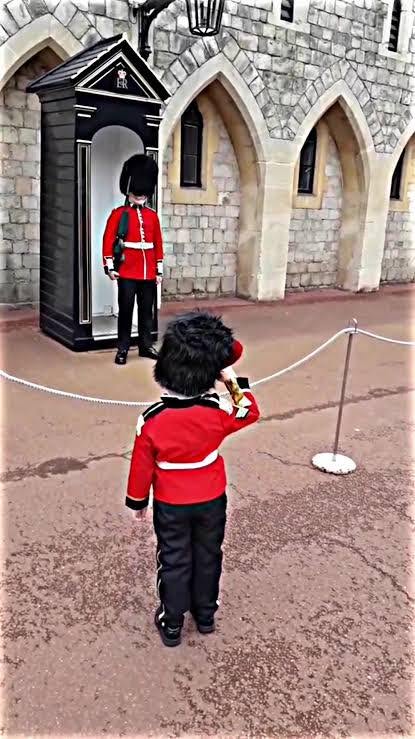
When I was a small boy growing up in Chester, England, I wanted with all my heart to be a guard outside Buckingham Palace.
This was no passing fancy. I had the uniform, made to my size. I had the belt, the tall black bearskin hat, which as a boy I called a Busby, and a real rifle, unloaded, but a real rifle all the same. And I would stand for hours outside our house, perfectly still, refusing to move a single muscle. The other boys in the neighborhood would come out and ask if I wanted to play. I would not so much as blink. I had seen the real guards outside the palace, and they did not move for anyone. Children could shout, sing, and pull faces, and those guards stood like statues. So I did the same.
Every year we visited my uncle in London, and the highlight for me was always the same. My parents and I would take the Underground across the city to reach the palace in good time for the Changing of the Guard ceremony, and I would stand with my face pressed between the palace railings, trying to get as close as I could to the action, studying every movement of the guards.
One year an American tourist who had missed the Changing of the Guard asked if she could take my photograph. I looked the part. I am, to this day, in someone’s photo album in America, a small English boy at rigid attention.
And I had a secret hope. I used to imagine that the Queen might glance out of one of those tall windows, see this devoted little guard standing there outside the palace, and be charmed. I imagined her summoning a member of staff and saying, “Would you bring that little boy and his parents in? I should like to have tea with them.”
I genuinely hoped for it. I knew when she was in residence, because the Royal Standard flag would fly over the palace. She was in there somewhere, just beyond the glass. Surely all my effort would be noticed.
It never happened. Of course it never happened.
Years later, as a teenager who had traded the dream of being a guard for the dream of playing football, I read in the Chester newspaper that the Queen was going to visit my own city. The paper printed the exact route her car would take the next morning. I knew Chester like the back of my hand, and I worked out that if I climbed a particular lamp post on a certain street, I would be above the crowds with a clear view of Her Majesty as she passed.
The next morning I climbed up and waited. And as her car came slowly down the street, for one brief moment, her eyes and mine met. I gave a small nod. And the Queen, just for a moment, nodded back.
That was it. That was the whole of my relationship with royalty: a nod from a passing car. She never wrote to me about it. It did not feature in the royal records. But for a boy who had once stood for hours in a miniature uniform, it was a moment.
I tell that story because it captures something the apostle Paul says in one of the most important verses in the whole Bible. Writing about why God saves the people He saves, Paul concludes: “So then it depends not on human will or exertion, but on God, who has mercy.” – Romans 9:16
Not on human will. Not on human exertion. Not on the man who wills, nor on the man who runs.
All my striving as a boy could never have made me royalty. I could stand still for a hundred years. I could wear the uniform, learn every detail, climb every lamp post in England, and still none of it could bridge the gap between a subject on the street and a son in the royal house. The most that striving could ever earn me was a nod from a passing car. Adoption into the family was never on offer to my effort, however sincere, however devoted.
But if I leave the picture there, I have told you only half the truth, and the smaller half at that. For at least the boy in the uniform admired his Queen. He loved the Crown and longed to serve it.
That is not what the Bible says we were.
Scripture does not describe us as wistful subjects standing politely on the street, hoping to be noticed. It describes us as rebels. We were “enemies” of God (Romans 5:10). The mind set on the flesh “is hostile to God” (Romans 8:7). We did not tip our hats to the King and hope for an invitation. We took up arms against His throne and did everything in our power to unseat Him from it.
That is what makes the doctrine of election so staggering.
If we were merely admiring subjects who failed to earn our way in, grace would be wonderful enough. But we were traitors to the Crown, and the King reached down not to reward our striving, but to rescue us from our rebellion. He did not adopt us because we wanted in. He adopted us while we were doing all we could to dethrone Him.
Yet this mercy was not cheap. The King did not pretend our treason did not matter. The Son of God bore the judgment His people deserved, rose from the dead, and brought rebels home by blood-bought grace.
And here is the gospel, better than anything my boyhood imagination could invent. The King of all kings, entirely of His own free mercy, has taken rebels who hated Him and made them His own children. He did not wait to be impressed. He did not respond to our effort, because our effort was all bent against Him. He set His love on His people before they were born, before they had done anything good or bad, “not because of works but because of him who calls” (Romans 9:11).
And He did not merely permit us to squeak into a back room of the palace. He brings us near, names us as His own, and bids us “with confidence draw near to the throne of grace” (Hebrews 4:16).
The boy in the guard’s uniform could only hope to be noticed. The rebel, by sovereign grace, is welcomed home as a son.
If you are in Christ, you did not earn your way in, and you never could have. You did not even want in until He made you willing. You were adopted by sheer sovereign mercy while you were still in rebellion against the throne, and that is not cold doctrine. It is the warmest news in the world.
The believer’s place in the family does not rest on the strength of human striving, which rises and falls. It rests on the unchanging will of the God who has mercy on whom He has mercy, granting repentance and faith to those He saves.
I never did have tea with the Queen. But by grace alone, and not by any effort of mine, the King I once resisted has adopted me as His own, brought me near through Christ, and welcomes me to dine at His table.
“So then it depends not on human will or exertion, but on God, who has mercy.” – Romans 9:16